Data cut-off 03.09.2026. CPV = CPM ÷ 1,000. This is a reward rate with admission conditions and limits, not the actual cost of the entire campaign. Fund does not equal expenses. Views are a total counter, not unique reach; approved works are counted separately. Views do not equal unique reach or sales. Conclusions about marketing mechanics are an editorial analysis; the presence of a campaign around a brand does not necessarily mean its direct placement.
A dating app has a person whose words can be more engaging than a description of its features. The campaign around Bumble was built on real interviews with its founder, Whitney Wolfe Herd. Authors were invited to select her best moments, compile short publications, and add mandatory design elements. The source of attention became a lively conversation in which the brand already had a human voice.
Cutting interviews into clips means finding answers that introduce a person without requiring them to watch the entire conversation. Video clipping is especially useful if the founder’s voice helps to understand the product’s character. One fragment can explain a position, another can show a manner of reasoning, but both must preserve the original idea. The marketing value of such material arises from the feeling of a live introduction. Therefore, it is important for the editor to leave context: the viewer must understand what the heroine is talking about and why her words relate to the brand.
Your founder’s interviews may already contain the first stories for a new audience. Launch their video clipping on VibeVO and invite authors to find the most expressive fragments.
Data snapshot 03.09.2026. CPV = CPM ÷ 1,000. This is the reward rate with eligibility conditions and limits, not the actual cost of the entire campaign. Fund does not equal expenses. Views are a total counter, not unique reach; approved works are counted separately. Views do not equal unique reach or sales. Conclusions about marketing mechanics are an editorial analysis; the presence of a campaign around a brand does not necessarily imply its direct placement.
Short videos easily attract attention far beyond the market where companies need buyers. In the campaign around StockX, this was taken into account directly in the terms: at least 40% of the audience must come from the USA. The topics of the videos were the service itself and the StockX Listings direction. Thus, the authors’ work with the short format received a clear geographical limitation from the very beginning.
For a company that chooses video clipping services, this example raises the right question: whose attention needs to be gained? The creative task here is initially linked to a specific market. The geographical condition helps authors choose a presentation understandable to the audience, and helps the marketer evaluate the campaign more meaningfully than by a general counter. Video clipping becomes part of product promotion when the task defines both the subject of discussion and the desired viewer. This is especially useful where accidental popularity far beyond the market does little to help the business.
Start a campaign on VibeVO with a clear description of the product and the target audience. Such a brief will give authors a guide for short videos about your brand.
Data cut-off 03.09.2026. CPV = CPM ÷ 1,000. This is a reward rate with eligibility conditions and limits, not the actual cost of the entire campaign. Fund does not equal expenses. Views are a total counter, not unique reach; approved works are counted separately. Views do not equal unique reach or sales. Conclusions about marketing mechanics are an editorial analysis; the presence of a campaign around a brand does not necessarily mean its direct placement.
When Steve Aoki or Rhea Ripley opens a pack of cards, a regular unboxing gets another reason to be watched. In the campaign around Topps, authors were given an official bank of materials: celebrities with new packs, finds of unique cards, and bright episodes from Fanatics Fest. The task was to find moments where a recognizable face, anticipation, and a strong reaction coincided.
In this example, highlight editing gives the collectible product several different entry points to the audience. Someone notices a familiar artist, someone else a rare card, and someone stops at the emotional reaction. Video clipping allows working with these interests separately, using a common bank of footage. At the same time, the product must remain the reason for what is happening: the viewer sees exactly what was found and why it is important. This way, a celebrity helps open a story, and the find itself maintains its connection to the brand.
Gather product footage, guests, and exciting finds as the basis for your campaign on VibeVO. Invite authors to choose the moments from which a new audience will be interested in getting to know you.
Data cut-off 03.09.2026. CPV = CPM ÷ 1,000. This is a reward rate with eligibility conditions and limits, not the actual cost of the entire campaign. Fund does not equal expenses. Views are a total counter, not unique reach; approved works are counted separately. Views do not equal unique reach or sales. Conclusions about marketing mechanics are editorial analysis; the presence of a campaign around a brand does not necessarily mean direct placement by the brand.
A pack of collectible cards opens in a few seconds. But for an avid collector, these seconds contain an entire drama: what will be inside? In the campaign for eBay Live sellers, the source material was recordings of such unboxings. Editors were offered to extract the most expressive finds and reactions from long broadcasts, turning them into short, emotional stories.
Such cutting of long videos into short ones preserves the most emotional part of the broadcast: anticipation, discovery, and reaction. For sellers, video clipping can be a way to explain the appeal of collecting without a long lecture about card series. Highlight editing is especially useful when the pleasure of a product is hard to describe in words but easy to see on a person’s face. It’s important to leave enough context so that the good fortune is understandable to a new viewer, and the emotional episode is linked to the process of buying and opening itself.
Are there recordings of unboxings or demonstrations where viewers are genuinely surprised? Use them as the basis for a campaign on VibeVO: a short story can begin precisely with this reaction.
Previously published terms, verified 03.09.2026. CPV = CPM ÷ 1,000. This is a reward rate with eligibility terms and limits, not the actual cost of the entire campaign. Fund does not equal expenses. Views do not equal unique reach or sales. Conclusions about marketing mechanics — editorial analysis; the presence of a campaign around a brand does not necessarily mean its direct placement.
How many condoms are being ordered right now? In the DoorDash campaign, this question was displayed on two billboards — in New York and Los Angeles. Counters showed orders in real-time, turning an ordinary urban structure into a small public show. Authors of short videos were offered ready-made footage and a simple task: to convey the unexpectedness of this idea so that the viewer would want to share what they saw.
The video clipping market is rapidly developing, transforming from a simple video cutting tool into a powerful channel for advertising reach. A joint study by VibeVO, a video clipping platform, and Go Influence, an influencer agency, sheds light on the current state of the short video, video clipping, and social media banner advertising market, demonstrating how these formats are becoming key for brand promotion.
Short vertical videos have long ceased to be just entertainment. For companies, it is already an independent promotion environment. A single episode, interview, live broadcast, review, or conversational recording turns into a series of short videos, each of which can become a separate point of contact with the audience.
This study was prepared by VibeVO and Go Influence based on VibeVO data for the last 30 days as of June 8, 2026. The indicators describe the studied array of short videos and do not claim to evaluate the entire internet. However, the database is large enough to see the main patterns: concentration of views, differences in platforms, thematic cores, and audience within topics.
A brief version of the study is published on Sostav.
Key figures of the study
Indicator
Value
Views in the saved 30-day volume
252.81 million
Videos
4,224
Authors in the database
141
Pages in the database
228
Ad launches
16
Share of the three main topics
86.1%
Audience coverage
99.2%
Graphs from the updated table
29
Main conclusion: the video clipping market can no longer be described only as mechanical video cutting. It is developing as a tool for managed advertising reach, where the topic, platform, author, release speed, design, placement environment safety, and result measurement are important. Banner advertising in social networks also changes its role: it works not separately from the video, but during viewing or next to it.
Why short video has become a mass format
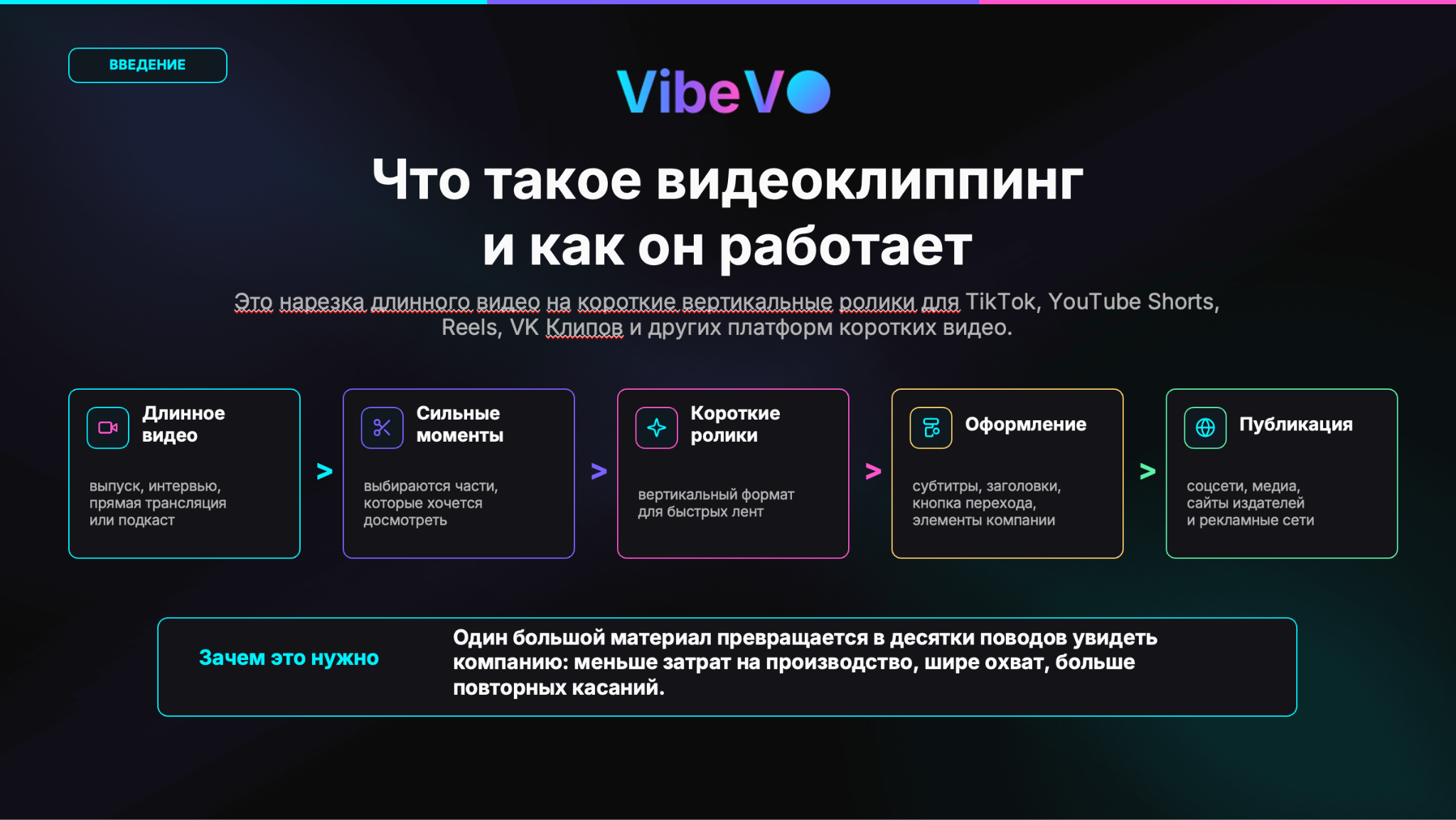
Video clipping is the transformation of long material into short vertical videos for recommendation feeds and author publications. The original video is broken down into strong moments, each fragment receives subtitles, a title, design elements, and a clear next step: go, save, watch to the end, take advantage of an offer, or learn more.
The economics of this approach are simple: one large piece of content provides dozens of reasons to re-engage with the audience. Instead of a one-off release, a company gets a series of repeated touchpoints, and platforms get content that is easier to distribute in fast feeds. Therefore, video clips are becoming not an auxiliary technique, but a separate way to buy attention.
External benchmarks in the presentation show why this shift has become widespread:
TikTok users spend an average of 95 minutes per day on the app.
Video advertising spending on the internet in the US exceeds 80 billion dollars.
Even if markets and platforms differ by country, the logic of consumption itself is already obvious: attention has shifted to short videos.
Chart 1. How video clipping works: the path from a long episode to a series of short videos. Source: VibeVO data, updated 08.06.2026. Click on the chart to open it in full size.
Overall picture: topics and platforms
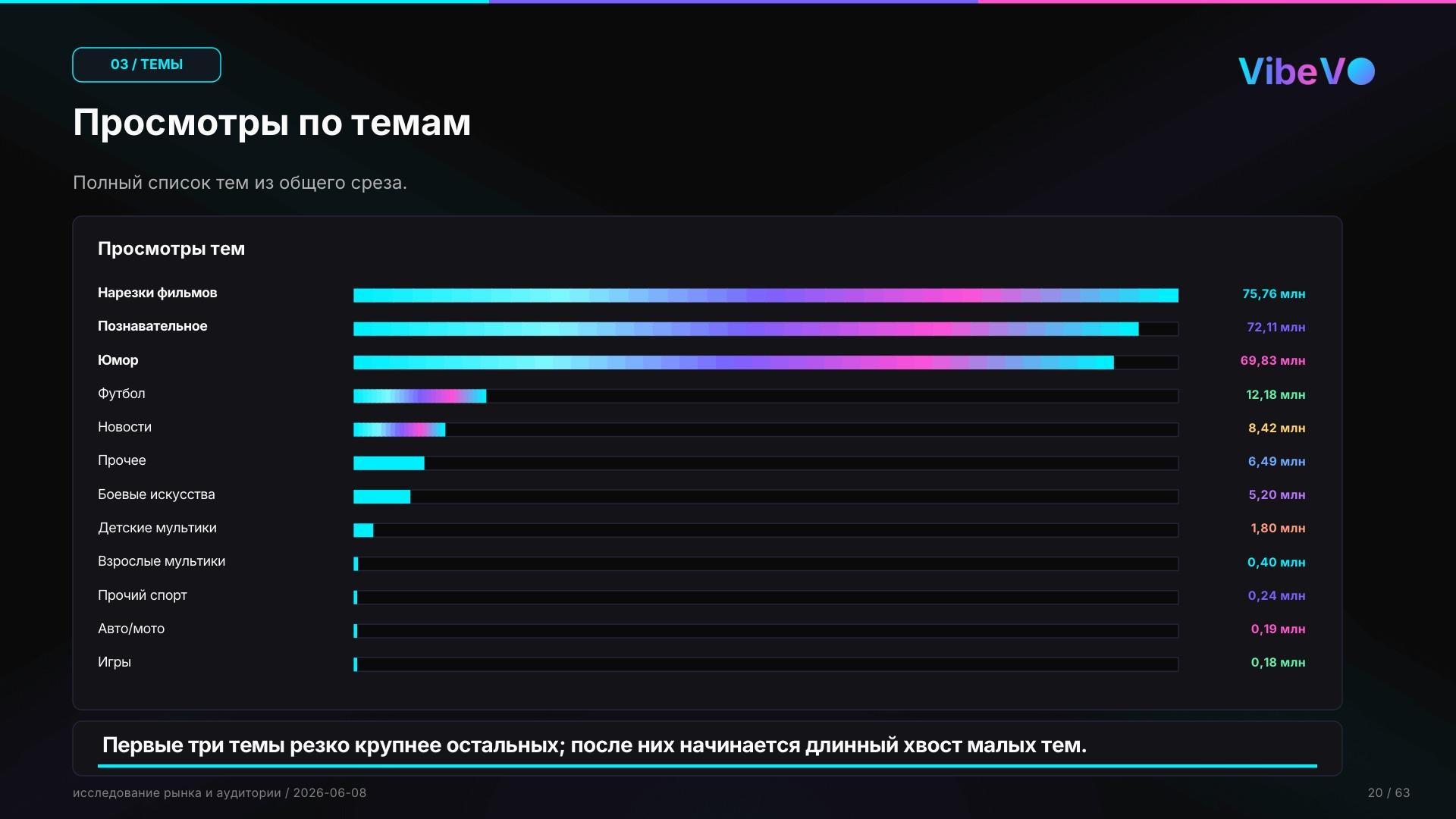
In the updated cut, the market looks concentrated. The three largest topics — movie clips, educational videos, and humor — account for 86.1% of the saved volume. Movie clips garnered 75.76 million views in 30 days, or 30.0%. Educational videos yielded 72.11 million views, which is 28.5%. Humor is almost at the same level: 69.83 million views, or 27.6%.
After the top three, a long tail begins: football — 12.18 million views, news — 8.42 million, other topics — 6.49 million, martial arts — 5.20 million. Children’s and adult cartoons, other sports, auto and moto, games are significantly less represented in the studied cut. This is an important caveat for placements: small topics cannot be generalized by the same rules as the largest ones.
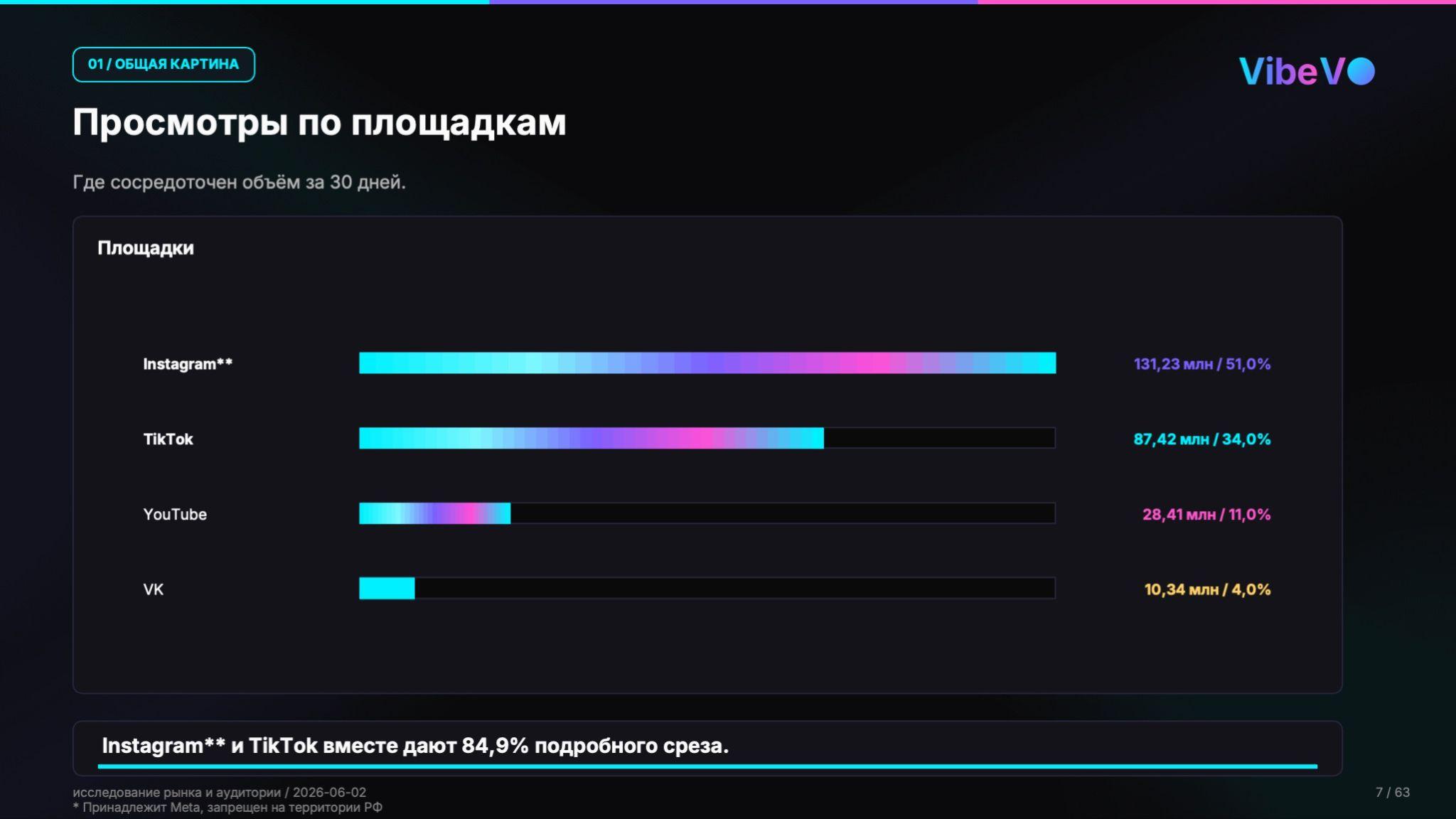
By platforms, Instagram* became the leader: 131.23 million views, or 51.0% of the detailed volume. TikTok yielded 87.42 million views, or 34.0%. Together, they form 84.9% of the detailed cut, but other platforms do not disappear: they can be important for individual topics, creators, and strong publications.
Chart 2. Views by topic over 30 days: the three largest topics are significantly larger than the rest. Source: VibeVO data, updated 08.06.2026. Click on the chart to open it in full size.Chart 3. Views by platform: Instagram* and TikTok form the bulk of views. Source: VibeVO data, updated 08.06.2026. Click on the chart to open it in full size.
Database size and strength of individual platforms
The database includes 4,224 videos with an active topic, 141 authors, 228 pages, and 16 advertising campaigns. This allows us to look not only at the overall volume but also at how platforms behave differently. Some provide scale, while others provide a stronger upper part of publications.
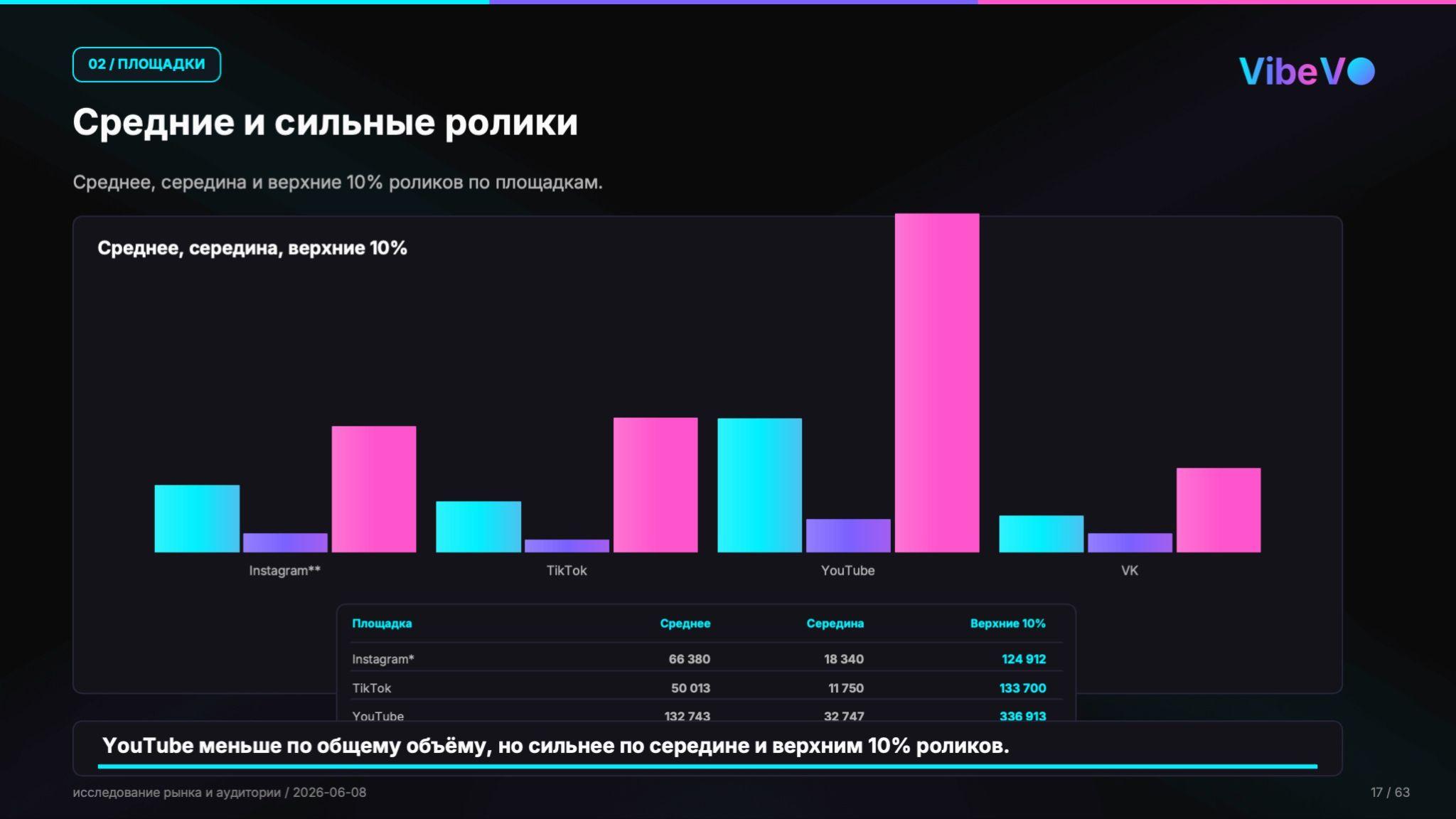
Instagram* leads in overall volume, but YouTube’s algorithms react more sharply to viral videos and give them a larger share of reach. On average, one video on YouTube received 132,743 views. For Instagram*, the average was 66,380, and for VK, it was 36,277.
Such a distribution changes the placement plan. Mass reach is logically sought in large Instagram* and TikTok bundles, but if there is viral content, YouTube can be a platform where it is easier to gain reach.
Chart 4. Distribution of reach among the top 10% most popular, median and average values by platform: YouTube is smaller in overall volume but stronger in the top 10%. Source: VibeVO data, updated 08.06.2026. Click on the chart to open it in full size.
It is better to analyze topics in bundles: topic plus platform
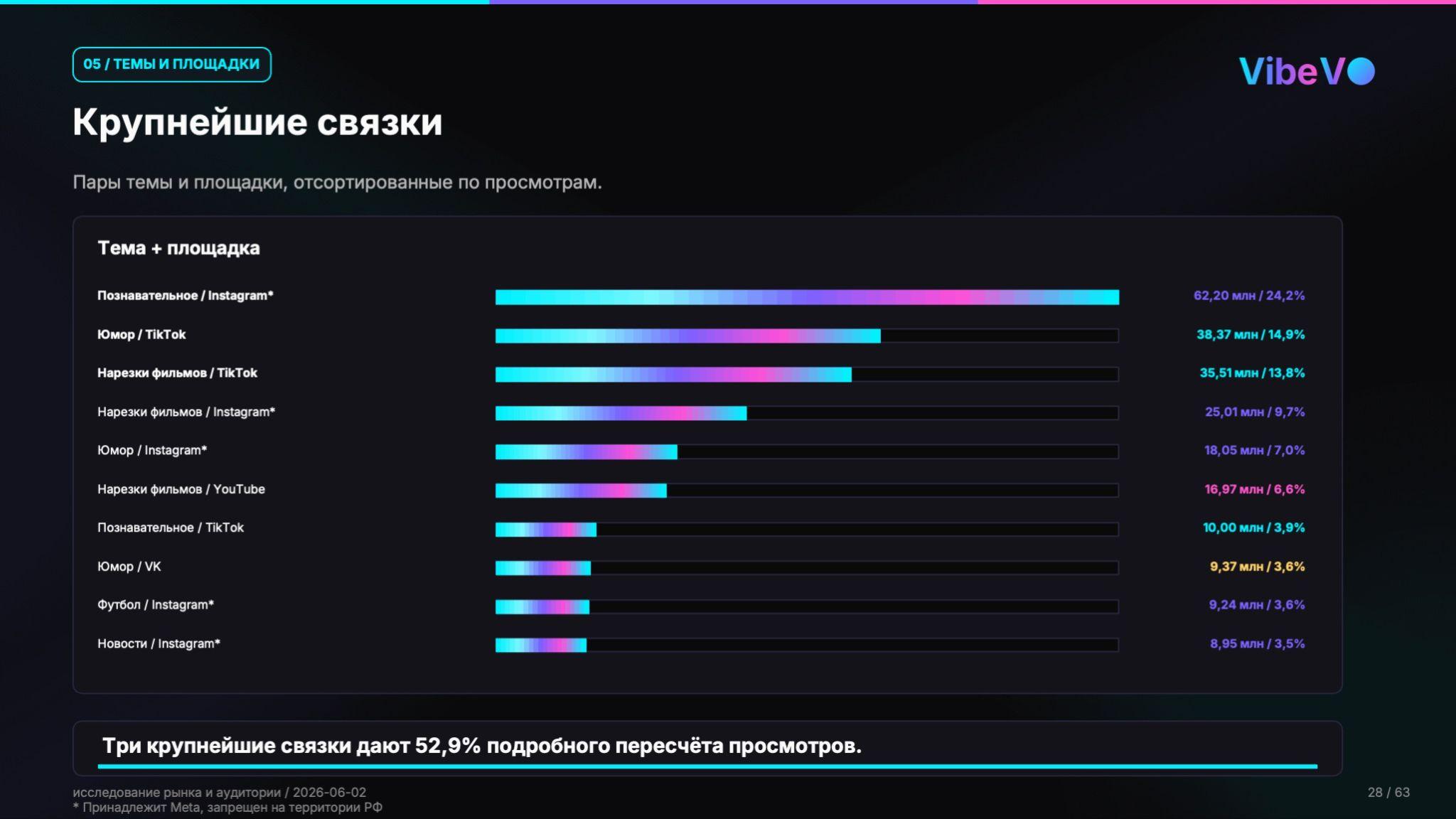
The total volume across the platform does not fully explain the market. The largest reach points occur where the topic and the distribution medium coincide. In the updated data, the largest combination is educational videos on Instagram*: 62.20 million views, or 24.2% of the detailed recalculation. This is followed by humor on TikTok – 38.37 million views, or 14.9%, and movie clips on TikTok – 35.51 million views, or 13.8%.
The three largest combinations account for 52.9% of the detailed recalculation of views.
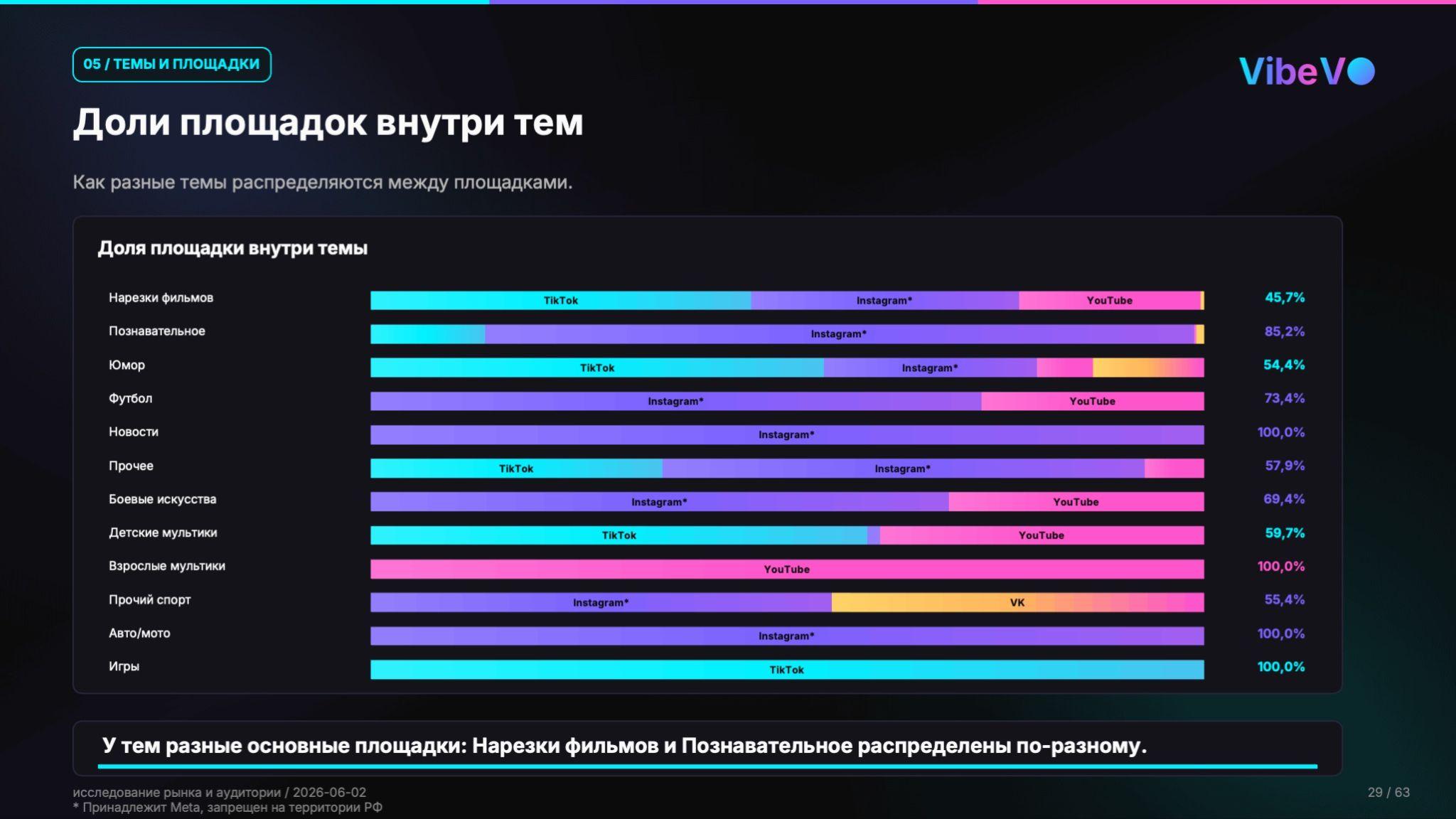
That is why video clipping cannot be launched using a single general grid for all tasks. For educational videos, auto/moto, Instagram* works better; humor, games, and movie clips rely heavily on TikTok; adult cartoons rely on YouTube. Different topics require different platforms, creators, and designs.
Chart 5. Largest topic and platform combinations: main volume arises from several combinations. Source: VibeVO data, updated 08.06.2026. Click on the chart to open it in full size.Chart 6. Platform shares within topics: different topics have different main platforms. Source: VibeVO data, updated 08.06.2026. Click on the chart to open it in full size.
Views are sharply distributed: the top portion of videos yields results
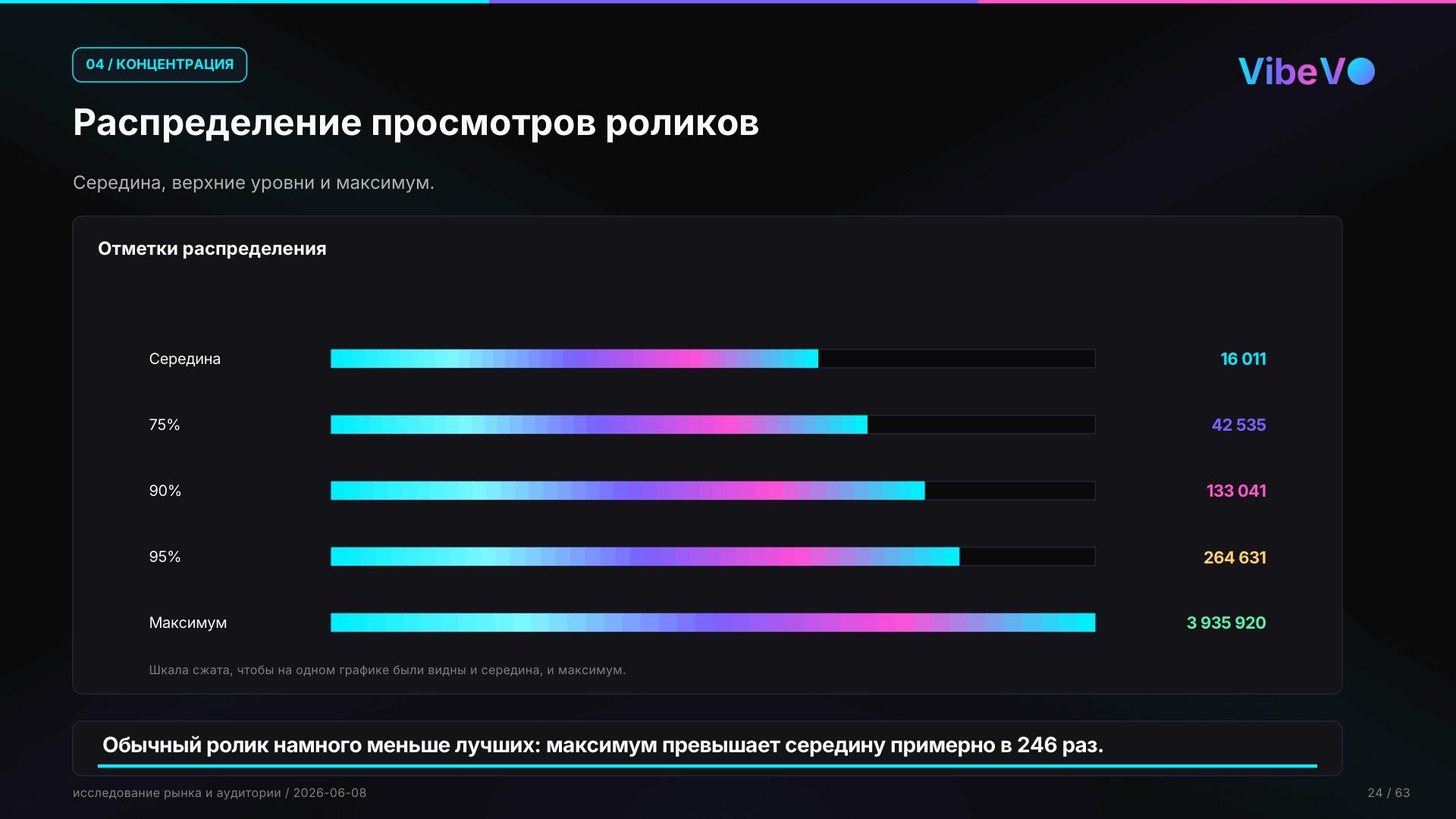
In short feeds, the average result hides a very strong unevenness. The average number of views is 16,011 views over 30 days. The 75th percentile is 42,535 views, the 90th percentile is 133,041. The maximum video garnered 3,935,920 views, which is approximately 246 times more than the median. As expected, the distribution is very uneven.
Even more illustrative is the share of the best publications. The top 10 videos generated 23.88 million views, or 9.3% of the volume. The top 50 videos – 62.48 million, or 24.3%. The top 10% of videos collected 165.54 million views, or 64.3% of all views. In other words, most views are generated by the top 5% of videos.
A practical conclusion for advertising in video clipping: you cannot rely on a single video. You need a set of video clips with different first seconds, titles, subtitles, overlays, and advertising message options. It’s not just the most beautiful video that wins, but a series of attempts where the best publications quickly gain more weight.
Banner advertising in video and on other top platforms has become more accessible. Yandex Direct has finally opened access to small and medium-sized businesses to the “Panorama” reach advertising tool. This means that now even small players can launch unified campaigns with reach across all key Yandex services: from Search and Market to Kinopoisk. Forget about influencers where CPM is off the charts. Now you can get mass reach for pennies.
What is “Panorama” and why is it important for an arbitrageur?
The “Panorama” tool is not just another banner in the Yandex Advertising Network. It is a real opportunity for small and medium-sized businesses to go beyond existing demand and increase reach using brand tools that were previously only available to large players with multi-million budgets.
Key advantages for CPA marketing:
Unified campaign: Launch ads simultaneously on desktops, smartphones, and Connected TV. No more need to create separate campaigns for each format.
Reach of over 120 million unique users per month. This is 1.6 times more than on popular marketplaces. Imagine how much traffic you can collect.
Prime banner: Access to the most prominent ad placements in over 20 Yandex services, including Browser, Kinopoisk, Alice AI Studio. This is not some obscure corner of a website.
Accounting for audience overlaps and controlling ad frequency. No more burning through your budget on the same user.
Media video advertising: Ability to connect video in Yandex Video Network (200+ Yandex Advertising Network sites, including TV channels and online cinemas). This is ideal banner advertising in short videos, where CPM cheaper than 50 rubles – a dream for any arbitrageur.
The future is DOOH: Soon, Yandex’s digital out-of-home advertising screens will appear in “Panorama”. This means you will be able to buy reach without creating a video, simply by placing your banner.
Real math: why “Panorama” is more profitable than influencers
Many small and medium-sized companies still use only one media format, for example, banners in the Advertising Network. But “Panorama” combines all surfaces into one campaign, offering mass reach for pennies.
“For small businesses, investing in a brand and their own sales channels is no longer a ‘pretty picture,’ but a way to go beyond current demand and tell a new audience about themselves,” — Alexey Shtokolov, Director of Products and Artificial Intelligence at Yandex Advertising.
According to Yandex, in the first half of 2026, the number of SMEs using media advertising in Direct increased by 40%, and investments in such campaigns increased by 44%. Every second one launched image formats for the first time. This shows a trend: the market is moving towards transparent and effective reach, not blind faith in bloggers.
How does “Panorama” simplify life?
No need for a large media team: Lowers the entry threshold for reach formats. No need to assemble a separate campaign for each service.
Large audience: Monthly reach of over 120 million unique users. This is not some micro-blogger who will gather a couple of thousand.
Presence where users spend time: Search, Mail, Kinopoisk, and other services.
Budget doesn’t matter: The cost of placement is not limited by an entry threshold. You can test hypotheses for 1000 rubles.
One setting for all devices: Desktop, phone, TV. Simple and effective.
Geotargeting optimization: another plus
Previously, Direct updated its geotargeting algorithms. Now the system analyzes not only the user’s current location, but also the context of their queries, changed geolocation, and previous user experience. This allows for more precise targeting of the audience, which is especially important for local businesses.
Frequently asked questions
How does “Panorama” work in Yandex Direct?
“Panorama” allows you to launch unified media campaigns that are automatically optimized for display on various Yandex platforms – from Search to Kinopoisk and Video Network. The system manages ad frequency and takes into account audience overlaps to achieve maximum reach at optimal costs.
How does “Panorama” differ from regular banners in Direct?
The main difference of “Panorama” is its omnichannel approach and automated management. Regular banners often require separate campaigns for different platforms, while “Panorama” combines them into one, providing comprehensive reach and control over the frequency of contact with the user on all available surfaces, including banner advertising in short videos and Prime banners.
Why did Yandex Direct open “Panorama” to small and medium-sized businesses?
Yandex aims to provide SMBs with access to image and reach advertising tools that were previously only available to large brands. This allows small and medium-sized businesses to go beyond existing demand, increase brand awareness, and attract new audiences using effective and transparent promotion channels.
Conclusion: your chance for millions of views
“Panorama” is not just a new tool, it’s a paradigm shift. Now banner advertising in TikTok, advertising in Reels, and banner in YouTube Shorts can be easily integrated into your strategy through programmatic video banners, getting the lowest CPM in shorts. This is your chance to get cheap reach and mass reach for pennies, without spending on bloggers and expensive shoots. Start testing hypotheses right now and grab your piece of traffic.
New Anthropic AI Models: Fable and Mythos 5.1 – Cheaper, Smarter, Safer
Anthropic has introduced new versions of its advanced AI models to the world – Fable and Mythos 5.1. This is not just an update, but a real breakthrough in the field of neuro-production by subscription and mass video generation by neural network. Key changes include a significant reduction in token costs and fewer false positives from safety mechanisms, making these neural networks an ideal tool for AI video for advertising and creating AI commercials.
Are you ready to learn how these innovations can transform your business, making content production more accessible, efficient, and secure? Let’s dive into the details and see how Fable and Mythos 5.1 are changing the game in the world of artificial intelligence.
Revolution in AI Cost and Access
The most important change in Fable is cost optimization. Now, the cost of 1 minute of AI video becomes even more competitive. Fable 5.1, the open version of the model, is already available on cloud platforms and via the Anthropic API.
Anthropic has implemented the concept of Zero Data Retention, allowing clients to run models on their own infrastructure without data leakage. This is critically important for projects where privacy is paramount, such as AI UGC for a crypto project.
In June, the high-privacy service Enterprise Frontier Safeguards will be launched. It will allow clients to control AI usage monitoring while maintaining security.
“Anthropic has never trained on enterprise data without explicit permission and never will,” company representatives stated, emphasizing their commitment to data protection.
Performance and Capabilities of Mythos 5.1
The Mythos 5.1 model, designed for registered cybersecurity and life sciences partners, demonstrates record-breaking benchmark results. For example, in Terminal-Bench 4.0 (CLI-based encoding) and Humanity’s Last Exam (general reasoning), it exceeded expectations.
Scientific Discoveries and Ethical Aspects
Anthropic also unveiled three new scientific discoveries made by the models before their release, including GPU optimization and a highly detailed map of Venus.
The Mythos system card rates the model as “low-risk” in the context of automated AI development, which is important for human control over technology.
While Mythos 5.1 is slightly more prone to “off-target behavior” compared to Opus 5, it is significantly better than Mythos 5 and Claude Sonnet 5 in terms of ignoring limitations and hallucinations.
“It is more willing to cooperate with human misuse and accept unverified claims of authority than Opus 5, but less often ignores explicit limitations, hallucinates inputs, or falsely claims to complete tasks than previous models,” the system card states.
Business Applications: From Crypto to E-commerce
These new models open up unprecedented opportunities for businesses. Text-to-video generation, AI avatar with subtitles, AI voiceovers, AI clips with face swapping — all of this is now more accessible.
Companies can use Fable 5.1 to create AI UGC for a crypto project or to launch an AI video factory for e-commerce. The effectiveness of AI versus real UGC significantly increases, reducing costs and time for content production.
Our service offers neuro-production by subscription, using such advanced models. Find out how much one AI creative costs and how AI content production can transform your marketing. Where to order mass content generation for crypto or e-commerce? We are ready to help you scale the impossible.
Frequently Asked Questions
What is Zero Data Retention in Anthropic models?
Zero Data Retention is a feature that allows customers to run Anthropic AI models on their own infrastructure, ensuring that no data leaves their protected environment. This is critical for companies with high confidentiality requirements, such as financial or medical institutions, as well as for AI UGC for a crypto project.
How does Fable 5.1 reduce video generation costs?
The reduction in token costs in Fable 5.1 directly decreases the operational expenses of using the model. This makes mass video generation by neural network, including creating AI commercials and an AI pipeline of 500 videos per day, significantly more economical and accessible for a wide range of companies striving for high efficiency in AI versus real UGC.
What advantages does Mythos 5.1 offer Anthropic partners?
Mythos 5.1 offers partners in cybersecurity and life sciences enhanced performance and accuracy in complex tasks. The model demonstrates record-breaking results in benchmarks such as Terminal-Bench 4.0 and Humanity’s Last Exam, enabling more complex research and analytical tasks. Its capabilities for text-to-video generation and AI avatar with subtitles also expand possibilities in specialized applications.
Can Fable 5.1 be used to create UGC content for advertising?
Yes, Fable 5.1 is ideal for neural networks for UGC advertising. Thanks to reduced costs and improved performance, companies can effectively create AI videos for advertising, including animated AI characters and AI clips with face swapping, which can surpass traditional UGC in quality and effectiveness, while significantly reducing production costs. This allows for scaling the impossible in advertising campaigns.
Conclusion
The release of Fable and Mythos 5.1 by Anthropic is a significant step forward in the development of artificial intelligence. These models are not only cheaper and more productive but also offer an unprecedented level of privacy and control.
If you want to know how much one AI creative costs or where to order advanced AI content production for crypto, contact us. We will help you use these innovations for mass video generation by neural network and achieve your business goals. It’s time to scale the impossible!
The era of traditional SEO, where CPM is profitable and hypothesis testing is cheap, is becoming a thing of the past. Today, buyers are increasingly turning to AI assistants, such as ChatGPT, Gemini, or Perplexity, to get direct answers to their questions. This changes the rules of the game for marketing teams and requires a re-evaluation of budgets. If your company is not mentioned in these AI answers, you are losing potential customers.
Why the old marketing structure doesn’t work?
Traditional marketing department structures were geared towards ranking in Google. SEO specialists were responsible for positions, content teams generated articles based on keywords, and paid advertising filled the gaps in organic traffic.
All of this assumed that the buyer would see the results page and click on a link. However, today many skip this page, directly asking AI questions. For example, the query “best contract management software for mid-market legal teams” now yields a list of three vendors. If you’re not there, you’re out of the game.
“I asked one question: which department is responsible for ChatGPT recommending you? No one had an answer, because the answer was — no one.”
Ranking does not guarantee citation
Companies with first-page Google rankings are often mentioned in only a few of the 20 answers from AI assistants.
One of our clients with 14 keywords on Google’s first page was mentioned in only 4 of 20 AI answers.
Work that ensures AI citation, such as creating consistent entity signals, third-party endorsements, and structured original content, is often not part of anyone’s job description.
Because budgets follow organizational structure, money continues to be spent on methods that AI models no longer reward. Planning a year in advance only exacerbates the problem, locking in old bets.
Three role changes to adapt to AI search
You probably don’t need new employees. You need three changes in areas of responsibility and a clear answer to the question of ownership.
Usually, it’s the same person. Their task expands from “where do we rank” to “where are we cited.” This means managing the brand entity everywhere AI models read information: your website, LinkedIn, G2, Crunchbase, Reddit, industry directories.
Entity fragmentation is the most common problem. Different brand names, domains, conflicting descriptions — AI perceives this as several weak companies instead of one strong one. A single owner can fix this in a quarter, and it costs almost nothing but attention.
2. The content team shifts from volume to evidence
Halve your publishing calendar. Redirect those hours to creating content that can be cited by AI: original data, customer results with specific numbers, expert comments from company employees, and pages structured to extract clear statements.
Eight general posts a month lose to one article with unique data. Evaluate the team not by volume, but by the number of citations received and the impact on the sales funnel.
3. Digital PR moves from the brand budget to the performance budget
AI models reward consistency of information from independent sources. Mentions in industry publications, review platforms, and communities now do the same work that backlinks did a decade ago.
This means PR stops being a “soft” expense item that can be cut in a bad quarter and becomes an acquisition channel with quarterly goals and KPIs. CPM cheaper than 50 rubles is possible through PR with clear metrics.
Budget Math: How to Reallocate Funds
Consider an example of a client who spent $60,000 per month on marketing. Price comparison before and after restructuring:
Before restructuring:
Paid Search: $30,000
Content Production: $12,000
SEO Retainer: $8,000
Brand & PR: $5,000
Tools: $5,000
After one quarter:
Paid Search: $24,000 (20% reduction, to protect branded queries and converting non-branded campaigns)
Content: $10,000 (fewer articles, but with more substantial evidence)
AI Search Program: $10,000 (entity cleanup, structured data, measurements)
Digital PR with targeted citation metrics: $10,000
Tools: $6,000 (added AI visibility tracker, e.g., Peec AI or Semrush AI toolkit)
Don’t completely abandon paid search. It’s the purest source of data on buyer intent, which is necessary for testing AI assistants. The rule is simple: move 15-20% of the budget in the first quarter, then let the evidence guide the rest. No one should stop a working paid program “on faith.”
90-Day Action Plan
Don’t reorganize the team on day one. First, measure, then experiment, then scale what works.
Weeks 1-4: Baseline
Test 20 of your key buyer queries in four major AI assistants.
Record every answer, every mention, every competitor.
Fix entity fragmentation. It costs nothing and has a cumulative effect.
Weeks 5-8: Pilot Launch
Create a small team: an AI search leader, one content specialist, and a portion of the PR budget focused on a single product line.
Everything else operates as usual, providing a control group and reassuring the rest of the team.
Weeks 9-12: Compare and Scale
Compare citation rates for test queries, referral traffic from AI assistants, and the number of inbound deals that mentioned discovering you through an AI tool.
Move budget where the evidence points. Reorganization follows results, not the other way around.
Three Mistakes That Burn Budget
Hiring an AI specialist before conducting baseline measurement. It’s impossible to write a job description until you know where your citation gaps are.
Completely cutting classic SEO. AI assistants still rely on search indexes. Well-ranked pages are more often read by models. This is a rebalancing, not a burial.
Launching AI search as a side project. If it doesn’t have a separate line in the budget, it doesn’t have an owner, and work without an owner doesn’t move. Allocate a budget, even a small one, and assign responsibility.
Six months after restructuring, the mentioned software company increased its mentions in AI responses from three to 12 out of 20. Demo requests received through AI assistants are now tracked in their CRM. The size of the marketing team has not changed. Only the direction of investment has changed, aligning with current buyer behavior. Your organizational structure is a bet on how buyers will find you. Most structures still bet on the search results page, which fewer buyers are viewing each month. It’s time to change that bet.
Frequently Asked Questions
What is the role of an SEO specialist in the era of AI search?
The role of an SEO specialist expands: they become an AI search leader, responsible not only for ranking but also for the brand’s citation by AI models across all relevant platforms and directories. This includes managing brand entity and eliminating information fragmentation.
What’s cheaper: a banner or a blogger?
In the context of AI search, what’s cheaper: a banner or a blogger is an outdated question. More important is which channel provides citation and evidence for AI models. Digital PR, aimed at getting mentions in authoritative sources, can be more effective than direct advertising or influencers, as AI values consistency from independent sources.
What CPM should be considered profitable for AI-oriented marketing?
What CPM should be considered profitable now depends on citations. If you get a CPM cheaper than 50 rubles through Digital PR, which leads to mentions in AI responses and, as a result, to leads, this is more profitable than a high CPM in traditional advertising without such an effect.
Is AI worth it?
Yes, AI is worth it if you want to remain competitive. AI search is not just a trend, but a new reality. Investing in adapting your marketing strategy to AI search allows for cheap hypothesis testing and ensures visibility where your customers are.
How to measure the effectiveness of investments in AI search?
Effectiveness is measured by several indicators: the citation level of the brand by AI assistants, referral traffic from these assistants, and the number of inbound deals that indicate AI as the source of discovery. These metrics help to understand how much money each ruble spent will bring.
Conclusion
The marketing landscape is changing. The focus is shifting from traditional SEO to AI search, where price vs. result is evaluated by citation and impact on the sales funnel. Reallocate your budget, change roles, and test hypotheses to stay in the game. Your organizational structure should reflect how customers search for and find information today. Learn more about our AI marketing strategy.
Your links, payouts, and team remain the same, but everything else has scaled significantly. Mavely is now fully integrated into the Later platform, providing you with the same familiar experience you’ve built your business on, but with much greater prospects. This merger opens access to Later’s extensive network of corporate partners, including brands like Nike, Wayfair, Unilever, and Southwest Airlines, as well as the ability to directly apply for promotional campaigns.
Mavely is now Later: Enhanced Opportunities for Your Business
Why did Mavely become part of Later?
Later’s acquisition of Mavely in January 2025 was driven by a vision of the unique potential content creators were developing. For a year and a half, we watched you grow and thrive in your endeavors.
This community has paid out over $300 million, a clear testament to what can be achieved when creators are consistently rewarded for converting content.
“the creator economy is still young, but it’s evolving faster every day. It’s being built in real-time by creators, marketers, and brands who are striving to create something valuable without disrupting what already works,” notes Paige, CEO of Creator.
Today marks the next step in our evolution, and it’s not just a name change on the login screen. The platform you’ve grown your business on is now fully integrated into Later, making you part of everything Later has created: a powerful engine for influencer marketing, a social media management platform, an infrastructure for social commerce, and a team of experts working with the world’s largest brands.
How will the integration of Mavely and Later affect your income?
Turn affiliate marketing into sponsored partnerships: Your links now represent you to Later’s entire network of corporate partners, including Nike, Wayfair, Unilever, and Southwest Airlines. This means more opportunities for discovery by leading brands and securing paid partnerships that go beyond a single affiliate link.
Expand your earning methods: Instead of waiting to be noticed, you will soon be able to browse and apply for campaigns directly within the platform, at your convenience. These are two new ways to increase your income, and neither requires changing your current content creation process.
Track performance in real-time: You’ll maintain full visibility into clicks, conversions, and earnings, always knowing what’s working and directing more energy toward the content and brands that yield the best results, instead of acting on guesswork.
What remains unchanged?
All your previously published links continue to work exactly the same. Your commission structure and payment schedule remain unchanged. If you’re used to receiving payments on the 1st and 15th, that won’t change.
You’ll still get paid faster than most affiliate networks, many of which make creators wait up to 90 days.
The relationships you’ve built with our team also remain. Whether you relied on our team for strategic sessions or just needed a quick answer, the same level of personal attention remains. The logo on the screen has changed, but the people behind it are the same ones who have always been there.
More than just tools: support and growth
Building a content business can feel like a solo effort. Full participation in Later means you get more than just tools. You get a support system that shows up at the most important moments, including strategic coaching, educational resources, in-person meetings, and press opportunities that can elevate your profile beyond your audience.
You also get direct access to Later Social — a platform that helps creators plan, schedule, and publish their content to Instagram, TikTok, Facebook, LinkedIn, Pinterest, and other social media, using a single organized calendar.
What does this mean for partner brands?
For brands that have already built creator commerce programs through Mavely, this work is fully protected and now connected to a much larger influencer marketing ecosystem. For brands already working with Later, this adds new, measurable ways to run influencer campaigns.
Affiliate marketing, creator activation, and performance-based partnerships are all now available on one platform.
Later is now a unified platform where brands can discover creators, activate them, and see exactly how their content drives real business results, from the first click to the final sale.
What’s next?
The best news is that you don’t need to do anything for this transition. Log in, and everything you’ve created will be in place, but now under the Later name and with many more features. In the coming weeks, you’ll start to see new opportunities from Later’s network of brands in your account, and we’ll keep you constantly informed about what that looks like.
Frequently Asked Questions
Why is Mavely becoming Later?
Mavely is becoming Later to provide creators with enhanced opportunities, access to a larger network of brands, and an integrated platform for social media management and marketing, combining the best features of both systems.
Has Mavely shut down?
No, Mavely has not shut down. Your account, links, and earnings will remain exactly the same. Everything you’ve built will stay, it’s the same home with a new name.
Will my commission rates change?
No, your commission rates and brand deals will remain the same. Your trusted tools will stay the same, but with stronger support.
Will my payout schedule change?
The payout schedule remains the same: the 1st and 15th of each month, with no interruptions. While other networks might make you wait 60-90 days, we continue to pay faster and more frequently.
What will happen to my mave.ly links?
They will remain active and continue to generate revenue, as every link you’ve already published will work. If anything changes in the future, we will notify you well in advance.
Do I need a new account or password reset?
You don’t need a new account or password reset; you just need to update the app to see the new design. This ensures you have one less thing to worry about, so you can continue to focus on growing your business.
Is my data safe?
Yes, your data is safe, as we maintain the same data protection and privacy measures with no changes. The way your information is stored and processed has not changed.
What’s new for me?
You can expect more brand partnerships, more opportunities to participate in campaigns, and a larger network behind you. Being part of Later means you have access to leading brands and more ways to maximize your earnings.
Am I on my own to figure this out?
No, you are not alone. The same creator success team and support you already know are here to help. You’ll never figure this out alone, that’s the point of being part of a larger team.
Conclusion
The integration of Mavely into Later is not just a rebranding, but a strategic expansion of opportunities for content creators and brands. By combining advanced tools for social media management, influencer marketing, and social commerce, Later offers a single window for all needs. This solution is designed to relieve you of the “headache” of finding and coordinating disparate services, ensuring budget and nerve savings. We are confident that the new platform will be a powerful catalyst for your growth, providing access to unprecedented opportunities and reliable support. Contact us to learn more about how Later can transform your business.
CRITICAL RETRY: the previous result was empty or used the wrong language. Every natural-language sentence must be English.