Data on AI visibility is unstable: generative models produce different answers each time, so a single measurement can be misleading. A new study by IQRush proposes a stopping rule to determine when ratings become reliable. In this article, we will break down how to distinguish real growth from measurement noise and what practical conclusions follow for marketers.
Why Single Measurements of AI Visibility Are Unreliable
Search engines like SearchGPT, Gemini, and Perplexity introduce randomness into every answer. The same query can yield different sources — this is a feature of the architecture. The study showed that, for example, when testing SearchGPT on the topic of running gear, Tom’s Guide received about 9.5% of citations, while Runner’s World received approximately 6.0%. The difference of 3.5 percentage points was within the margin of error, so claiming Tom’s Guide’s superiority was incorrect.
How Much Data Is Needed for a Reliable Rating
The answer consists of two conditions that must be met simultaneously. First: the order must stop changing. After collecting a sufficient number of responses, the top sites begin to stand out clearly. Second: the difference between the top sites must exceed the measurement error. If competitors are too close, the rating does not reflect real superiority.
In 30 tests across different platforms and topics, the number of responses needed to meet both conditions ranged from 33 to 94 (only responses with citations were considered). In three out of 30 cases, this was not achieved even after 125 queries — all on SearchGPT, where the top sites were too similar.
Practical Takeaways for Marketers
Rand Fishkin (SparkToro) advises: before spending money on tracking AI visibility, make sure the provider “shows their math.” The IQRush study provides a simple stopping rule to avoid relying on intuition. If after updating content you see a 3 percentage point increase in citations, this could be natural variation. Measure indicators before and after multiple times — a single measurement is indistinguishable from noise.
Different Platforms — Different Data Requirements
Gemini loads citations from the same sites within a single response, so many citations carry little new information. SearchGPT gives fewer citations per response but distributes them more widely — each response contains more independent data. The same number of responses on two platforms does not provide the same confidence: a budget sufficient for Gemini may leave you in the dark on SearchGPT.
When Data Is Insufficient: Know When to Stop
In three out of 30 tests, the top sites never clearly separated. In such cases, the right decision is to refrain from publishing a rating. A tracker that can say “insufficient data” is more valuable than one that outputs a confident order with every query.
Only leaders can be trusted: with enough responses, they pull away from the middle and tail. But even for the top 10, the typical margin of error is about five positions, and every fifth position is more than 10. Do not publish exact rankings beyond the top of the list.
Limitations of the Study
This is a preprint based on 30 tests across three platforms using questions generated by ChatGPT, not real user queries. The exact numbers do not transfer to your topics — treat them as a form of the problem, not a table of values. In one test, 125 questions yielded only 104 useful responses (17% loss), so the actual number of queries should be higher.
The method was validated internally: the early rating was compared to the final one, not to an external benchmark. However, an independent team from the University of St. Gallen (Julius Schulte, Malte Bleeker, Philipp Kaufmann) published similar results on their dataset in April, confirming that a single reading is unreliable.
The Future of AI Visibility: From Exact Numbers to Ranges
Reporting on AI visibility is moving toward a format with margins of error, as in advertising and web analytics. Until Search Console reports which clicks came from AI, the task falls on you: run the check multiple times and report a range, not a single number from a dashboard.
Frequently Asked Questions
How many times should you query AI search to get stable data?
From 33 to 94 responses with citations, depending on the platform and topic. There is no universal threshold.
Can you trust AI visibility dashboards?
Only if they show the margin of error and multiple measurements. A bare number without context is a red flag.
What to do if citations increase by 3% after a content update?
Take several measurements before and after. If the difference persists — it’s real growth. If not — it’s noise.
Which platforms require more data?
SearchGPT — due to fewer citations per response but greater independence of each response. Gemini — conversely, gives many citations, but they often repeat the same sites.
Conclusion
The main takeaway:AI visibility is not a fixed metric but a range. Use the stopping rule, check multiple times, and do not publish ratings if the top sites have not separated. Only then will you get data you can rely on. Start implementing these principles today to make your AI visibility reports reliable and useful for decision-making.
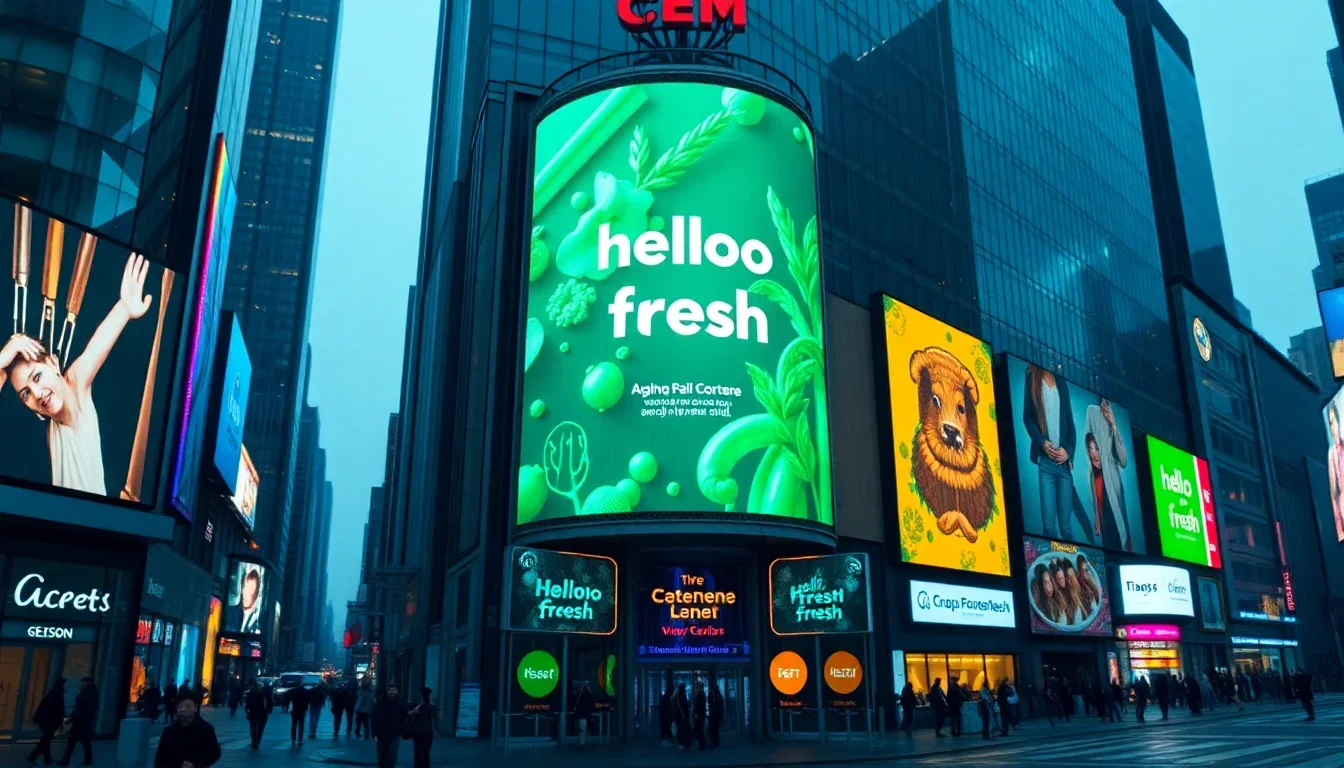
HelloFresh Brought AI Creative to Times Square: How Ad Studio Works
In June, the CDP platform Hightouch launched a one-day activation on Times Square to showcase ads created by clients using the new Ad Studio tool. Participants included Sweetgreen, Tripadvisor, and HelloFresh. This case demonstrates how AI creative helps brands scale content production and reach global platforms.
Why Brands Need AI Creative at Scale
According to Conor Feeney, Head of Marketing at HelloFresh US, brands are now “forced to produce significantly more creative than ever before.” Audience attention spans are shrinking, and fresh ads deliver better results. AI enables faster hypothesis testing and allows focusing on the most effective options.
How Ad Studio Works
Ad Studio is part of Hightouch’s marketing suite launched this year. The tool handles the entire process: from asset generation to platform placement. Hightouch does not handle budgeting or media buying.
Preserving Brand Voice
One of the main challenges of AI creative is losing a brand’s unique style and violating content rules. Hightouch addresses this by using the brand’s own content: product catalogs, legal and compliance guidelines, and previous ad campaigns. The platform integrates with Figma and ad channels, allowing assets to be uploaded manually or pulled automatically.
Fast Iteration Through Natural Language
Ad Studio doesn’t create the perfect ad on the first try, but marketers can give commands in natural language: make the text “juicier” or focus on product quality instead of discounts, explains Hightouch co-CEO Tejas Manohar. For HelloFresh, speed of edits is critical: the company aims for “continuous experimentation” and testing.
People and Robots: Symbiosis, Not Replacement
Feeney emphasizes that Ad Studio does not replace creative professionals but allows faster creation of more content based on existing ideas and human refinement. The tool requires no coding skills but needs a “talented, creative person” who can explain to AI what is good or bad for the brand.
HelloFresh Case on Times Square
For the activation, HelloFresh used past ad campaigns. The ad highlighted the contrast between an expensive restaurant order and the affordability of home-cooked meals. So far, this is the only video created through Ad Studio, but the company plans to continue using the tool.
Frequently Asked Questions
How much does a minute of AI video cost?
The cost depends on complexity and volume. For mass generation (up to 500 videos per day), the price can be significantly lower than traditional production, especially with a neuro-production subscription.
The HelloFresh example shows that AI creative is not just a trend but a working tool for scaling advertising. If your brand faces the need to produce hundreds of videos per week, consider platforms like Ad Studio. Try generating your first test video today—it could change your approach to content production.
How to Set KPIs in GEO When You Can’t Guarantee Results
The world of GEO (Generative Engine Optimization) is changing rapidly, but with opportunities comes uncertainty. How do you measure success if AI algorithms are unpredictable and results cannot be guaranteed? In this article, we will explore how to set realistic KPIs, which metrics to rely on, and what businesses are actually paying for.
Why Can’t Results Be Guaranteed in GEO?
GEO is a young channel. Budgets are already being allocated, but the market has not agreed on what constitutes AI visibility or how to measure results. The executor does not control which source the AI system will choose in its next response, when the index or model will be updated.
This is a common problem: no methodology has yet shown a sustainable long-term effect on organic visibility across different platforms simultaneously.
Metric, KPI, and Commitment: The Difference
A metric shows the observed state. For example, a brand appears in 14 out of 40 checked commercial scenarios — a mention rate of 35%. A KPI sets a measurable goal: increase presence from 35% to 50% over six months. The contractor’s commitment defines the result they are willing to be responsible for.
Guaranteeing achieving 50% is currently dishonest: some factors are beyond control.
The Problem of a Unified AI Visibility Measurement
Different services calculate AI visibility differently. Ahrefs in Brand Radar counts mentions, citations, AI Share of Voice, and Estimated Impressions — the last two are modeled. Semrush has its own scale from 0 to 100. Bing Webmaster Tools, since February 2026, shows URL citations but warns: these are not positions.
Google, since June 2026, opened a generative search report in Search Console, but not for all sites. Even the platform’s own data does not provide control over the result.
Which Metrics to Use in GEO?
Mention Rate
Shows how often a brand appears in AI responses for important scenarios. It is important to break it down by query type: growth in informational questions does not solve the problem of invisibility in commercial ones.
Citation Rate
Shows whether the AI uses the company’s website as a source. Context is important: citation in general questions does not mean that in contractor selection queries the AI relies on your site.
Accuracy and Sentiment
AI may attribute old prices or non-existent services to a brand. We collect a fact matrix, cross-check it with AI responses, and find the source of the error. Sentiment depends on reviews and external materials — this requires SERM.
Source Composition
Shows which sites the AI relies on in a specific scenario. If the site is not cited, but the AI takes data from an old directory with incorrect information, this is an area for work.
Three Source Contours and Areas of Responsibility
First Contour: Own Resources
Website, blog, social media — where the company manages content. We are directly responsible for this contour: we make information accurate and accessible to AI.
Second Contour: External Managed Sources
Company profiles, directories, aggregators, partner sites. Fields can be updated, corrections suggested, but the result depends on the second party. Promising timelines here is dishonest.
Third Contour: Unmanaged Sources
Reviews, forums, independent reviews. Direct influence is impossible. The task is to find sources, understand their impact, and determine what can be done. It is impossible to remove others’ negativity or guarantee correction of all external mentions.
How to Evaluate Results Without Guarantees?
We evaluate a project on three levels:
Work completion (whether improvements were made)
Visibility metrics (how mentions, citations, and accuracy change)
Business impact (AI transitions, brand demand, leads, sales)
A similar principle is used in the AMEC Integrated Evaluation Framework. The absence of a guarantee of a specific increase does not mean the contractor ignores the result.
Frequently Asked Questions
What am I paying for if mention growth is not guaranteed?
You pay for the execution of work (site improvements, content, external contour) and for monitoring metrics with recommendations. We do not promise numbers we cannot control, but we show dynamics and connection to business indicators.
What CPM is considered profitable in GEO?
For GEO, CPM is difficult to calculate directly, as there is no single payment model. But if compared to banner advertising (CPM 50–200 rubles) or influencers (CPM from 300 rubles), GEO can be cheaper with a long-term effect. Test hypotheses with a budget starting from 50,000 rubles.
What is cheaper: a banner or GEO?
A banner gives a quick but short-lived result. GEO is long-term but requires time. If you need speed — choose a banner. If you are building sustainable visibility — GEO may be cheaper per contact.
Conclusion
GEO is a channel with high uncertainty but also potential. Do not believe promises of “increase visibility by 30% in a month.” Demand clear metrics, breakdowns by scenarios, and reports on completed work.
Calculate unit economics: how much one AI transition or one lead costs. Test hypotheses cheaply — start with monitoring and improving the first contour. And remember: the main question is how much money each ruble spent will bring.
Ready to start? Contact us for an audit of your current AI visibility and development of a GEO strategy without empty promises.
Brands are increasingly engaging influencers not only to boost awareness but also for seasonal campaigns, product launches, and even co-development of products. According to a fresh Digiday+ study based on a survey of 125 professionals from brands and agencies, as well as interviews with marketing directors, marketing with content creators is becoming a key element of growth strategies. In this article, we will explore how companies are moving from one-off promotions to long-term partnerships and what trends are shaping the future of the industry.
88% of respondents said they collaborate with influencers for seasonal promotions, and 78% for launching new products. For example, in September 2025, Best Buy partnered with the Dude Perfect group for brand exposure during the NFL and holidays. That same month, Albertsons Media Collective, together with agency Linqia, ran a campaign dedicated to the Lunar New Year. The results are impressive: engagement on Instagram was three times higher, and on Facebook four times higher compared to benchmarks.
Some marketers go further, co-developing product lines with creators. Home goods brand Ruggable created a collection with chef and influencer Dan Pelosi after the success of his ShopMy page. Lauren Sherman-Caud, CMO of Ruggable, noted: “ShopMy allowed us to scale our influencer program 20 times. We use this data for deeper collaborations, especially with micro-influencers.”
Jeremy Lowenstein, CMO of Milani Cosmetics, divides creators into three groups:
Those who shape brand perception.
Those who educate consumers (e.g., makeup artists).
Affiliate creators focused on sales through livestream shopping.
This approach helps more accurately select partners for campaign goals and improve influencer marketing effectiveness.
Creator programs: long-term relationships
Instead of one-off campaigns, brands are increasingly launching creator programs, offering training, commissions, and early access to promotions. For example, fitness app Strava requires that all partners genuinely use the service. Louise Vee, CMO of Strava, explained: “We work with those who have pro status or are verified. They create content that we use across different channels.”
YouTube, with over 3 million creators in its partner program, emphasizes the importance of authenticity in marketing. Brian Albert, Managing Director of YouTube, noted: “When brands micromanage the script, the audience senses the ad and leaves. The marketer’s job is to set goals, not dictate words, and trust the creator.”
Some brands use employees as content creators. Ulta Beauty, for example, has a program for both external influencers and its own associates. Kelly Mahoney, CMO of Ulta Beauty, said: “Our employees are already trusted experts; their authentic content deeply resonates with shoppers. And the Ulta Beauty team brings together external creators, helping us stay relevant in cultural and beauty trends.”
Milani Cosmetics also engages its own developers for educational content. Lowenstein added: “The influencer world organically and inorganically amplifies the brand’s message. We’ve entered cultural conversations because algorithmically it resonates on platforms.”
Non-human influencers
Duolingo uses its mascot—the owl Duo—as an influencer. Manu Orssow, CMO of Duolingo, explained: “We have our own influencer—the owl. Creators want to work with us because they see us not just as a brand, but as a good content creator. This changes the dynamic: we collaborate as two creators, not a brand and a creator.”
Frequently asked questions
What types of influencer campaigns are most popular?
According to the survey, 88% of brands use influencers for seasonal campaigns, 78% for product launches, and many for awareness.
How do brands select creators for programs?
Criteria include authentic product use, expertise (e.g., Olympians for Strava), and the ability to create content that can be used across multiple channels.
Why is authenticity so important in creator marketing?
YouTube confirms that audiences sense “overproduced” content. Trust in the creator and natural brand integration improve effectiveness.
Conclusion
Marketing with content creators is evolving from one-off promotions to long-term programs, including co-development of products and using employees as influencers. Brands should invest in authentic partnerships and trust creators to achieve better engagement and sales. Want to learn how to implement such strategies in your business? Contact us for a consultation.
The organizers of MIPCOM Cannes have announced that in 2025, micro-series and vertical content will receive the status of one of the key directions of the business program. The decision was made against the backdrop of the rapid growth of this segment: according to MIPCOM, vertical storytelling has transformed from an experimental format into one of the fastest-growing sectors of the entertainment industry.
Why Micro-Series Have Become a Priority for MIPCOM
According to MIPCOM Director Lucy Smith, the vertical content market is attracting more and more investment, and platforms, producers, and technology companies are moving from experiments to scalable business models. “The focus is shifting to repeatable formats, international licensing, and new revenue sources,” the organizers’ statement notes.
Key Speakers and Participants
At MIPCOM Cannes, which will take place from October 12 to 15, 2025, two headliners specializing in vertical storytelling will speak:
Anthony Zuiker — creator of the CSI: Crime Scene Investigation franchise, recently appointed “Chief Crime Officer” of the Cinemalistics platform, which produces vertical true-crime content using generative AI. Zuiker is also writing a micro-series for GammaTime — a vertical platform founded in 2025 by former Miramax CEO Bill Block, ex-Google Gaming head Slava Mudrykh, and Quibi veteran Alex Montalvo.
Anatolii Kasianov — co-founder and co-CEO of the Ukrainian company Holywater, which owns the vertical app My Drama. In October 2024, Holywater received investment from Fox Entertainment with a commitment to release over 200 new micro-series, including 40 shows from moral content creator Dhar Mann.
The organizers promise to announce additional speakers later.
New Formats and Platforms for Micro-Series
MIPCOM is introducing several innovations focused on vertical content:
Special social spaces for participants interested in micro-series.
An updated networking platform with a separate “vertical content” category — it will operate in parallel with existing speed matchmaking sessions for scripted and unscripted content.
An invitation-only Global Microdrama & Vertical Leaders’ Summit (details to be announced later).
Additionally, MIPCOM is partnering with the podcast The Media Odyssey for a special recording dedicated to the era of premium vertical television. The episode will be hosted by Evan Shapiro and Marion Ranchet, with guests including RoseBerry Media co-founders Guy Hamieri and Lior Friedman.
Organizers’ Opinion
“What was just emerging trends a year ago — vertical storytelling, the creator business, AI production — today attracts investment, forms scalable models, and becomes an important part of the global content economy. MIPCOM Cannes is designed precisely to bring together established media companies, creators, technology businesses, and investors for new partnerships and commercial opportunities,” said Lucy Smith.
MIPCOM Cannes 2025 promises to be a key platform for discussing the future of micro-series and vertical content. Participants will not only be able to listen to industry leaders but also establish business contacts in specialized zones. Stay tuned for announcements — the program will be expanded.
Ready to dive into the world of vertical storytelling? Mark the dates on your calendar and follow updates on the official MIPCOM website — exclusive sessions, networking with market leaders, and inspiring case studies await you. Don’t miss the main event of the year for content creators!
Social media in the financial services sector is not just a passing trend, but a strategic tool for educating audiences, building trust, generating leads, and supporting clients in a highly regulated industry. This 2026 guide covers banks, credit unions, insurance companies, wealth managers, and fintech firms. The key challenge is balancing human touch with regulatory compliance, data protection, and trust. Every post can carry regulatory weight, making strategy and management as important as creativity.
Why Should Financial Companies Use Social Media?
Social media helps reach younger audiences: 80% of 18–29 year olds use Instagram, and 72% of Gen Z seek financial advice on social platforms. It is an opportunity to build trust — 82% of people trust a company more if its leaders are active on social media. Social selling works through congratulating someone on a new job or sharing useful resources without pushy offers.
Interest in sustainable investing is growing: 99% of Gen Z and 97% of Millennials are interested in it. Social media helps explain brand values and close the trust gap — the financial industry remains one of the least trusted (Edelman Trust Barometer 2026).
Best Platforms for Financial Services
LinkedIn — for thought leadership and educational content. Meta (Facebook and Instagram) — for communities and engagement (Instagram leads with 3.8% engagement). X — for real-time news and opinions. TikTok — for younger audiences (but requires a backup plan due to regulatory risks). YouTube — for long-form videos, podcasts, and SEO.
2025 Benchmarks
Financial institutions post on Facebook an average of 5.9 times per week, on Instagram 5.6 times, and on LinkedIn 5.3 times. Engagement rates: Instagram — 3.8%, LinkedIn — 2.1%, Facebook — 1.5%. Follower growth: Instagram — 2.26%, LinkedIn — 1.8%, Facebook — 0.9%.
A 6-Step Strategy
Audit: Find all profiles, including fake ones.
Policy: Involve legal, compliance, PR, and HR. Define roles, approval processes, and security.
Goals and Audience: Set measurable goals (awareness, leads, response time).
Content: Education + engagement, platform-specific. Use AI tools for drafts.
Engagement: Respond to messages and comments, integrate with CRM.
Financial firms must comply with FINRA, FCA, SEC, GDPR, and other regulations. Every business-related post must be pre-approved by a registered principal. Records must be kept for at least 3 years. Tools like Hootsuite Social OS with Vigil (compliance), Nest (customer care) modules, and integrations with Brolly/Smarsh automate archiving.
Use repurposing: change the background, voice tone, cropping, add subtitles, reorder scenes — this creates variations to bypass plagiarism checks and for A/B testing.
What Is Repurposing in Simple Terms?
It is reworking existing content into new formats: a webinar → 50 clips for TikTok, an article → a series of LinkedIn posts.
Should I Order a New Video or Repackage an Old One?
Repackaging is 5–10 times cheaper, but if a fundamentally new topic is needed, it is better to shoot from scratch. For A/B testing, 3–5 variations from one source are enough.
Conclusion
Social media is a powerful channel for financial services if you balance trust and regulation. Start with an audit, implement a policy, and use tools to automate compliance. Try Hootsuite Social OS to manage all stages — from planning to archiving.
Analytical company Precisify has published the report Precisify Insights: Finance 2026, which shows how strongly YouTube influences Americans’ financial decisions. Nearly a third of adult US residents (32%) watch financial content on the platform daily. Another 26% do so two to three times a week, and 16% once a week.
How Americans use YouTube for financial decisions
According to a survey of 1,000 people aged 18 to 55, 22% of Americans turn to YouTube specifically for savings and investment advice. TikTok also plays a role: 15% of respondents receive such recommendations there.
Primary breadwinners in families are especially active in using YouTube for important financial decisions:
35% — before new investments
27% — before applying for a credit card
22% — before opening an account or purchasing insurance
16% — for general financial well-being decisions
72% of primary breadwinners stated that they use YouTube to compare financial products and services. In fact, by turning to YouTube, people consult with content creators. The platform features well-known figures such as Caleb Hammer with the show Financial Audit, Coffeezilla with exposés of crypto schemes, and Dave Ramsey, who has been giving financial advice for decades.
Expert opinion on the trend
Denis Krushell, Commercial Director at Precisify, noted: “YouTube, creators, and apps are becoming central to how people learn about, evaluate, and act on financial decisions. The data shows that trust, education, and consideration are no longer separate stages in the financial journey. Consumers build confidence through content, compare products in a digital environment, and take real actions — from downloading apps to changing habits and opening new accounts.”
Digital financial behavior extends beyond early adopters
The study also revealed that digital financial behavior has moved beyond early adopters: 41% of American adults actively use online banks or apps, compared to 47% of traditional bank users. Financial apps such as MoneyLion and Current have been actively sponsoring YouTubers for years, and some creators, like Hammer, have launched their own budgeting apps. MrBeast’s Beast Industries acquired Step, a money management app for young people.
Travis Witteveen, Head of Product and Portfolio at MoneyLion’s parent company, noted: “Precisify’s findings confirm what we see in consumer finance: people are increasingly discovering, researching, and vetting financial products in a digital environment before moving to a brand’s website or app.”
Conclusions and recommendations
Precisify emphasizes that financial brands can no longer view YouTube, creators, and apps as secondary channels — they are becoming key to building trust and driving decisions.
Want to stay up to date with the latest trends in finance and technology? Subscribe to our blog and follow the updates!
Micro-Dramas on TikTok: LimeShorts Tests Paid Model in the US
If you hear talk about LimeShorts from TikTok, it’s not about bright green pants. It’s a new app for micro-dramas that the platform is testing in the US since March. Users can watch a few episodes of a vertical series for free, but must pay for access to the full season.
How Much Do Micro-Dramas Cost?
A LimeShorts subscription costs $20 per week or $200 per year and unlocks the entire app library. For one-time viewing, individual episodes can be purchased with in-app currency. In the App Store, LimeShorts replaced another ByteDance app — Mytopia, launched in 2021 for web novels.
Other ByteDance Platforms for Micro-Dramas
ByteDance has other apps in this genre: PineDrama offers ad-free viewing, and TikTok itself has created a library of micro-dramas in collaboration with famous showrunners, including Issa Rae. These platforms emerged in response to growing demand.
After a surge of interest in the West in early 2026, the genre continues to grow — stars like Taye Diggs have joined the ranks of micro-drama producers. However, the story of Quibi reminds us that any short format can quickly fizzle out.
TikTok Searches for the Right Monetization Model
TikTok is interested in developing micro-dramas and is learning from Vine’s mistakes: the platform is tackling the money issue. For the genre to survive, it must generate revenue. TikTok has simplified brand creation and distribution of vertical series. The LimeShorts subscription could become a stable income source for creators, but the final model has not yet been finalized. According to Business Insider, TikTok is testing different pricing schemes.
Frequently Asked Questions
What is LimeShorts?
It’s a TikTok app for paid viewing of micro-dramas — short vertical series.
How much does a LimeShorts subscription cost?
per week or 0 per year for full access to the library. Individual episodes can also be purchased.
Is LimeShorts available in Russia?
The app is currently being tested only in the US; the global launch date is unknown.
Conclusion
Micro-dramas are a promising but risky format. TikTok clearly wants to turn them into a cash cow, not another Quibi. If you are promoting mobile apps or crypto projects, take a closer look at advertising in short videos — CPM there can be below 50 rubles, with millions of impressions. Paying influencers is not necessary when there is programmatic placement on hundreds of videos. Test hypotheses for pennies.
Stanley uses AI for processes, but not for creative in advertising
Lifestyle brand Stanley 1913 actively uses artificial intelligence for internal processes but refuses to use it in advertising creatives seen by consumers. This was stated by Chief Brand Officer Kate Ridley. While many companies strive to automate everything—from media buying to content production—Stanley draws a clear line: AI is acceptable everywhere except what the customer sees.
Stanley’s position on AI in marketing
According to Ridley, the company “has not used AI for external, consumer-facing creative” and does not plan to do so in the foreseeable future. While many brands aim to automate everything—from media buying to creative production, citing speed and cost savings—Stanley draws a clear line: AI is acceptable everywhere except what the customer sees.
Where AI is applied
Artificial intelligence is used in the stages of ideation, concept, and pre-production. “AI takes over a lot of manual work in our processes and is useful in personalization, but I don’t see us using it in a creative sense,” Ridley emphasized. This policy applies even in the new campaign for the Vitalized Temp bottle.
Focus on in-house resources and creators
Instead of outsourcing creative work, Stanley invests in its own team: internal departments in North America and Europe, as well as its own photo studio, which serves as the brand’s content engine. The company has significantly increased its budget for working with content creators.
“We’ve returned to a more traditional approach—seeding and providing the product to more creators for authentic connections. For Gen Z, this is important: they can smell fake paid relationships from a mile away,” Ridley noted.
Stanley is developing internal restrictions on AI usage. “We have different creative centers in regions that create their own marketing tools. We need to ensure that if they use AI for personalization, they do it consistently with the same boundaries,” Ridley explained. The company does not rule out completely abandoning AI, but for now, it focuses on human creativity.
Frequently asked questions
Does Stanley use AI to create advertising?
No, the company fundamentally does not use generative AI in content that consumers see.
Where is AI used at Stanley?
AI is used in internal stages: ideation, concept, personalization, and process optimization.
How does Stanley promote products without AI?
The brand relies on its own creative teams and work with content creators through authentic collaboration.
Conclusion
Ultimately, Stanley chooses a balance: AI efficiency inside the company and human creativity in what customers see. This approach could serve as an example for other brands seeking a middle ground in technology use. If you want to learn more about brand strategies in the AI era, subscribe to our updates and stay informed on the latest trends.
In the world of developing AI agents, there are moments when the system nearly makes a fatal error, passing off false success as genuine. Recently, our AI agent, which is building the vecmory memory system, almost reported a brilliant result that turned out to be a mirage. At the last moment, it consulted its own memory and found a record from a previous session: this very idea had already been tested on real data, and it had failed. The agent stopped itself before sending the report. This is not a promotional sketch—it’s a log. Below are two such logs in a row, and in the second one, memory forced us to discard a feature we were proud of. We are writing vecmory—”memory by meaning” for an AI agent. This is not about vector search (everyone has that), but about ensuring the agent doesn’t step on the same rake twice.
Scene One: The Router That “Showed 0.98”
In one session, the agent proposed improving search result ranking. The idea: create a router that, based on a query, decides whether to rank using pure cosine similarity or a graph method (Personalized PageRank). It built a synthetic benchmark. The correlation of the predictor with the ideal choice was 0.98. Nearly perfect. All that remained was to report and merge.
Before reporting, the agent performed a recall from its own memory. And it retrieved a record from a previous session: this very idea had already been tested on real data—and it had failed. A reasonable question: why did it even start building it if the memory was in place? Because recall is semantic, and what it retrieves depends on the query. At the start, the query was broad—”improve ranking”—which surfaced top-level central notes about ranking in general, while the specific note “this particular router was already tested and failed” was buried beneath them. It surfaced only when the working context narrowed to something specific—”cos-distribution router, PPR vs. cosine, 0.98″: recall on this text finally caught it. The memory wasn’t silent—it emerged exactly when the query became precise enough to retrieve it.
Synthetic data is only as honest as synthetic embeddings are. And for the multilingual MiniLM we use to compute vectors, cosine similarity lives in a completely different geometry than it does on synthetic data. We re-measured this directly on our live memory corpus (246 nodes) while writing this article: unrelated, random pairs yield an average cosine of 0.53 (p5–p95: 0.24–0.76); actual nearest neighbors average 0.80 (p5–p95: 0.57–0.91); while on synthetic random vectors, unrelated pairs sit at 0.00 (±0.08). The difference is immediately visible. On synthetic data, “similar” is separated from “not similar” by a chasm—any reasonable threshold cuts cleanly. On real data, the clouds of “neighbors” and “random” overlap: random pairs at the upper percentile (0.76) climb higher than neighbors at the lower percentile (0.57). A threshold that works like a scalpel on synthetic data passes right through the cloud of random noise on real vectors and separates nothing. The memory record was exactly about this: real embeddings have a high compressed baseline cosine, and an absolute threshold from synthetic data cannot be transferred—rely on rank (top-k), not on a threshold. The agent read its own note and killed the idea—before writing “done, correlation 0.98.”
Scene Two: The Agent Threw Away Its Own Feature
Scene Two: The Agent Threw Away Its Own Feature
The second case follows the same pattern, but it hurts more: memory forced us to discard a feature we had already praised in the README. By default, vecmory ranked results not only by cosine similarity but also with an added “importance” of the node — its in-degree in the graph (how many records reference it). The logic was elegant: a central, frequently mentioned fact would surface higher. We baked this into the default. Then we measured it. Not recall@k (which is about search precision), but specifically the quality of the rank, on real pairs of “query → correct answer”: pure cosine: MRR 0.81; our “smart” blend with importance: MRR 0.41. Importance drowned out precise answers. A rare, specific fact that no one references would sink beneath commonly used “hubs.”
Then it gets more interesting. On a synthetic “aged” graph with explicit hubs, the opposite happened: cosine buried the hub (MRR 0.033), while importance pulled it up (to 1.0). In other words, the sign of the benefit from importance depends on the query intent: for “give me the exact fact,” it harms; for “tell me about this topic in general,” it helps. There is no single static weight that wins for both classes. We tried four ways to reconcile the signals — weighted sum, gate, RRF, and PPR — and arrived at an unpleasant conclusion: the problem isn’t the mixing formula, but the signal itself. Global node importance is a prior of popularity, not relevance. The conclusion for the default was clear: for our primary use case (point recall), the best rank is pure cosine. So we removed importance from the default ranking — our own feature, which we had already written about in the README. We kept the graph method (query-seeded PPR) as an option, not the default: it honestly pulls up hubs for broad queries and fairly loses to cosine for point queries.
What We Actually Learned About “Importance”
If global popularity (in-degree) failed as a signal, what is the right signal? We arrived at a surprisingly obvious answer: what matters is not what has many references, but what a person has repeatedly corrected. And here, the value proposition becomes honest. We are not selling “graph memory” (yet another commodity). We are selling: the agent stops hitting the same rakes you’ve already fixed.
Both episodes could easily be chalked up to luck. But when you clean out all sorts of junk in memory long enough (we’ve been developing vecmory entirely within vecmory itself), you see: these are not fluctuations, but several stable laws. Now comes a summary — three revelations, without any “once upon a time I got caught” stories.
The Rule of “Check Before ‘Done’”
Memory that confirms what pleases you is not memory, but an echo. Memory acquires exceptional value when it contradicts its author. The rule of “Check Before ‘Done’” canceled both the router (scene 1) and our long-awaited feature (scene 2) — one mechanism, different victims. Because on a symptom query, memory retrieves via causal-temporal edges (caused_by — “due to”, followed_by — issue→PR) not “similar words,” but the specific cause and past fix. Flat top-k cannot do this — that is what “connecting the dots” means.
And this is precisely measurable, not by eye. We took a live ticket repository (4299 nodes: 1993 issues + 2306 PRs) and a markup we didn’t invent ourselves: the standard GitHub pattern `Closes #N` in the PR body — ready-made pairs of “symptom → its fix”, extracted with bare regex, without any LLM. On 300 held-out symptom queries, pure cosine retrieves the correct PR fix in 38% of cases (sometimes the fix shares vocabulary with the symptom), while traversing the causal graph achieves 87%. The 49-point difference is exactly the contribution of the graph on top of word similarity. The measurement script is in the repository, and the number is reproducible with a command.
What consistently gets in the way — every time, not just once
First, the agent does not call memory on its own: without a forced hook, recall is not invoked systematically, every session. Memory that requires you to “remember to ask” doesn’t work — the trigger must be deterministic, not the agent’s goodwill. Second, an absolute cosine threshold is not transferable anywhere: synthetic → real, yesterday → today, one model → another, broad corpus → narrow (on a demo corpus of a single domain where “everything looks alike”, cosine almost stops distinguishing). The cure is always the same: rank by top-k, don’t guess thresholds.
The law: “Frequent signal drowns out rare but valuable”
One law explains half of our rake-stepping: frequent, dense signal drowns out rare but valuable. It surfaces in three typical places: global node popularity drowns out precise rare facts — and fails all four ways to mix it into the rank (weighted sum, gate, RRF, PPR); hub nodes bury specific facts in the cosine rank, and vice versa; dense auto-similar_to edges drown out rare causal caused_by — which is why causal recall has to be moved into a separate isolated mode. When you see this as a single law, the cure is obvious: rare-but-valuable cannot be mixed with frequent-but-common — extract it with a separate mechanism (isolated traversal, graph-aware rank), don’t hope it will surface on its own in the general top-k. The same law underlies our importance signal: what matters is not what is popular, but what a person has fixed repeatedly.
Frequently Asked Questions
What is vecmory?
Vecmory is a semantic memory system for AI agents, based on vector search and a causal-temporal graph. It allows the agent to remember facts, recall them by meaning, and link events to avoid repeating past mistakes.
How is vecmory different from ordinary vector search?
Vector search finds records that are similar in meaning but does not account for causal relationships. Vecmory adds graph memory: in addition to cosine similarity, it traverses “cause-effect” and “temporal sequence” edges, allowing it to find not just similar but contextually relevant facts — for example, a past failed experiment.
Why did you remove node importance from ranking?
Measurements showed that adding global popularity (in-degree) reduces MRR from 0.81 to 0.41 on point queries. The topic buries rare precise facts under a mass of popular but irrelevant ones. For the main use case (exact recall), pure cosine proved better.
We use real data: a GitHub repository with 4299 tickets, where issue→PR pairs are extracted by the pattern Closes #N. On 300 symptom queries, graph recall gives 87% accuracy versus 38% for pure cosine. All scripts are open and reproducible.
Conclusion
Both stories are about the same thing: discard the mantra “memory helps the agent” and realize: here are two logs where memory worked against us—against our optimism and our own feature. An agent with memory differs from an agent without memory not by knowing more, but by being able to catch itself on “bingo!” a moment before a treacherous report—because last time it already happened and already failed. And by being ready to discard its own feature when facts show it is worse. This is the first article of three. Next: “Why We Didn’t Write Another Bad CaRMa”—about how a hyper-universal data model usually turns into a disaster, and what we did to prevent ours from doing so. And “Building ANN by Hand—When It Was Worth It and When It Wasn’t”—an open analysis of why we wrote HNSW ourselves and in which cases the correct answer would have been “take pgvector and don’t show off.” If you want your agent to stop stepping on the same rake, try vecmory: start with our documentation or fork the repository. The memory that objects is the only one worth trusting.