Previously published terms, verified 03.09.2026. CPV = CPM ÷ 1,000. This is a reward rate with eligibility terms and limits, not the actual cost of the entire campaign. Fund does not equal expenses. Views do not equal unique reach or sales. Conclusions about marketing mechanics — editorial analysis; the presence of a campaign around a brand does not necessarily mean its direct placement.
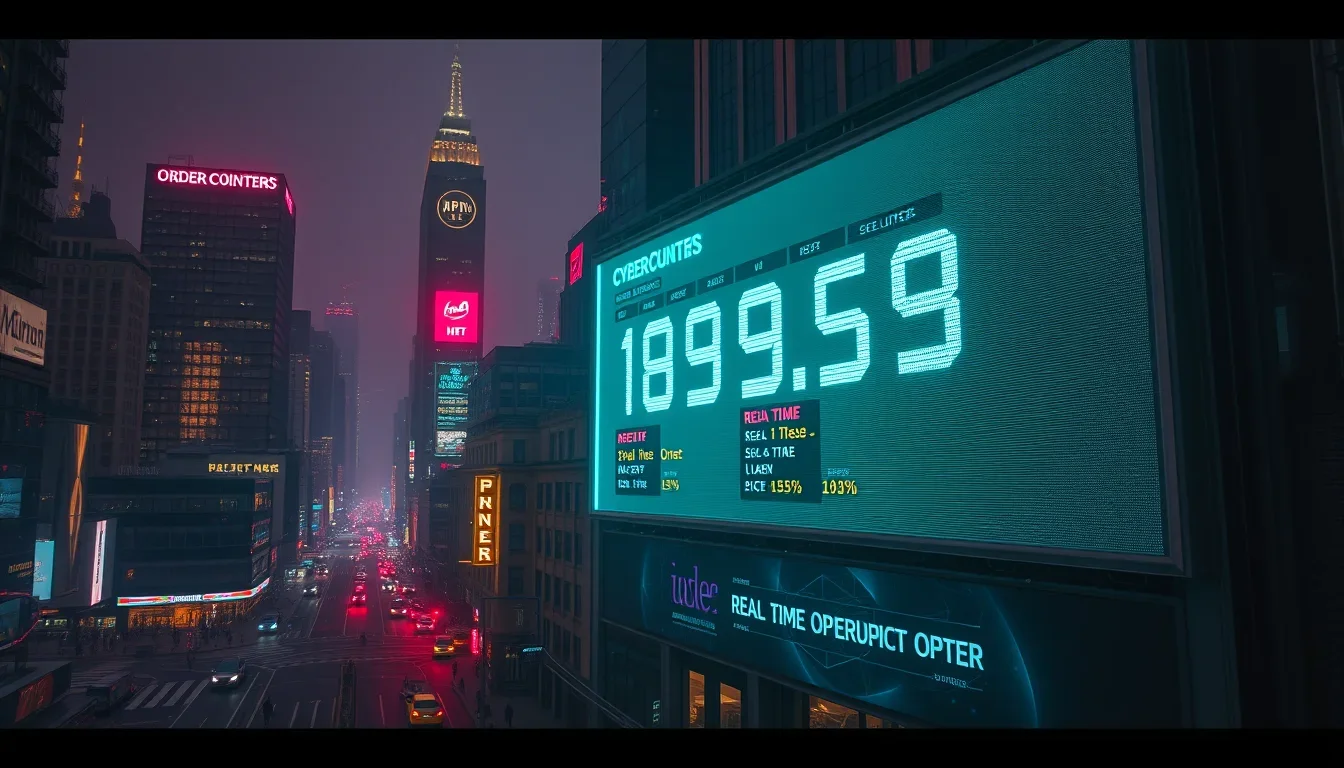
How many condoms are being ordered right now? In the DoorDash campaign, this question was displayed on two billboards — in New York and Los Angeles. Counters showed orders in real-time, turning an ordinary urban structure into a small public show. Authors of short videos were offered ready-made footage and a simple task: to convey the unexpectedness of this idea so that the viewer would want to share what they saw.
The video clipping market is rapidly developing, transforming from a simple video cutting tool into a powerful channel for advertising reach. A joint study by VibeVO, a video clipping platform, and Go Influence, an influencer agency, sheds light on the current state of the short video, video clipping, and social media banner advertising market, demonstrating how these formats are becoming key for brand promotion.
Short vertical videos have long ceased to be just entertainment. For companies, it is already an independent promotion environment. A single episode, interview, live broadcast, review, or conversational recording turns into a series of short videos, each of which can become a separate point of contact with the audience.
This study was prepared by VibeVO and Go Influence based on VibeVO data for the last 30 days as of June 8, 2026. The indicators describe the studied array of short videos and do not claim to evaluate the entire internet. However, the database is large enough to see the main patterns: concentration of views, differences in platforms, thematic cores, and audience within topics.
A brief version of the study is published on Sostav.
Key figures of the study
Indicator
Value
Views in the saved 30-day volume
252.81 million
Videos
4,224
Authors in the database
141
Pages in the database
228
Ad launches
16
Share of the three main topics
86.1%
Audience coverage
99.2%
Graphs from the updated table
29
Main conclusion: the video clipping market can no longer be described only as mechanical video cutting. It is developing as a tool for managed advertising reach, where the topic, platform, author, release speed, design, placement environment safety, and result measurement are important. Banner advertising in social networks also changes its role: it works not separately from the video, but during viewing or next to it.
Why short video has become a mass format
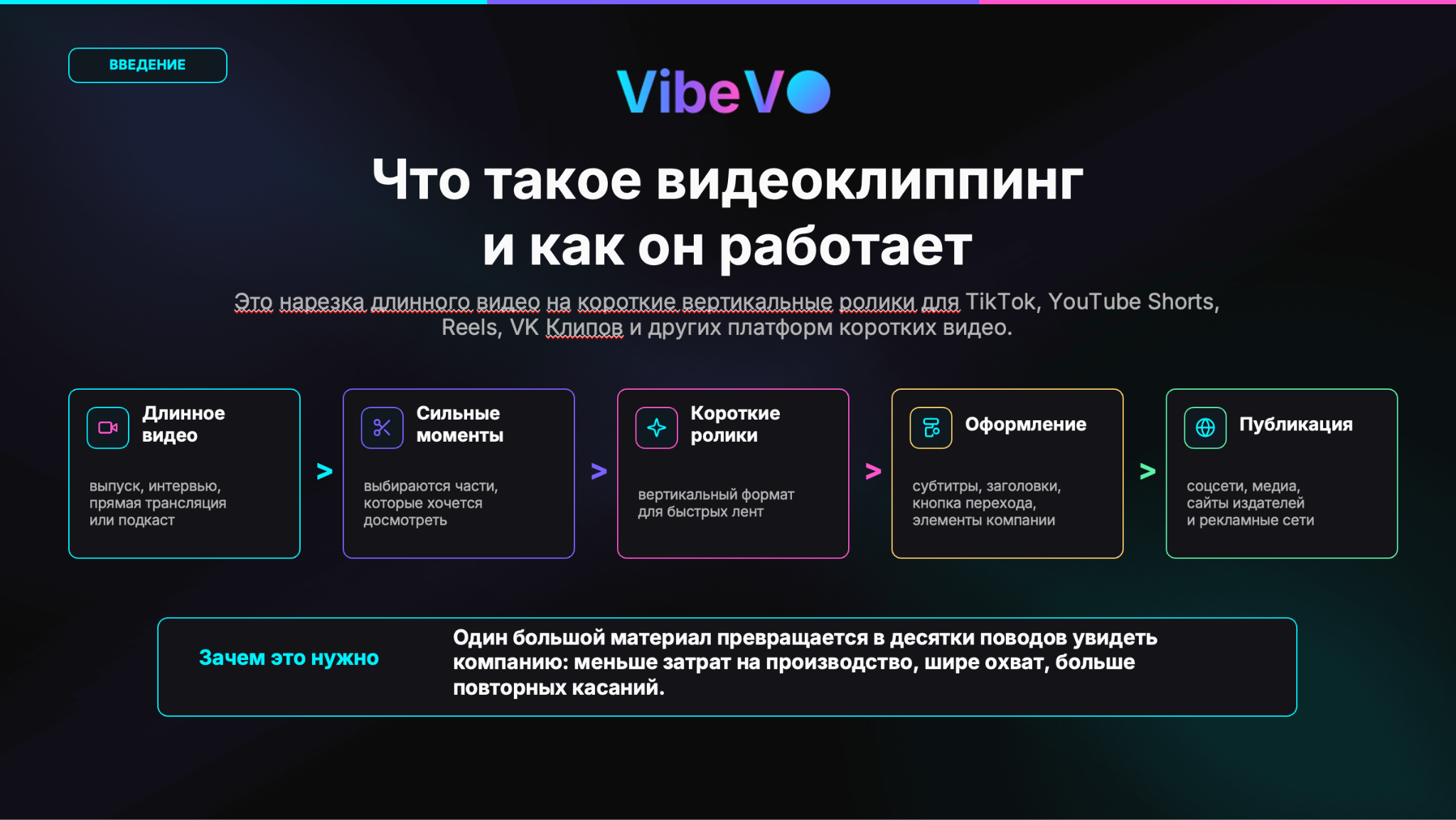
Video clipping is the transformation of long material into short vertical videos for recommendation feeds and author publications. The original video is broken down into strong moments, each fragment receives subtitles, a title, design elements, and a clear next step: go, save, watch to the end, take advantage of an offer, or learn more.
The economics of this approach are simple: one large piece of content provides dozens of reasons to re-engage with the audience. Instead of a one-off release, a company gets a series of repeated touchpoints, and platforms get content that is easier to distribute in fast feeds. Therefore, video clips are becoming not an auxiliary technique, but a separate way to buy attention.
External benchmarks in the presentation show why this shift has become widespread:
TikTok users spend an average of 95 minutes per day on the app.
Video advertising spending on the internet in the US exceeds 80 billion dollars.
Even if markets and platforms differ by country, the logic of consumption itself is already obvious: attention has shifted to short videos.
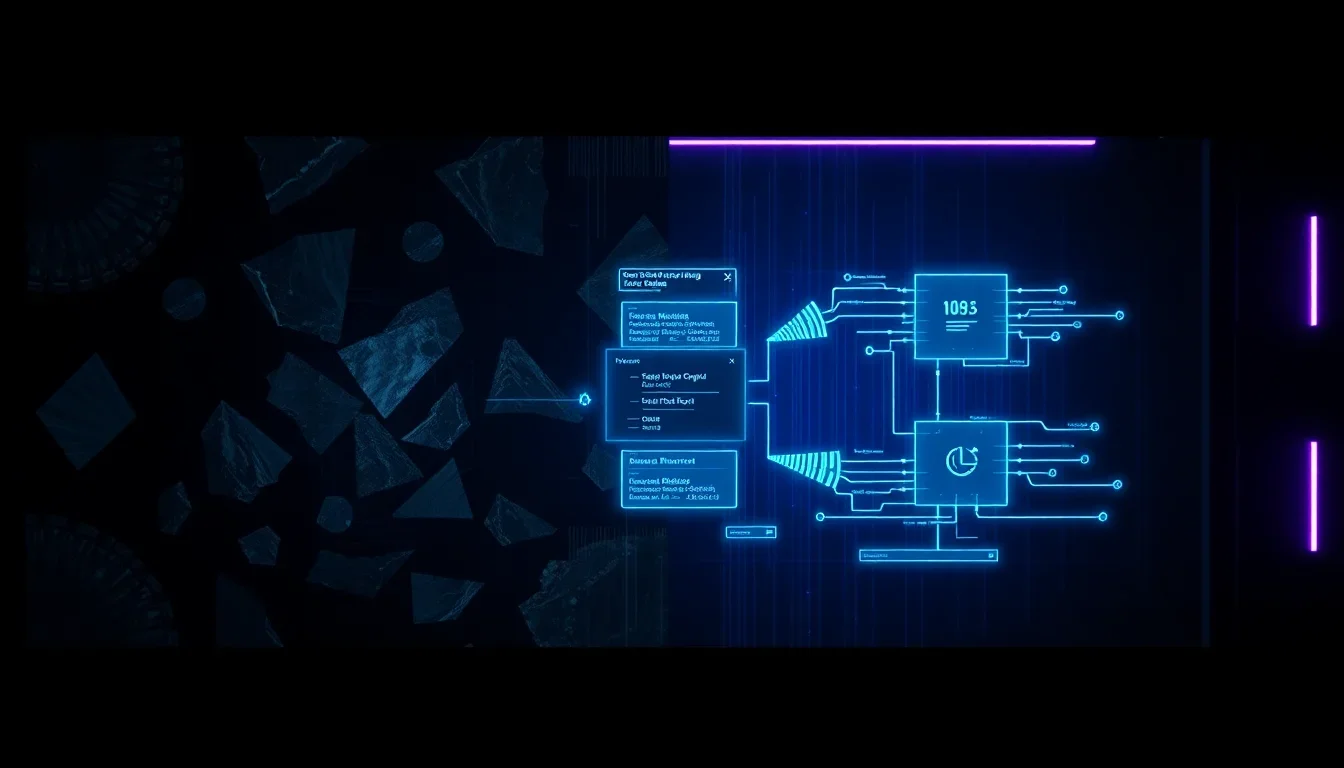
Chart 1. How video clipping works: the path from a long episode to a series of short videos. Source: VibeVO data, updated 08.06.2026. Click on the chart to open it in full size.
Overall picture: topics and platforms
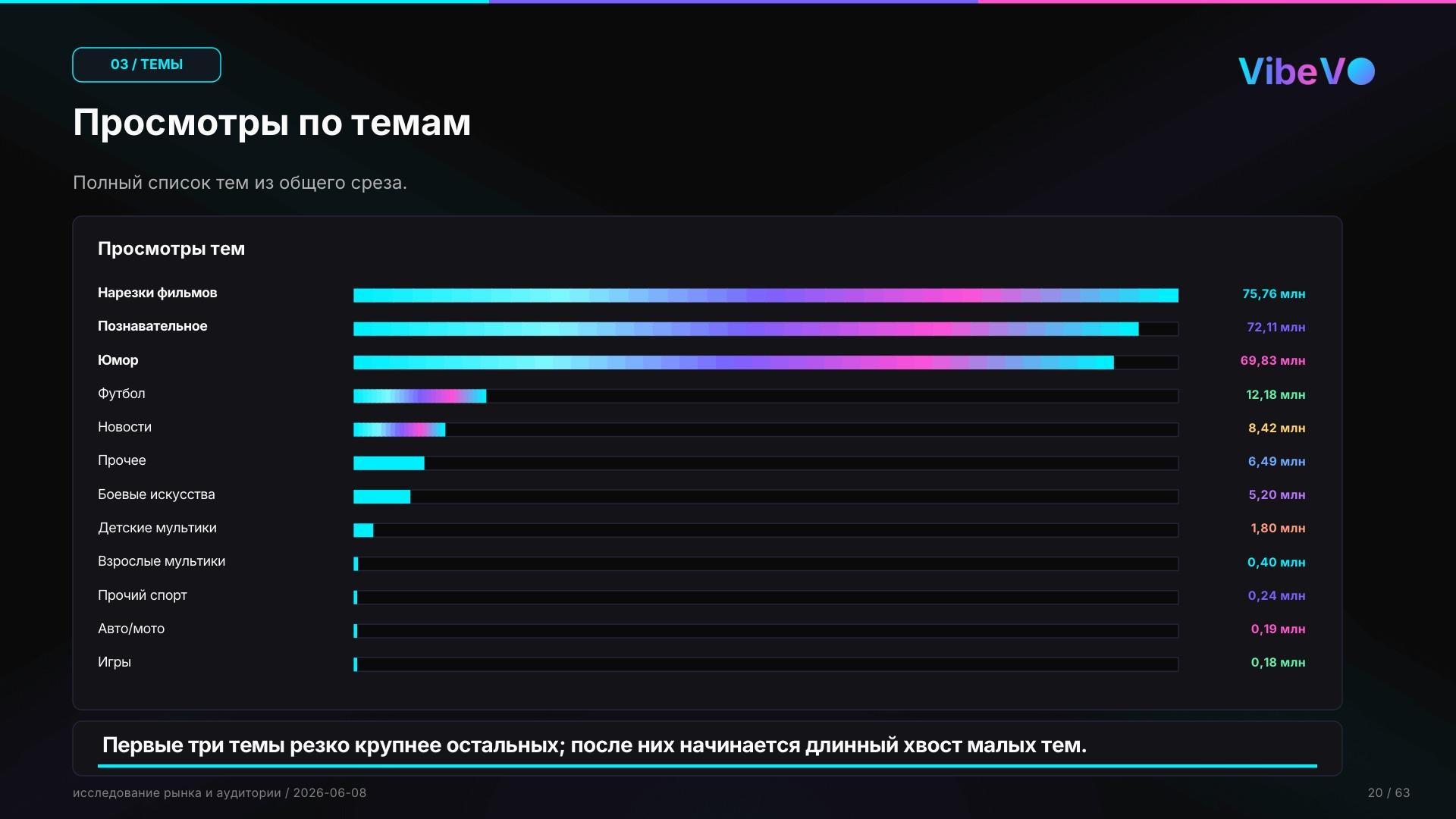
In the updated cut, the market looks concentrated. The three largest topics — movie clips, educational videos, and humor — account for 86.1% of the saved volume. Movie clips garnered 75.76 million views in 30 days, or 30.0%. Educational videos yielded 72.11 million views, which is 28.5%. Humor is almost at the same level: 69.83 million views, or 27.6%.
After the top three, a long tail begins: football — 12.18 million views, news — 8.42 million, other topics — 6.49 million, martial arts — 5.20 million. Children’s and adult cartoons, other sports, auto and moto, games are significantly less represented in the studied cut. This is an important caveat for placements: small topics cannot be generalized by the same rules as the largest ones.
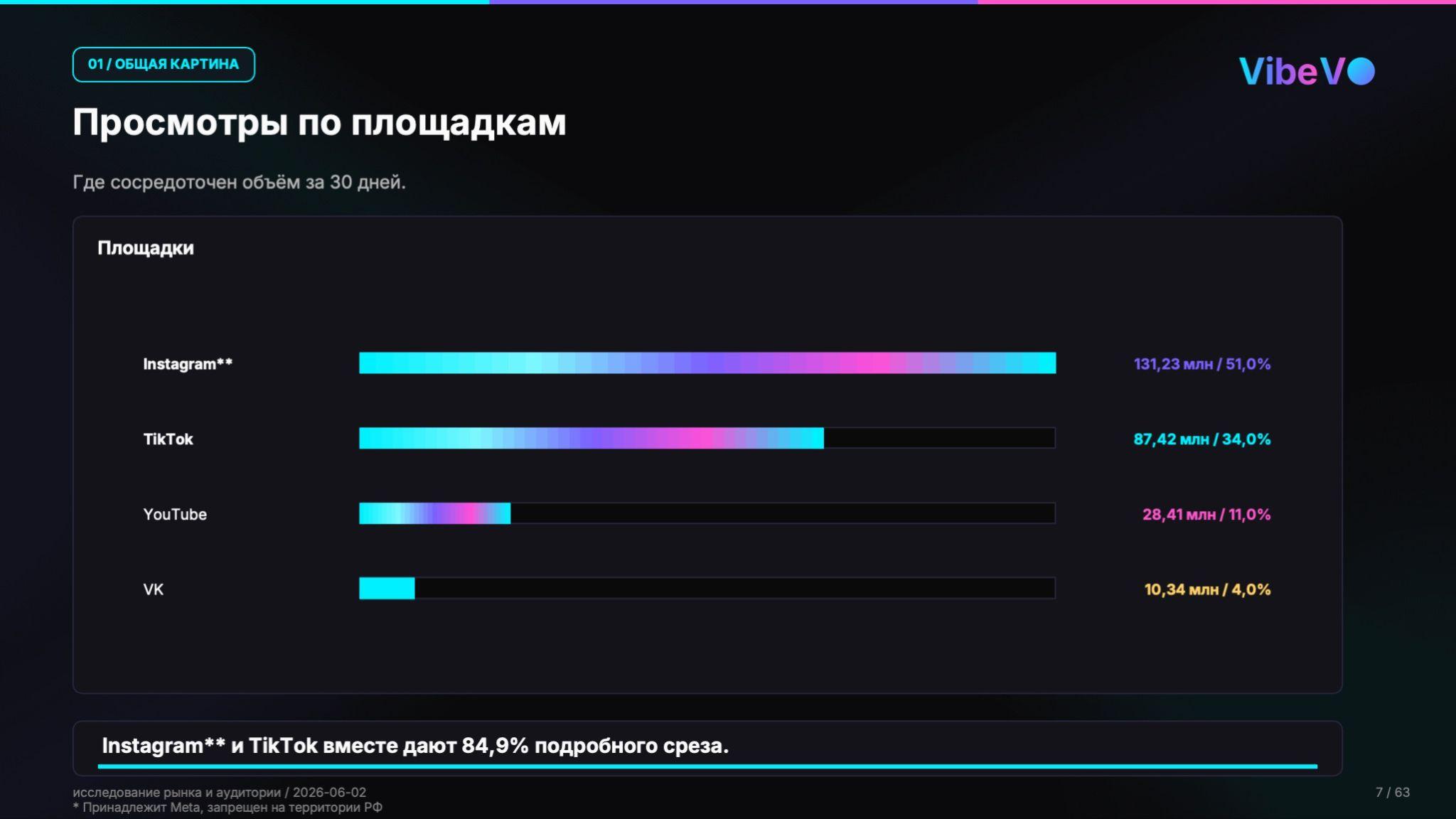
By platforms, Instagram* became the leader: 131.23 million views, or 51.0% of the detailed volume. TikTok yielded 87.42 million views, or 34.0%. Together, they form 84.9% of the detailed cut, but other platforms do not disappear: they can be important for individual topics, creators, and strong publications.
Chart 2. Views by topic over 30 days: the three largest topics are significantly larger than the rest. Source: VibeVO data, updated 08.06.2026. Click on the chart to open it in full size.Chart 3. Views by platform: Instagram* and TikTok form the bulk of views. Source: VibeVO data, updated 08.06.2026. Click on the chart to open it in full size.
Database size and strength of individual platforms
The database includes 4,224 videos with an active topic, 141 authors, 228 pages, and 16 advertising campaigns. This allows us to look not only at the overall volume but also at how platforms behave differently. Some provide scale, while others provide a stronger upper part of publications.
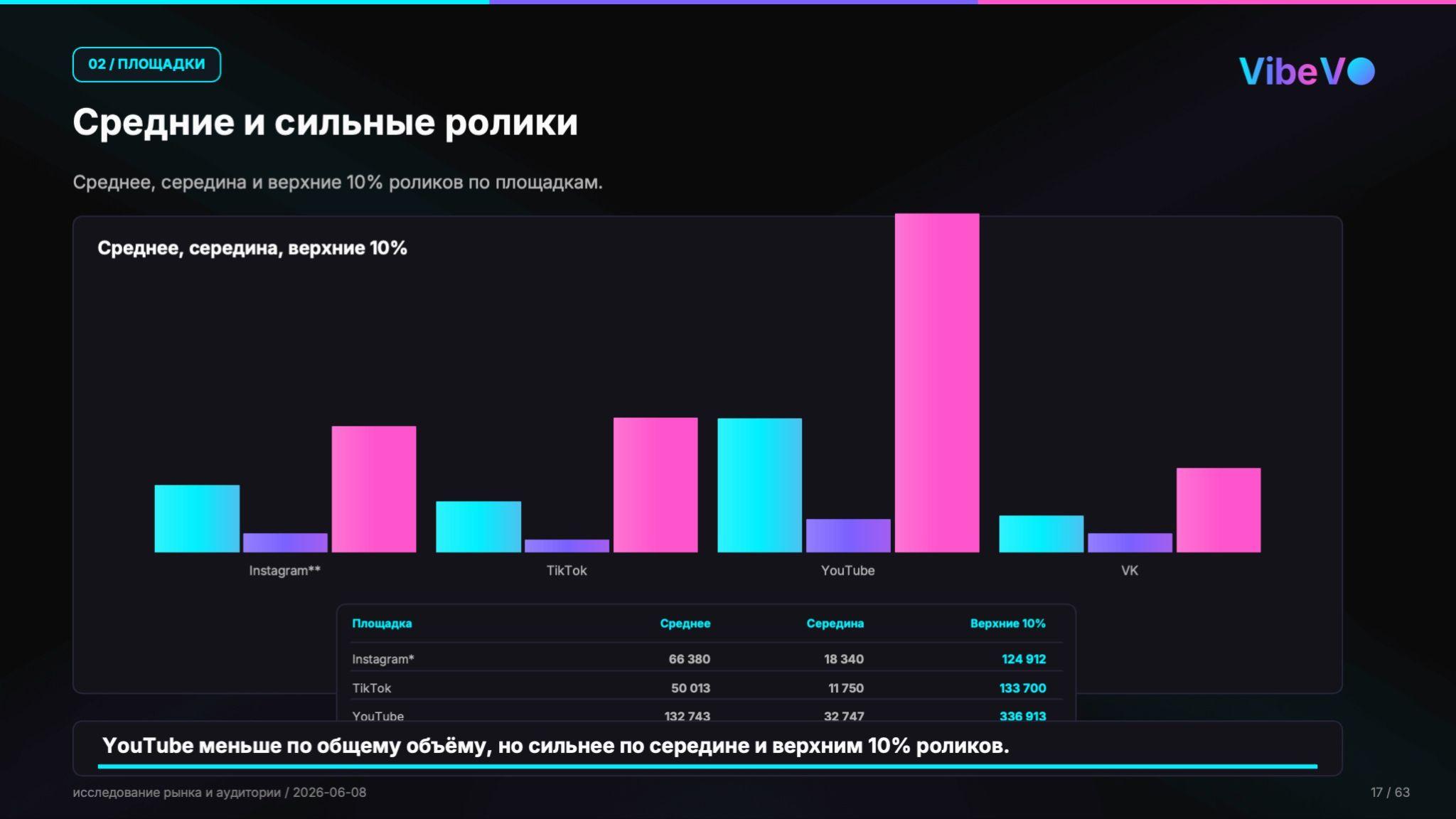
Instagram* leads in overall volume, but YouTube’s algorithms react more sharply to viral videos and give them a larger share of reach. On average, one video on YouTube received 132,743 views. For Instagram*, the average was 66,380, and for VK, it was 36,277.
Such a distribution changes the placement plan. Mass reach is logically sought in large Instagram* and TikTok bundles, but if there is viral content, YouTube can be a platform where it is easier to gain reach.
Chart 4. Distribution of reach among the top 10% most popular, median and average values by platform: YouTube is smaller in overall volume but stronger in the top 10%. Source: VibeVO data, updated 08.06.2026. Click on the chart to open it in full size.
It is better to analyze topics in bundles: topic plus platform
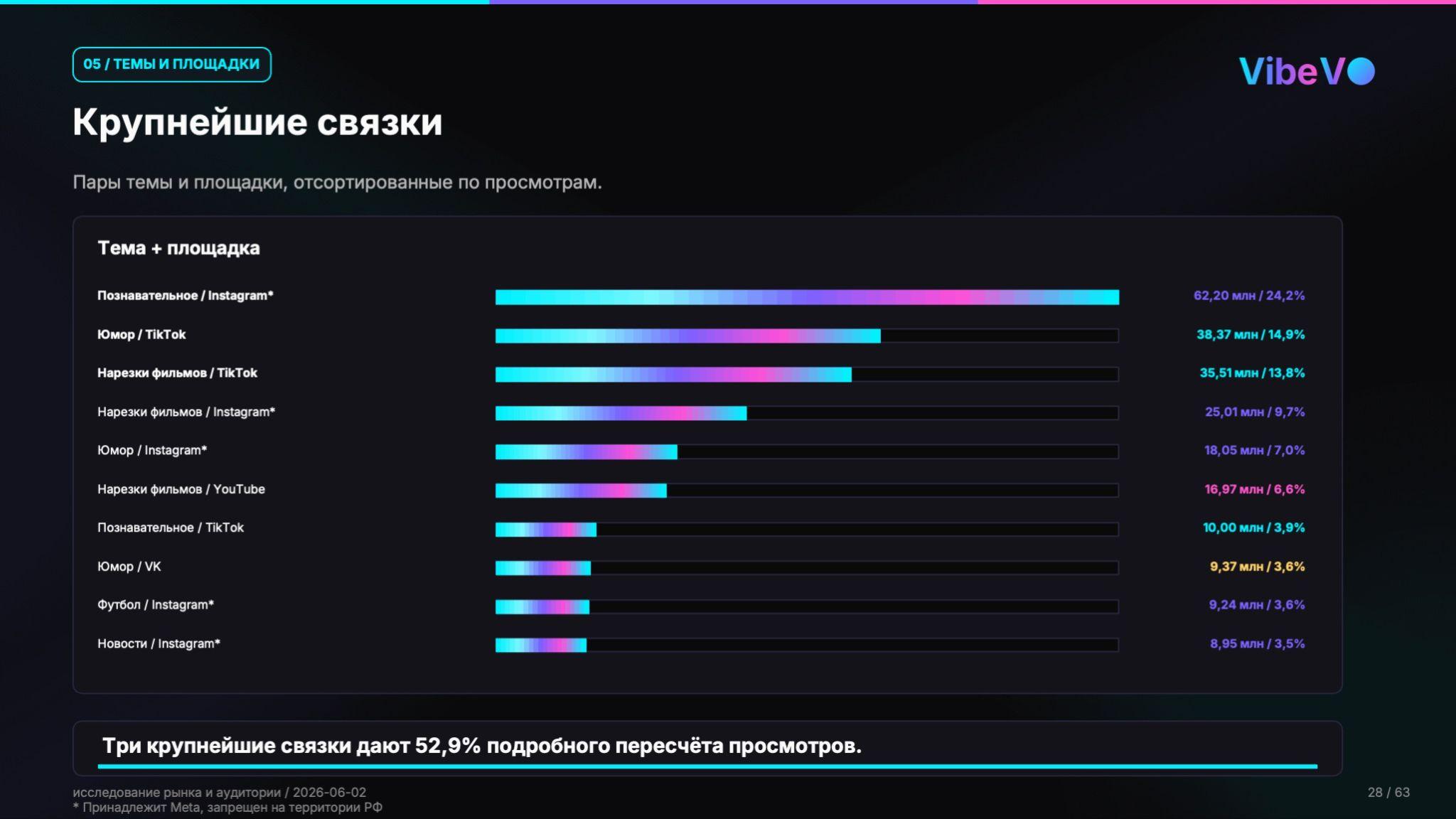
The total volume across the platform does not fully explain the market. The largest reach points occur where the topic and the distribution medium coincide. In the updated data, the largest combination is educational videos on Instagram*: 62.20 million views, or 24.2% of the detailed recalculation. This is followed by humor on TikTok – 38.37 million views, or 14.9%, and movie clips on TikTok – 35.51 million views, or 13.8%.
The three largest combinations account for 52.9% of the detailed recalculation of views.
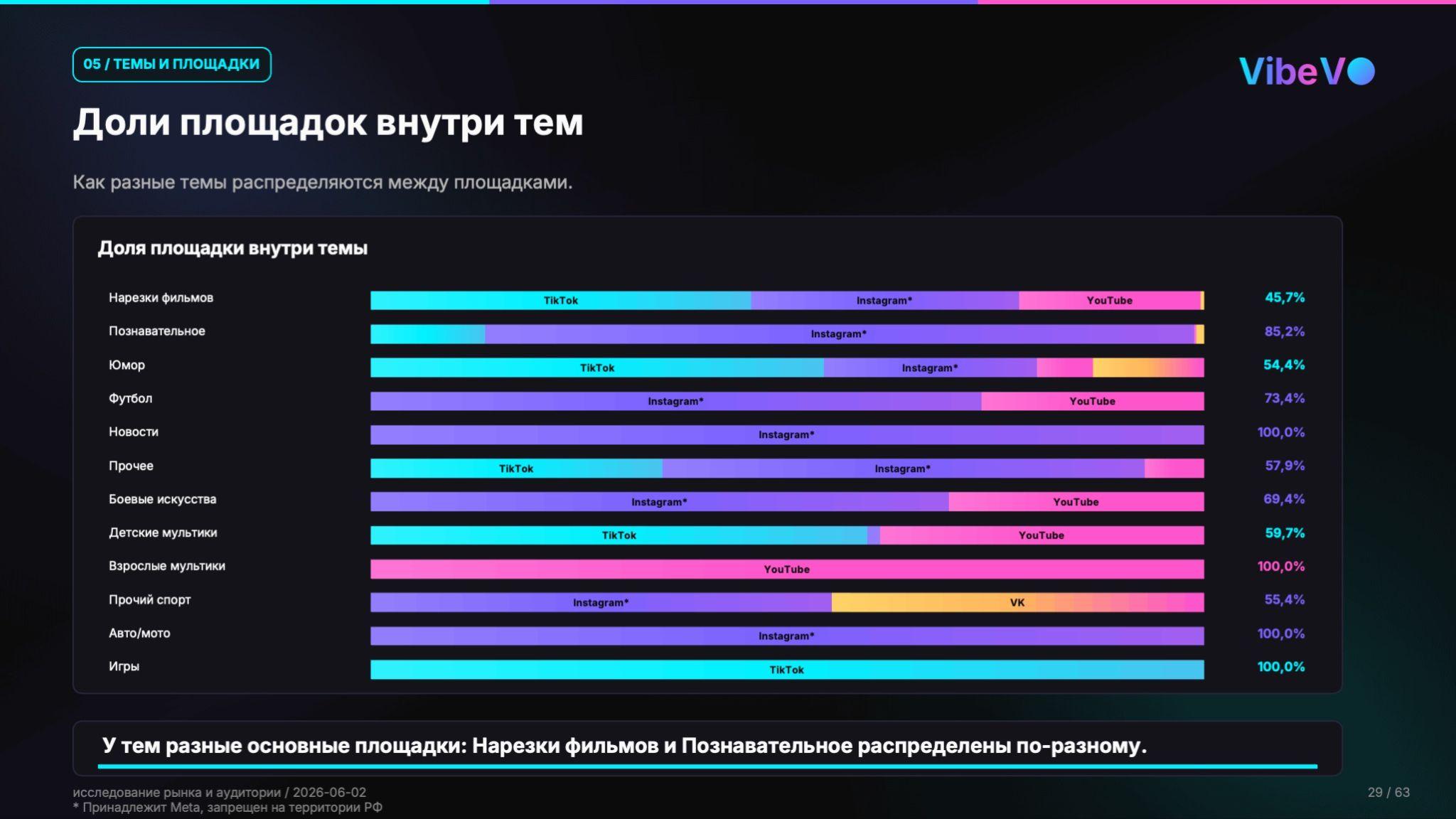
That is why video clipping cannot be launched using a single general grid for all tasks. For educational videos, auto/moto, Instagram* works better; humor, games, and movie clips rely heavily on TikTok; adult cartoons rely on YouTube. Different topics require different platforms, creators, and designs.
Chart 5. Largest topic and platform combinations: main volume arises from several combinations. Source: VibeVO data, updated 08.06.2026. Click on the chart to open it in full size.Chart 6. Platform shares within topics: different topics have different main platforms. Source: VibeVO data, updated 08.06.2026. Click on the chart to open it in full size.
Views are sharply distributed: the top portion of videos yields results
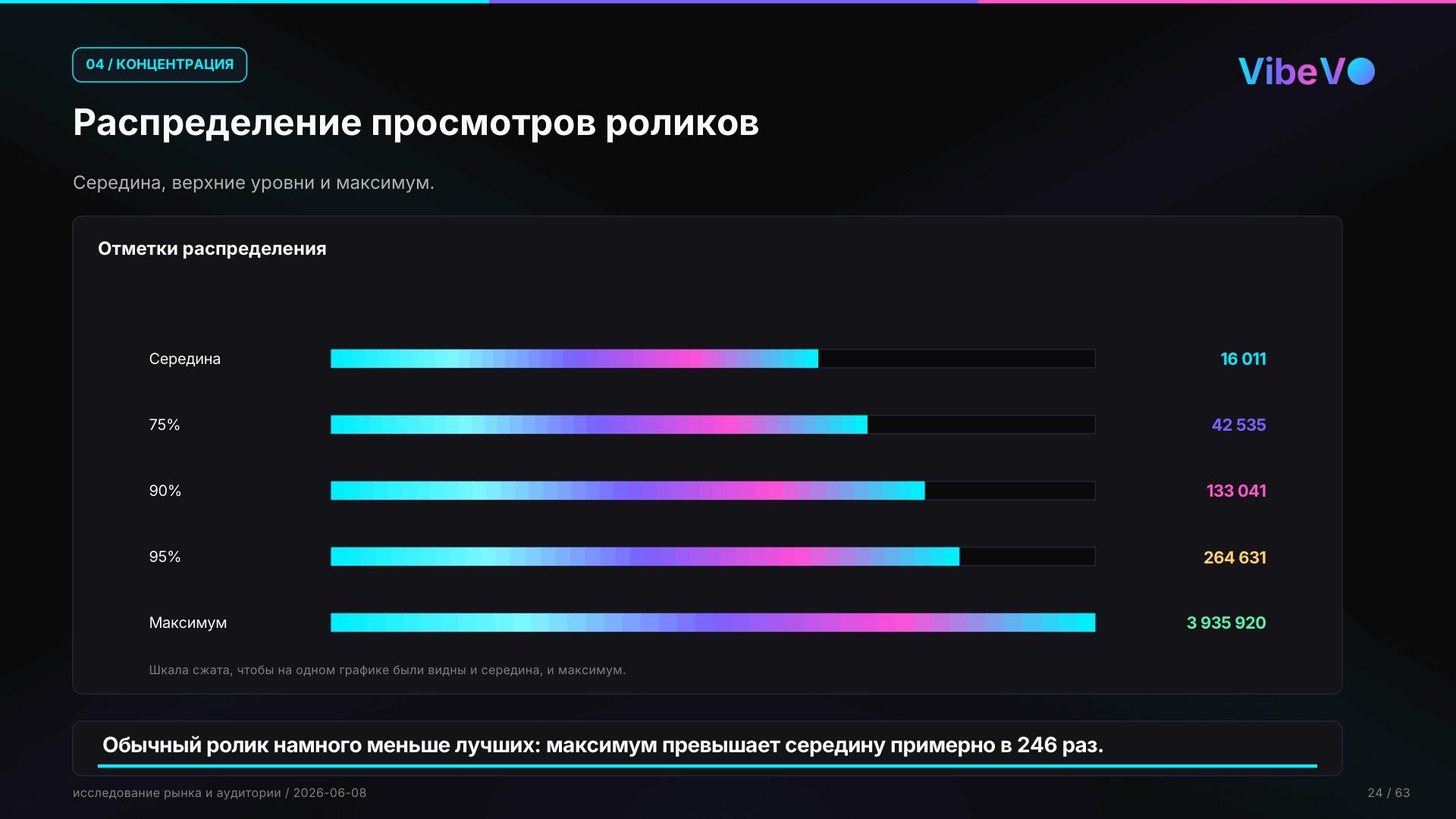
In short feeds, the average result hides a very strong unevenness. The average number of views is 16,011 views over 30 days. The 75th percentile is 42,535 views, the 90th percentile is 133,041. The maximum video garnered 3,935,920 views, which is approximately 246 times more than the median. As expected, the distribution is very uneven.
Even more illustrative is the share of the best publications. The top 10 videos generated 23.88 million views, or 9.3% of the volume. The top 50 videos – 62.48 million, or 24.3%. The top 10% of videos collected 165.54 million views, or 64.3% of all views. In other words, most views are generated by the top 5% of videos.
A practical conclusion for advertising in video clipping: you cannot rely on a single video. You need a set of video clips with different first seconds, titles, subtitles, overlays, and advertising message options. It’s not just the most beautiful video that wins, but a series of attempts where the best publications quickly gain more weight.
Tired of the routine and want to turn a long video into clips right from your mobile, without losing quality or extra effort? In this article, we will take a detailed look at the best StreamLadder alternatives for cutting streams, podcasts, and videos, so you can effectively monetize your stream through clips, by publishing them on TikTok, Reels, and Shorts. Forget the difficulties: now you can do it in 30 minutes from a 2-hour stream!
Six of the seven most well-known StreamLadder alternatives, such as Eklipse, OpusClip, Medal, Cross Clip, and Vizard, offer native applications for iOS and Android. StreamLadder itself also has a mobile app. Klap works only through a browser, and the Powder service has ceased to exist.
Most popular StreamLadder alternatives have mobile apps. Klap works only in a browser. Powder has closed and should not be included in current lists.
The main difference is “upload first” versus “connect first”. OpusClip, Vizard, and StreamLadder require a file or URL. Eklipse and Medal process videos on their side, sending ready-made clips to the phone.
Cross Clip stands out by accepting a clip URL from Twitch or Kick, eliminating the need to upload the original video.
Subtitle addition and trimming features are available in all apps. Complex highlight editing with multi-layer editing and timeline work remains the prerogative of desktop versions for now.
Direct publishing to TikTok, Reels, and Shorts is possible from Eklipse, StreamLadder, and Cross Clip.
Highlight Pipeline: How Does It Work on Mobile?
The clip creation process consists of five steps. Most applications easily handle the third and fourth stages (editing and export). However, the key point for cutting streams from a phone is the first step: how does the video get into the application?
Eklipse: Connection and Automation
“Eklipse is a breakthrough for streamers. You connect your account, and the AI automatically cuts highlights while you stream. When you pick up your phone, the clips are already waiting for you!”
Eklipse allows you to connect your Twitch, Kick, YouTube, or Facebook account. Artificial intelligence automatically detects highlights in your stream while you are still live. By the time you open the app on your phone, the clips are ready.
What you can do: Trim start/end points, edit auto-generated subtitles, crop video for vertical formats (9:16) for TikTok, Shorts, or Reels.
Export: No watermarks, saves to camera roll, can be published or scheduled immediately.
Limitations: Only works with connected platforms. Local files are not supported.
StreamLadder: Synchronization Convenience
The StreamLadder mobile app (requires iOS 17.4+) syncs with the web version. You can start a project on PC and finish it on your phone.
Publishing: Built-in Content Publisher for TikTok, Reels, and Shorts.
Additional: Montage Maker, stream schedule graphics, emotion creation from frames.
Reviews: The mobile app is less convenient than the web version; the montage builder is limited.
OpusClip: For Ready Files
OpusClip is great for cutting a podcast into video or video already on your phone. AI generates clips from a long video, which can then be reviewed, subtitled, and a template applied.
Interface: Supports eight languages.
Main Nuance: The video must be on the phone. For Twitch VODs, this means pre-downloading, which complicates the mobile workflow.
Medal: Social Network for Clips
Medal is more of a clip-sharing network than a full-fledged editor. The gameplay recording app captures video from the phone, and the social app allows you to view, trim, and share clips.
Rating: High rating of 4.8 in the iOS App Store.
Limitations: Does not convert long VODs into vertical short videos with subtitles. No auto-clipping from stream archives.
Cross Clip: Link Convenience
Cross Clip from the Streamlabs team is an underrated tool for working with phones. It accepts a clip URL from Twitch or Kick, eliminating the need to download the file.
Features: Trimming, highlight area selection, layout editing with changeable video layers.
Price: Basic features are free. Premium subscription ($4.99/month) removes watermarks, provides 1080p at 60fps, and larger uploads.
Limitations: Only works with existing clips, not 6-hour VODs.
Vizard: For Conversational Content
Vizard is positioned as a mobile tool for podcasts, vlogs, and interviews. It extracts highlights with auto-subtitles. However, users note that significant edits are best done in the web version.
Features: Optimized for conversational content, not gaming streams.
Recommendation: Use the app as a frontend for clip generation.
Klap: Browser Only
Klap does not have a native mobile app. It works through a mobile browser (klap.app), which limits integration with the camera roll and sharing features.
Powder: Service Closed
Powder has ceased operations. Any lists of alternatives that include it are outdated.
Two Types of Workflows: Which to Choose?
At the core of all these tools are two approaches:
Connect-first: Eklipse, Medal. The service stores your video, and your phone acts as a viewer with editing features. You don’t need to move large files. This is ideal for multi-hour streams when you only have your phone.
Upload-first: OpusClip, Vizard, the StreamLadder app, and Cross Clip (in file mode). You provide the video yourself. This is convenient if the video was shot on your phone or if it’s short. For Twitch videos, this can be problematic.
Cross Clip, with its URL paste function, is a hybrid: architecturally it’s “upload-first,” but it feels “connect-first” if you need an existing clip.
Frequently Asked Questions
Does StreamLadder have a mobile app?
Yes, StreamLadder has apps for iOS (requires iOS 17.4+) and Android. Clips and projects sync with your streamladder.com account, allowing you to add subtitles, stickers, and publish content directly from your phone.
Can I fully cut a Twitch VOD from my phone?
Yes, but only with tools that read VODs from your connected account, rather than requiring you to upload them. Eklipse offers such a feature. “Upload-first” tools require you to first get the file onto your device, which is a stumbling block for phone-only workflows.
Which mobile clipping app is free?
The basic features of Cross Clip and Medal are free, with paid plans for watermark removal and higher export quality. OpusClip and Vizard operate on a monthly credit system. Klap does not have a free permanent plan or an app.
Is there a StreamLadder alternative specifically for Android?
All mentioned apps, except Klap, are available on Google Play. These include Eklipse, StreamLadder, OpusClip, Medal, Cross Clip, and Vizard. They allow for 9:16 cropping from horizontal and other features.
Does Powder still work?
No, the Powder service has ceased to exist.
Conclusion and Call to Action
Choosing the right tool for cutting streams from your phone depends on where your source material is located. If your video is stored in your Twitch, Kick, or YouTube archive, and you want to get clips without opening your laptop, choose tools with a “connect-first” feature. Connect your account, and let the clips wait for you when you pick up your phone.
Don’t miss out! Create an Eklipse account, connect your channel, and check the app after your next stream. You don’t have to be a professional streamer to create amazing gaming clips. Let Eklipse AI automatically detect your best moments and turn them into epic highlights! Free clips are available.
Are you tired of spending hours searching for highlights in multi-hour streams? In a world where stream cutting has become an assembly line for audience growth, choosing the right tool is critical. We will break down the best AI editors so you can package your raw footage into highlights 10 times faster, without watermarks and with maximum efficiency. The main thing is to choose a tool based on your content type, not just a list of features.
Why does the choice of AI editor depend on the source material?
Many reviews miss a key point: each AI editor is designed for a specific type of content. The wrong choice will lead to a waste of time and money. Most AI editors charge based on the duration of the uploaded material, not the number of clips obtained.
For example, a 6-hour stream can “eat up” your entire monthly credit limit.
Key takeaways on AI editors:
Input duration-based pricing: AI editors like OpusClip charge 1 credit per minute of uploaded video. A 6-hour stream will require 360 credits with a Pro plan of 300 credits for $29/month.
Speech dependency: Editors based on transcription (Descript, OpusClip) work great for podcasts but are useless for silent gameplay.
Canva for brands: Good for short branded videos, but has limitations (up to 20 audio clips, AI clips of 6-8 seconds).
Eklipse – leader for gaming: The only one of the five with native game event detection. Clip generation requires a paid plan.
Overview of the best AI editors for video cutting
Each of these tools answers the question: how does it determine which seconds are worth keeping? The answer to this question determines its effectiveness for your content.
Eklipse: For gaming streamers and VODs
Best use case: transforming VODs from Twitch, Kick, or YouTube into vertical clips without manual review of the recording.
Best use case: cutting long interviews, podcasts, or webinars into short vertical clips.
Strengths: Excellent clip selection based on speech. Automatically centers the speaker in the frame.
Limitations: Billing based on the duration of the uploaded video. A 6-hour stream can exceed the monthly credit limit. The free plan is limited to 60 minutes per month.
Ideal creator: Podcaster or interviewer working with recordings from 30 to 90 minutes.
Descript: For educational and scripted videos
Best use case: tutorials, courses, and any content where words come first.
Strengths: Video editing via transcription is an intuitive process. Deleting sentences in the text automatically removes them from the video. The filler word removal feature saves hours.
Limitations: Prices have increased. Limited transcription hours on plans. The free plan exports 720p with a watermark. Requires speech.
Ideal creator: Teacher or solo author whose videos start with a script.
Canva: For branded content
Best use case: Branded social media videos where consistency is more important than in-depth editing.
Strengths: Branding kits, shared templates, free tier with 1080p watermark-free export. Ideal for marketing teams.
Limitations: Limited video editor functionality (up to 20 audio clips, 6-8 second AI clips). Runs slowly on long projects.
Ideal creator: Small marketing team creating consistent, branded content.
How to choose an editor by content type?
The choice of tool should be determined by your workflow and content type.
Streamer: You need highlight detection first, editing second. Eklipse is ideal, CapCut for refining individual clips.
YouTuber: If you’re repurposing long videos into Shorts, start with OpusClip or Descript, using CapCut for final touches.
Podcaster:Descript, without hesitation. Transcription-based editing matches your logic.
Marketing team:Canva. The value is in brand management and shared templates.
If you spend more time looking for clips than creating them, you have a detection problem. If it’s on subtitles and transitions, it’s an editing problem that CapCut or Canva will solve for a fraction of the cost of an AI plan.
Frequently Asked Questions
Which editor is best for cutting game clips?
Eklipse. It’s the only one that analyzes game events and audio peaks, not just speech. This allows it to find highlights even in silent game moments where other editors are powerless. This is important if you want to cut without losing quality.
Can AI automatically resize videos for Reels and Shorts?
Yes. OpusClip, Descript, Eklipse, and CapCut can convert horizontal video to 9:16 format. Quality varies, but most tools can track an object so that the cropping follows the action.
What is the difference between a TikTok editor and a social media editor?
A TikTok editor is optimized for one platform: vertical cropping, trending audio, native subtitles, and short attention spans. A social media editor covers multiple platforms, including horizontal and square formats, brand management, and post scheduling. CapCut is TikTok-focused, while Canva and Descript are multi-platform.
How long does it take to cut a stream?
With the right AI tool, such as Eklipse for game streams, you can get bulk cuts of 100+ clips in minutes after uploading, significantly reducing the time a person who cuts streams would spend manually.
Conclusion
Choosing the right AI editor for stream and podcast clipping is not about finding the “best” tool, but about finding the tool that perfectly matches your source material and workflow. Before subscribing, check two things: how the plan is priced (by upload duration or by clips) and whether the tool can identify moments that are important to you. If your archive consists of VODs from streams, and the problem is that good moments are lost in hours of recording, start with Eklipse. Create an Eklipse account and scan your stream to get your first clips for free and start monetizing your content today!
The era of fragmented queries is fading. Data from a year of Google’s AI search mode shows: users are asking complete questions, not fragments of phrases. This is critically important for stream highlights and any other content: now the main information should be at the beginning so that AI algorithms can instantly extract it and present it in their reviews. If you bury the essence in long introductions, your content risks going unnoticed.
Evolution of Search: From Keywords to Dialogue
Since the launch of AI mode, user queries have fundamentally changed. According to Shivani Mohan, Google’s VP of Data Science, AI mode has reached 1 billion active users per month. But it’s not just about the increase in the number of queries.
Query length has tripled: The average query in AI mode in the US is three times longer than traditional queries.
Multimodal search: More than 1 in 6 queries now include images, voice input, or interactive dialogue.
Growth of images: Image-based queries are growing by 40% monthly.
Follow-up questions: Users ask clarifying questions, indicating the depth of their search.
The most common first words in AI mode queries are “what,” “how,” “I,” “is,” and “can.” This demonstrates a shift from searching by individual words to task- and question-oriented search, similar to communicating with a human.
Five User Behavior Modes in AI Search
Mohan identifies five main user behavior modes, each requiring a specific approach to content:
Explore: Open-ended queries for brainstorming. Growing 30% faster than overall AI mode traffic.
Decide: Queries with comparison words (“which of,” “which one”). Growing 40% faster.
Learn: Understanding new concepts and professional development.
Create: Queries for image creation have tripled since the beginning of the year.
Do: Planning (workouts, travel, budgets). Growing 80% faster in the last six months.
“This is not just a change in ranking factors; it’s a transformation of user behavior. If you’re still building content around keywords, that model is rapidly becoming obsolete,” says Greg Jarboe.
To make your content effective in the new reality of AI search, follow these five steps:
1. Start with the main point
Place the main definition, key metrics, or main conclusions directly in the first sentence of each main section. This allows AI algorithms to quickly extract the necessary information.
2. Use specifics
Formulate sentences with specific brand names, geographical markers, exact dates, and verified numerical values. Avoid vague generalizations so that your text is “mathematically readable” for search engines and reduces the risk of AI “hallucinations.”
3. Structure for scanning
Organize the main text into short paragraphs (2-3 sentences). After section headings, use brief summaries, ordered lists, or structured tables. This facilitates segment extraction for AI and ensures readability for humans. This is especially important for mass cutting of 100+ clips, where each fragment must be self-contained and informative.
4. Prepare answers to follow-up questions
If multi-turn dialogues are growing by 40% per month, your content should answer the second and third questions a reader will ask after the first. Structure long content so that each section can serve as an answer to a specific follow-up question. This increases the likelihood that this particular “chunk” will be provided by the AI mode. For cutting game streams, this means creating clips that answer specific viewer questions.
5. Optimize multimodal content
With the growth of image queries (40% monthly) and a threefold increase in image creation requests, alt-text, image context, and visual content quality are becoming key ranking factors. They are no longer secondary but are part of what the AI mode reads.
Conclusion: From “assembly line” to “smart content production”
Success in modern SEO is not about flooding the internet with templated texts, but about mastering structural clarity that provides immediate and verified benefits to both algorithms and readers. Just as 19th-century journalists adapted to the telegraph, we must rethink our approach to content creation for the AI era. Cutting streams without losing quality, creating highlights, and cropping 9:16 from horizontal — all this requires not just technical skills, but also a strategic approach to information delivery. Remember that the person who cuts streams must now think like an SEO specialist so that every Twitch clipping or podcast video cutting works as effectively as possible to attract an audience. Contact us to find out how we can help you with this.
Frequently Asked Questions
How long does it take to cut a 2-hour stream?
The cutting time depends on the complexity of the content and the desired number of highlights. On average, professional cutting without loss of quality of a 2-hour stream into 5-10 clips can take from 1 to 3 hours, including adding subtitles for cuts and optimization. If you need bulk cutting of 100+ clips, automated tools such as Opus Clip analog service are used, which significantly speed up the process but require subsequent manual refinement.
What moments are usually cut from streams for highlights?
For highlight editing, the most emotional moments, key game events (e.g., “kills”, “win rates”), funny jokes, important announcements, Q&A sessions, and fragments that evoke a strong audience reaction are usually cut. The goal is to create cuts for TikTok from Twitch or YouTube that quickly grab attention.
Are subtitles needed for stream cuts?
Yes, subtitles for cuts are extremely important. They improve content accessibility, allow videos to be watched without sound (e.g., in public places), and increase engagement. In addition, subtitles contribute to better indexing of content by search engines, which is important for stream monetization through cuts.
What is the price for 1 hour of stream for cutting 20 clips?
The price for cutting 20 clips from a stream for 1 hour can vary depending on the specialist’s qualifications, the complexity of the editing, and the need to add graphics and subtitles. Approximately, the cost can range from 1000 to 3000 rubles per hour of source material, if it is a high-quality work taking into account SEO optimization and 9:16 cropping from horizontal for different platforms.
Tired of routine stream and podcast cutting? In 2026, Instagram offers new tools to increase reach and engagement without creating tons of new content. From smart TV apps to AI effects and clever audio tricks – learn how to quickly scale your presencewithout sacrificing quality.
In a world where user attention is the most valuable resource, Instagram continues to evolve, offering content creators new ways to stand out. 2026 will bring a series of innovations that will allow you not only to expand your audience but also to deepen engagement with it, using existing material. Get ready to learn how to turn your streams and podcasts into a powerful tool for growth, without drowning in endless production of new content.
Instagram TV App: A New Conveyor for Your Highlights
Instagram TV expands its presence, appearing on Samsung TVs, complementing Amazon Fire TV and Google TV. This means the app is available on most smart TVs. Setup is simple: download, scan the QR code, and your account syncs with the big screen in seconds.
How it Works and What it Means for Stream Cutting?
Personalized categories: The viewing experience is organized around interests, like on Netflix. Instagram expert Elizabeth Marberry noted a “For You” section, followed by categories based on her activity, such as “inclusive fitness,” rather than just “fitness.”
Granular categorization: The platform categorizes content very precisely based on consumption patterns. This means that your stream cuts will reach the most targeted audience.
Expert tip: Don’t try to fit into a category. It’s important to clearly define what you want to be known for. If all content consistently reinforces one theme, the algorithm will handle the categorization itself.
Stories on TV: Instagram Stories can also be watched on TV. Elizabeth Marberry describes this experience as surprisingly engaging, even for those accustomed to watching stories on their phone.
“Wide viewing on a widescreen”: The platform offers an option that displays viral horizontal videos in full-screen TV format.
Lessons from YouTube: YouTube has already paved the way for short, creator-driven videos on TV screens. Instagram is following this strategy.
“Marketers should view Instagram on TV as a viewing opportunity, not a reason for a radical overhaul. There’s no need to rebuild your content strategy. The fundamentals remain the same: a strong message, a clear customer journey, and content that grabs attention in the first few seconds. These elements work on any screen. New features won’t fix weak marketing,” advises Elizabeth Marberry.
Experiments with Horizontal Content and Reels
Who this is relevant for: Brands already producing horizontal or widescreen content (e.g., professional videographers) can experiment with uploading it to Instagram.
Trial Reels: Allow testing content with non-subscribers before full publication, minimizing risks.
Mobile features: On mobile devices, horizontal video in the standard Reels feed appears with black bars. Elizabeth recommends filling this space with text at the top and engaging questions at the bottom so that the content occupies the entire vertical frame.
Pro Tip: Reels are limited to 20 minutes for appearing in the feed. Regular posts can be up to 60 minutes. To ensure your stream highlights get maximum distribution through Reels, keep videos under 20 minutes. Instagram will warn you if the video length limits its reach.
AI Effects for Stories: How to Stand Out in the Stream
Instagram has introduced over 30 new AI effects for stories. These effects can transform photos by interpreting scene elements such as lighting, composition, and objects. Users can also create their own AI effects by entering prompts. Access them via the three-star icon on the story creation screen.
Strategy for Using AI Effects for Your Highlights
Attention-grabbing: Elizabeth sees these effects as useful “pattern interruptors,” rather than an everyday strategy. For example, during a product launch, an AI-transformed image can stand out in the stories feed.
Caution with authenticity: Stories have always been the most “raw” and authentic surface on Instagram. Adding AI effects risks undermining trust. Elizabeth agrees: stories work best for brands that show themselves unvarnished, share real moments, and communicate directly with their audience.
Frequency and Quality of Stories for Maximum Impact
Elizabeth recommends publishing five to six “raw,” spontaneous stories instead of two to three highly polished ones. Reducing friction in content creation leads to greater consistency, and consistency deepens trust. A highlight reel that looks natural will be more effective than an overly “packaged” product.
Pro Tip: The more engagement a story receives, the higher it ranks in your followers’ story feed. Conversational stories typically generate more replies and reactions, which directly impacts story visibility.
Swapping Audio and Music for Carousels: How to Get More Reach
Instagram now allows you to change audio in already published posts and carousels, while preserving all existing interactions such as likes, comments, and shares. No more deleting and re-uploading content.
Benefits of Audio Swapping for Your Edits
Solving licensing issues: If a licensed song is removed, you can simply replace it without losing accumulated engagement.
Testing: Publish a carousel with one audio, wait a few days, then replace it with another if engagement is insufficient. Audio sets the mood and tone of the content.
Important: Do not micromanage content performance on a 24-hour cycle. Some content gains momentum over several days or even weeks.
Music in Carousels = Reels Reach
Instagram announced that when music is added to a carousel, it now appears in the Reels tab. This is a significant change for Instagram reach. Carousels have traditionally been strong for retaining existing followers but limited in reaching new audiences. The Reels feed remains the primary surface for growth in visibility and discovery on Instagram.
Maximum reach: By adding music, a carousel can appear in both the standard feed and the Reels feed, expanding its potential reach.
Subtitles are critical: Elizabeth emphasizes the importance of subtitles for any content with speech. A significant portion of Instagram users view content without sound.
Pro Tip: To unlock Instagram’s full music library, change your account category to “digital creator” or “entrepreneur.” This can be done in “Edit Profile” > “Category.”
Carousels with Multiple Captions: A New Level of Storytelling
Instagram recently introduced carousels with multiple captions, allowing you to add a separate caption to each slide, rather than using one general caption for the entire post.
How to Use This for Your Edits and Highlights
Photo dumps and behind-the-scenes moments: Ideal for “photo dump” formats or behind-the-scenes reviews. For example, a conference speaker can accompany each photo with a short story.
Deeper Storytelling: This feature opens up opportunities for deeper storytelling. Carousels already limit the amount of text on each slide; adding captions to each slide provides an additional layer of context, narrative, and calls to action.
Important: Just because Instagram provides another field to fill doesn’t mean every post needs it. Multi-caption carousels require “hooks” for each slide caption, increasing production effort. Evaluate whether the extra work serves a strategic purpose.
Caption Tip: The first line of a caption determines whether someone will read further. The most engaged users will read the full caption, so a strong call to action at the end is worth including. Even a simple engagement question like “Have you encountered this?” can generate significant comment activity.
Frequently Asked Questions
How Long Does It Take to Cut a Stream?
The time it takes to cut a stream depends on its length and the desired number of highlights. On average, cutting a 2-hour stream to create 5-10 clips can take from 30 minutes to 2 hours, if efficient tools are used and key moments are identified beforehand. For mass cutting of 100+ clips from long streams, automated services or a team will be required.
What Moments Are Usually Cut from Streams?
The most vivid and emotional moments are usually cut from streams: funny or awkward situations, key gaming events (killstreaks, victories), important announcements, answers to viewer questions, moments of maximum engagement, and unexpected twists. Educational highlights or fragments with expert opinions are also popular.
Are Subtitles Needed for Cuts?
Yes, subtitles for cuts are critically important. Many users view content without sound (on public transport, at work). Subtitles significantly increase the accessibility and understanding of your content, which directly affects engagement and reach. Instagram also values content with subtitles.
How Much Does It Cost to Order 20 Clips from a Stream?
The price for cutting 20 clips from a stream can vary greatly. It depends on the duration of the source material, the complexity of the editing, the need to add graphics, subtitles, and the urgency of the work. On average, the services of a person who cuts streams can cost from 500 to 5000 rubles per hour of source material or a fixed rate for a set of clips (for example, from 3000 to 15000 rubles for 20 high-quality clips).
Conclusion: Your Content Conveyor of the Future
Instagram is actively developing tools to expand reach, and 2026 brings many opportunities. From cutting streams without loss of quality to using AI effects and audio tricks, each tool is designed to help you package your raw material into attractive highlights. Don’t forget the importance of subtitles and experiment with formats. Use these updates to monetize your stream through cuts and attract a new audience. Start applying these strategies today so that your content doesn’t just exist, but truly works for you!
85% of marketers already use AI for content creation. But which tools are truly worth your time? We’ve gathered the best AI tools for social media in 2026, along with expert tips on how to choose the right one for your team.
The market is flooded with options, and without a clear plan, it’s easy to get lost. In this guide, we’ll break down the key categories of tools—from text generation to publication automation—and help you build your own stack for efficient work.
Best AI tools for writing texts and captions
For creating social media texts, Jasper, Anyword, and Claude stand out. Here are their key features:
Jasper
Jasper helps marketing teams create content in a consistent brand style. It stores tone and voice guidelines in one place and applies them across all campaigns.
Best for: enterprise teams working with multiple brands or markets.
Price: from $69/month per user with annual billing.
Important: Jasper does not publish content—you’ll need a separate scheduling tool.
Anyword
Anyword predicts content performance before publication by assigning it a predictive score. This allows you to assess potential audience response in advance and adjust your strategy.
Best for: performance marketing teams in mid-sized and large businesses.
Price: from $39/month with annual billing.
Important: limits on predictions on lower-tier plans.
Claude
Claude is a versatile AI assistant for generating ideas and drafts with natural language. It’s great for brainstorming and creating first versions of posts.
Best for: solo marketers and teams of any size.
Price: free plan available, paid from $17/month.
Tip: give Claude quality source material, otherwise you’ll get vague text.
Best AI tools for visual design
Canva, Adobe Express, and Ideogram are top choices for creating graphics. Visual content plays a crucial role in engagement, so choosing the right tool is critical.
Canva (Magic Studio)
Canva with Magic Studio lets you generate images from text descriptions, resize designs for different platforms, and edit photos without professional software. It’s a versatile solution for teams without a designer.
Adobe Express, powered by Firefly, is trained on licensed content (Adobe Stock), making it safe for brands. This is a key advantage for companies concerned about legal content purity.
Price: free plan, paid from $9.99/month.
Nuance: advanced Firefly features are in Photoshop and Illustrator, where the learning curve is steeper.
Ideogram
Ideogram excels at generating images with readable text — perfect for memes and announcements. This is a rare capability among AI generators, making it indispensable for certain tasks.
Price: free plan, paid from $15/month.
Privacy: on the free plan, works are added to the public gallery.
Best AI Tools for Video Repurposing
OpusClip and Riverside are leaders in turning long videos into short clips. This saves hours of manual work and allows you to maximize every hour of recorded material.
OpusClip
OpusClip automatically finds strong moments in long videos, cuts them into clips for Reels, TikTok, and YouTube Shorts, and adds subtitles. Algorithms analyze speech and dynamics to select the most engaging fragments.
Price: free plan with watermark, paid from $15/month.
Credits: roughly 1 credit per minute of video — long videos quickly exhaust the limit.
Riverside
Riverside is a recording studio and repurposing tool: record podcasts and interviews in 4K, then cut clips. The built-in editor allows you to quickly create publish-ready videos.
Price: free plan, paid from $24/month.
Tip: works best if you also record content in Riverside.
Tools Combining Creation and Publishing
Perch by Hootsuite, Buffer, and SocialBee are the best at combining creation and scheduling. They address the need for a unified workflow, eliminating the need to switch between different services.
Perch by Hootsuite
Perch is a platform for creating, scheduling, and publishing content with the AI agent Wisdom. It is the only tool that takes a post from draft to publication in a single workflow, significantly speeding up processes.
Price: from $99/month per user, free trial available.
Integrations: Canva, Adobe Express.
Buffer
Buffer is simple scheduling with an AI assistant for adapting texts to different platforms. Ideal for small teams that need a minimalist and intuitive interface.
Price: Free plan, paid from $5/month per channel.
Nuance: Price increases as you add channels.
SocialBee
SocialBee organizes and repurposes evergreen content on a schedule. This allows you to maintain a consistent social media presence without creating new posts daily.
Price: From $24/month.
Feature: Requires more setup due to categories and queues.
Expert Tips for Choosing an AI Tool
Professionals recommend the following:
Start with the problem, not the tool. Kayla Bautista (NP Digital) recommends asking: “What problem are we solving?” This helps avoid buying unnecessary software.
Make sure the tool understands social media. Christina Botte (EGC Group) checks whether the AI knows platform specifics, such as hashtags, formats, and audience behavior.
Look for built-in brand controls. Lindsay Wallace (IntraTEM) emphasizes the importance of a unified design system with a brand book, so content always matches the brand style.
Weigh accuracy against correction time. Sarah Bell (Personalized Creative) advises: “If fixing takes longer than saving, we don’t use it.” Evaluate the real time savings.
Check integration with your stack. Alexandra Novikova (Truck1) recommends tools that connect to CRM and schedulers, so data syncs automatically.
The best tools: Jasper, Anyword, Claude for texts; Canva, Adobe Express, Ideogram for visuals; OpusClip, Riverside for video; Perch, Buffer, SocialBee for publishing.
Are free AI tools enough?
Free plans are suitable for basic tasks but have limitations (watermarks, limits). For serious work, paid plans are better, offering more features and removing restrictions.
How does Hootsuite compare to standalone AI tools?
Hootsuite (Perch) combines creation, scheduling, and publishing in one place, whereas standalone tools require integration. This saves time switching between services and simplifies process control.
How do AI tools for social media work?
They use machine learning to generate text, images, videos, and schedule posts based on your data and goals. Models are trained on vast datasets and adapt to your tasks.
Can AI tools help with social listening?
Yes, some tools like Hootsuite include AI analytics to track mentions and sentiments. This allows you to respond quickly to feedback and manage brand reputation.
Conclusion
The choice of an AI tool depends on your tasks. Start by defining the problem, test the tools on real tasks, and make sure they integrate with your stack. Use free trials to assess how much time the tool saves.
Remember that AI is an assistant, not a replacement for strategic thinking. The best results are achieved by combining human expertise with machine efficiency. And if you want to simplify the process as much as possible, try Perch by Hootsuite — create, plan, and publish content in one place.
Ready to take your content to the next level? Start with a free trial and feel the difference today.
Trust is the main KPI in the creator economy: insights from YouTube and Adam W
At a closed meeting of The Made You Look Tour in Los Angeles, senior marketers heard from a top creator and the head of YouTube’s ecosystem about why trust is becoming a key performance indicator in the creator economy. 25 participants, no recordings — only a live conversation about how to build partnerships that actually work.
In an era when consumers are tired of intrusive advertising, it is authentic creator voices that become the bridge between brand and audience. But how do you measure what cannot be expressed in numbers? The answers are in this material.
The creator economy ecosystem is fragile, and that’s okay
Scott Sutton, CEO of Later, opened the session with an important message: the industry is still young, and all parties — brands, creators, platforms — are building it simultaneously. “This is truly a community, an ecosystem, and it is quite fragile,” he emphasized.
That is why the format of a meeting with a limited number of participants and no recording allows for discussing problems rather than just extracting profit. In such an atmosphere, honest conversations are born about what really matters.
“If you focus on value, it doesn’t matter who we were ten years ago or who we will be in five years” — Andrew Peterson, head of the creator economy ecosystem at YouTube.
Value matters more than format: a lesson for brands
Andrew advised brands to choose value for the audience rather than chase trends. This is what allowed YouTube to grow in connected TV, on-demand, and short-form without losing focus.
For marketers, this means: first determine what you give viewers, then choose the format. Not the other way around.
Reconsider what “good” view counts mean
Many marketers underestimate scale. Andrew gave an example: 180 views for a beginner is not a failure, while 20 million is the population of Oregon.
“What room have you been in with 180 people where that seemed small?” he asked. Every view is a person, and the real reach of creators is almost always higher than it seems at first glance.
Subscribers ≠ community: the difference between Instagram and YouTube
Adam W, a creator with 21K+ subscribers, clearly distinguished platform audiences. On Instagram and TikTok — passive scrollers; on YouTube — a community that notices details and genuinely takes an interest in the personality.
“There is a difference between a million views from random people and a million from those who are truly engaged with you,” Adam explained. This directly affects conversion: a community is more willing to click and buy.
Adam emphasized that audience growth requires both consistency and content value. “It’s quality and quantity: publishing content consistently, but making it useful at the same time,” he said.
Scott criticized the habit of equating a creator’s view with a banner impression. “A view is not an annoyed consumer with a blocked experience, but a fan who opens something interesting from someone they love,” he noted.
Mixing these metrics means undervaluing creator content and making wrong strategic decisions.
Brand at the End of the Joke: Adam’s Method
Adam shared his technique: he looks for the most relatable conflict around the product, builds a story or joke, and only then “lets in” the brand as the solution.
Example with Old Spice: a video built on the problem of odor gained 255 million views without advertising. Meanwhile, product placement at the beginning often fails.
Choice: Bring the Creator into Your World or Enter Theirs
Andrew proposed a key strategic question: “Are you trying to bring the creator into your world or enter theirs?” Both approaches work but require different implementations.
The Old Spice example is entering the creator’s world, which can be uncomfortable for brands used to controlling the message.
The Truth About the Brand from Creators
Scott noted that brands do not control perception: “You think you own the brand, but the consumer owns the perception.” Creators, being closer to the audience, often see the truth better.
Example with New Balance: the brand became desirable by listening to external opinion rather than fighting it.
Optimizing for AI Search: Trust Decides
Andrew suggested replacing the word “algorithm” with “audience.” YouTube recommends content that brings maximum value, and 78% of viewers trust creators in product recommendations.
LLMs also choose reliable sources, so authentic creator voices are already appearing in AI outputs — brands should invest in such partners.
Meet the Audience Everywhere
Andrew described his day: Shorts on the go, a podcast in the evening, a documentary on TV. Brands should think about the audience and story, then adapt the format to each moment.
Scott added that creators now participate in brand strategic planning, not just in one-off campaigns.
Frequently Asked Questions
What is The Made You Look Tour?
It is a series of closed meetings for senior marketers where the future of the creator economy is discussed. Participation is by invitation only, with no recording.
Why is trust the main KPI in creator marketing?
Because 78% of viewers trust creator recommendations, and this trust converts into purchases better than traditional advertising.
How should a brand choose between its own world and the creator’s world?
You need to consciously decide: bring the creator into your context or integrate into theirs. Both approaches work but require different creative strategies.
Conclusion
Trust is the currency of the creator economy, and it must be built through value, consistency, and a willingness to let go of control. Brands that understand this are already gaining a competitive advantage today.
Want to create partnerships that truly work? Request an invitation to the next tour or discuss a strategy with our team.
Stream clipping is not just editing, but a whole pipeline for producing short viral videos. Streamers and podcasters spend hours on live broadcasts, but it’s the highlights that bring in new viewers and monetization. In this article, we’ll break down how to quickly and efficiently clip a 2-hour stream, which moments to cut first, and whether subtitles are needed.
Why Stream Clipping Matters
According to statistics, 80% of viewers discover new streamers through short clips on TikTok and YouTube Shorts. Long broadcasts stay in the archive, while clips keep working for you 24/7. For example, Erling Haaland, a Norwegian footballer, grew on YouTube thanks to translating his videos into 44 languages — that’s also a form of content clipping.
Stream clipping is not just editing, but a whole pipeline for producing short viral videos. Streamers and podcasters spend hours on live broadcasts, but it’s the highlights that bring in new viewers and monetization. In this article, we’ll break down how to quickly and efficiently clip a 2-hour stream, which moments to cut first, and whether subtitles are needed.
Which Moments to Cut First
Experienced clippers know: not all moments are equally useful. Here’s a list of what makes it into highlights:
Chat interaction: when the streamer responds to donations or jokes with viewers.
Exclusive news: announcements, trend discussions.
Controversial or funny moments that could become memes.
For example, Addison Rae got a skin in Fortnite — that’s an event that can be turned into a clip with the streamer’s reaction. Such clips rack up millions of views.
How Long Does It Take to Clip a 2-Hour Stream
Manually clipping a 2-hour stream takes 2 to 4 hours. But with automation tools like Opus Clip or AI-powered services, you can cut that time down to 30 minutes. Algorithms automatically find the best moments, add subtitles, and crop the video to vertical 9:16 format.
For example, the DittoDub service helped Haaland translate content into 44 languages, which speeds up the localization process for clips. If you want to order 20 clips from a stream, it’s better to delegate this to a professional or use AI tools.
Do You Need Subtitles for Clips
Subtitles are a mandatory element. According to research, 85% of TikTok videos are watched without sound. Subtitles increase engagement by 40% and make content accessible to people with hearing impairments. Automatic subtitles can be added in CapCut or through services like Submagic.
It’s important that subtitles are large, contrasting, and appear in sync with speech. This increases watch time and viewer retention.
How to Cut a Stream for TikTok and YouTube Shorts
The 9:16 format is the standard for TikTok, Reels, and Shorts. Here’s a step-by-step guide:
Download the stream recording in original quality.
Import the video into an editor (CapCut, Premiere Pro).
Find the best moments using markers or AI analysis.
Crop the horizontal video to vertical, highlighting the main subject.
Add subtitles and dynamic effects.
Export at 1080×1920, add a cover and description.
Automatic stream clipping is a trend of 2024. Services like Opus Clip and Klap allow you to mass-produce 100+ clips in one click. This is ideal for those who want to monetize streams without extra effort.
Price per 1 Hour of Stream: What Freelancers Offer
The cost of clipping a stream depends on complexity and the number of clips. On average, freelancers charge from 500 to 2000 rubles per hour of source material. If you need clips with subtitles, color correction, and sound design, the price rises to 3000-5000 rubles. You can order 20 clips from a stream on freelance marketplaces or from specialized studios.
Some streamers hire a permanent clipper who works for a percentage of income. This is beneficial if clips generate steady traffic.
Tools for Automatic Clipping
If you don’t want to hire a person, use AI services. Here are the top 3:
Opus Clip — finds viral moments, adds subtitles and emojis.
Klap — analyzes speech and creates clips with dynamic scenes.
Vizard — automatically crops video and generates titles.
These tools save time and allow you to scale content production. For example, a streamer can cut 100+ clips in an hour without spending effort on manual editing.
Monetizing a Stream Through Clips
Clips are an additional source of income. You can earn from:
Advertising on YouTube Shorts and TikTok (partner programs).
Sponsored integrations in clips.
Selling merch through the description.
Attracting new subscribers to Twitch and YouTube.
For example, Liquid Death launched a drink inspired by MrBeast’s product, and it caused a stir. Similarly, a clip mentioning a trending brand can attract sponsors’ attention.
Frequently Asked Questions
How long does it take to clip a 2-hour stream?
Manually — 2-4 hours, with AI services — 30 minutes.
Are subtitles needed for clips?
Yes, they increase engagement by 40% and are necessary for viewing without sound.
What format is best for TikTok?
Vertical 9:16, resolution 1080×1920.
How much does it cost to have a freelancer clip a stream?
From 500 to 5000 rubles per hour of source material, depending on complexity.
Which automatic clipping services are the best?
Opus Clip, Klap, Vizard — they save time and create viral clips.
Conclusion
Stream clipping is not a luxury but a necessity for channel growth. Use automation to package content into highlights and attract a new audience. Start small: pick the 5 best moments from your last stream and make clips. In a month, you will see growth in views and subscribers.
If you are tired of manual work, order clipping from a professional or try an AI service. The main thing is to act quickly, like a conveyor belt. Good luck with clipping!
AI video editing removes two of the four layers of work and barely touches the other two. It eliminates the search for good moments and makes transcription, subtitles, and reformatting nearly free. But it doesn’t decide where to start a clip, nor does it evaluate whether it’s worth publishing. This division is the whole point, and almost no one sells it honestly.
In this article, we’ll break down what exactly AI automates, where its capabilities end, and how to use the saved time to create content that truly retains viewers.
Four Layers of Video Editing and Which Two AI Removes
Editing long videos into short formats involves four tasks: search, mechanical transformations, assembly, and evaluation. Search is reviewing hours of footage for valuable moments. Mechanical transformations are transcription, subtitles, vertical cropping, silence trimming, and audio leveling. Assembly is choosing entry and exit points, and the clip’s structure. Evaluation is understanding which clip deserves publication.
AI excels at search and mechanical transformations but is useless in assembly and evaluation. This division is key to understanding: the hours you used to spend on the first two layers can now be directed to the last two.
Layer 1: AI Editing Kills the Search Phase
Manual search scales linearly with video length, while automated search is almost constant. Detection models scan multi-hour recordings in 15–20 minutes and return a shortlist of moments. This breaks the limitation where a streamer who broadcasts more has less time for publishing.
Sam streams about 20 hours a week and used to publish two clips. It wasn’t a discipline issue: watching 20 hours to find six clips took more time than the stream itself.
Layer 2: Mechanical Work Is Now Nearly Free
Transcription is solved. Subtitles from transcription are solved. Cropping 16:9 to 9:16 with object tracking is solved. Silence trimming and audio leveling are solved. These tasks weren’t intellectually complex, just slow. Tools like Eklipse Studio combine the entire layer into a single pass.
Two points require attention: subtitle accuracy drops when background music is louder than the voice, and auto-cropping may track the wrong object in shots with divided attention.
Detection models are trained on discrete events, so they cut a window around the moment. But viewer retention in short formats is decided before that moment. YouTube reports that the decision to “watch or swipe” is made in the first frames, and TikTok claims that 90% of memorability comes in the first six seconds.
The model might give you a clip starting at the clutch resolution, when the viewer would have been held four seconds earlier, where three teammates died and you were left with 14 HP. The model doesn’t see the absence of an event — this is a structural limitation, not a maturity issue.
Layer 4: Evaluation Is Not Passed to AI
No model knows whether your clip is funny. It knows that the audio rose. These things overlap enough to find moments, but not to choose between them. Posting everything the model returns trains the recommendation system on the weakest content and drags down the reach of strong posts.
Nadia posted all 12 AI-generated clips, thinking volume was the goal. By cutting down to three per session and spending time on entry points, she began publishing four times less, but each post had a reason to exist.
Why AI Editing Advantages Are Becoming the Standard
Platforms are absorbing the first two layers. At TwitchCon Rotterdam, Twitch announced Auto Clips — automatic clips with subtitles based on chat activity, intonation, and on-screen events. 85% of streamers get a clip after every stream. Subtitles and vertical format have also become built-in.
This is not a reason to abandon third-party tools, but a reason to understand what you’re paying for: multi-platform support, detection across the entire VOD, deep edits, and control over assembly. Everything sold as “subtitles and cropping” will soon become a platform feature.
Where AI Editing Quietly Fails: Genre Dependence
Detection accuracy heavily depends on the game genre. Event-based models work well in shooters and battle royales, where kills and wins give clear signals. In strategies, simulators, and narrative games, accuracy drops, as tension builds over minutes and doesn’t produce spikes.
New models cover Just Chatting, IRL, and podcasts by reading emotional peaks. A practical rule: if the game has a kill feed or a victory screen — expect good detection and spend time on assembly; if not — look for it yourself.
Frequently Asked Questions
Can AI edit videos completely on its own?
No. AI reliably finds moments, transcribes, makes subtitles, crops, and cuts silence. But it doesn’t choose where to start a clip, doesn’t evaluate whether to publish, and doesn’t structure the sequence — that determines success.
Does AI editing really save time?
Yes, significantly, and it changes what time is spent on. Manual searching scales with video length, while automatic searching is almost constant. The hours saved are better spent on entry points and curation, rather than increasing the number of posts.
Can AI replace a human editor?
For extracting clips and formatting—yes. For narrative structure, comedic timing, or taste—no. Most creators don’t need an editor for the first category, and the second can’t be obtained from a tool at any price.
Why does AI pick uninteresting clips?
Because it detects events, not evaluates them. A sound spike is the same whether you laughed or a dog knocked over a lamp. Treat the output as a shortlist for curation, not finished clips.
Will Twitch’s built-in tools make AI editors unnecessary?
For basic clips with subtitles from a live stream—mostly yes. Third-party tools remain useful for detection across the entire VOD, multi-platform support, deep edits, and for streamers on Kick or YouTube.
What to do with the time AI gives you
AI editing is a solution to the labor problem dressed in quality clothing. It removes the search and makes the mechanics nearly free. For those who stream more than they can watch, this changes everything. But it doesn’t solve everything. Assembly and evaluation remain where they were, and now they are the only layers where one creator can outperform another.
The practical step is simple: let detection create a shortlist, spend the saved hours moving entry points earlier and cutting clips that a stranger wouldn’t understand. Don’t consider post volume a measure of success. If you want a shortlist waiting for you after your next session, connect Twitch or Kick and start clipping. You don’t need to be a streamer to create stunning gaming clips—Eklipse will automatically find the best moments.