Data cut-off 03.09.2026. CPV = CPM ÷ 1,000. This is a reward rate with eligibility conditions and limits, not the actual cost of the entire campaign. Fund does not equal expenses. Views are a total counter, not unique reach; approved works are counted separately. Views do not equal unique reach or sales. Conclusions about marketing mechanics are editorial analysis; the presence of a campaign around a brand does not necessarily mean direct placement by the brand.
A pack of collectible cards opens in a few seconds. But for an avid collector, these seconds contain an entire drama: what will be inside? In the campaign for eBay Live sellers, the source material was recordings of such unboxings. Editors were offered to extract the most expressive finds and reactions from long broadcasts, turning them into short, emotional stories.
Such cutting of long videos into short ones preserves the most emotional part of the broadcast: anticipation, discovery, and reaction. For sellers, video clipping can be a way to explain the appeal of collecting without a long lecture about card series. Highlight editing is especially useful when the pleasure of a product is hard to describe in words but easy to see on a person’s face. It’s important to leave enough context so that the good fortune is understandable to a new viewer, and the emotional episode is linked to the process of buying and opening itself.
Are there recordings of unboxings or demonstrations where viewers are genuinely surprised? Use them as the basis for a campaign on VibeVO: a short story can begin precisely with this reaction.
Previously published terms, verified 03.09.2026. CPV = CPM ÷ 1,000. This is a reward rate with eligibility terms and limits, not the actual cost of the entire campaign. Fund does not equal expenses. Views do not equal unique reach or sales. Conclusions about marketing mechanics — editorial analysis; the presence of a campaign around a brand does not necessarily mean its direct placement.
How many condoms are being ordered right now? In the DoorDash campaign, this question was displayed on two billboards — in New York and Los Angeles. Counters showed orders in real-time, turning an ordinary urban structure into a small public show. Authors of short videos were offered ready-made footage and a simple task: to convey the unexpectedness of this idea so that the viewer would want to share what they saw.
The video clipping market is rapidly developing, transforming from a simple video cutting tool into a powerful channel for advertising reach. A joint study by VibeVO, a video clipping platform, and Go Influence, an influencer agency, sheds light on the current state of the short video, video clipping, and social media banner advertising market, demonstrating how these formats are becoming key for brand promotion.
Short vertical videos have long ceased to be just entertainment. For companies, it is already an independent promotion environment. A single episode, interview, live broadcast, review, or conversational recording turns into a series of short videos, each of which can become a separate point of contact with the audience.
This study was prepared by VibeVO and Go Influence based on VibeVO data for the last 30 days as of June 8, 2026. The indicators describe the studied array of short videos and do not claim to evaluate the entire internet. However, the database is large enough to see the main patterns: concentration of views, differences in platforms, thematic cores, and audience within topics.
A brief version of the study is published on Sostav.
Key figures of the study
Indicator
Value
Views in the saved 30-day volume
252.81 million
Videos
4,224
Authors in the database
141
Pages in the database
228
Ad launches
16
Share of the three main topics
86.1%
Audience coverage
99.2%
Graphs from the updated table
29
Main conclusion: the video clipping market can no longer be described only as mechanical video cutting. It is developing as a tool for managed advertising reach, where the topic, platform, author, release speed, design, placement environment safety, and result measurement are important. Banner advertising in social networks also changes its role: it works not separately from the video, but during viewing or next to it.
Why short video has become a mass format
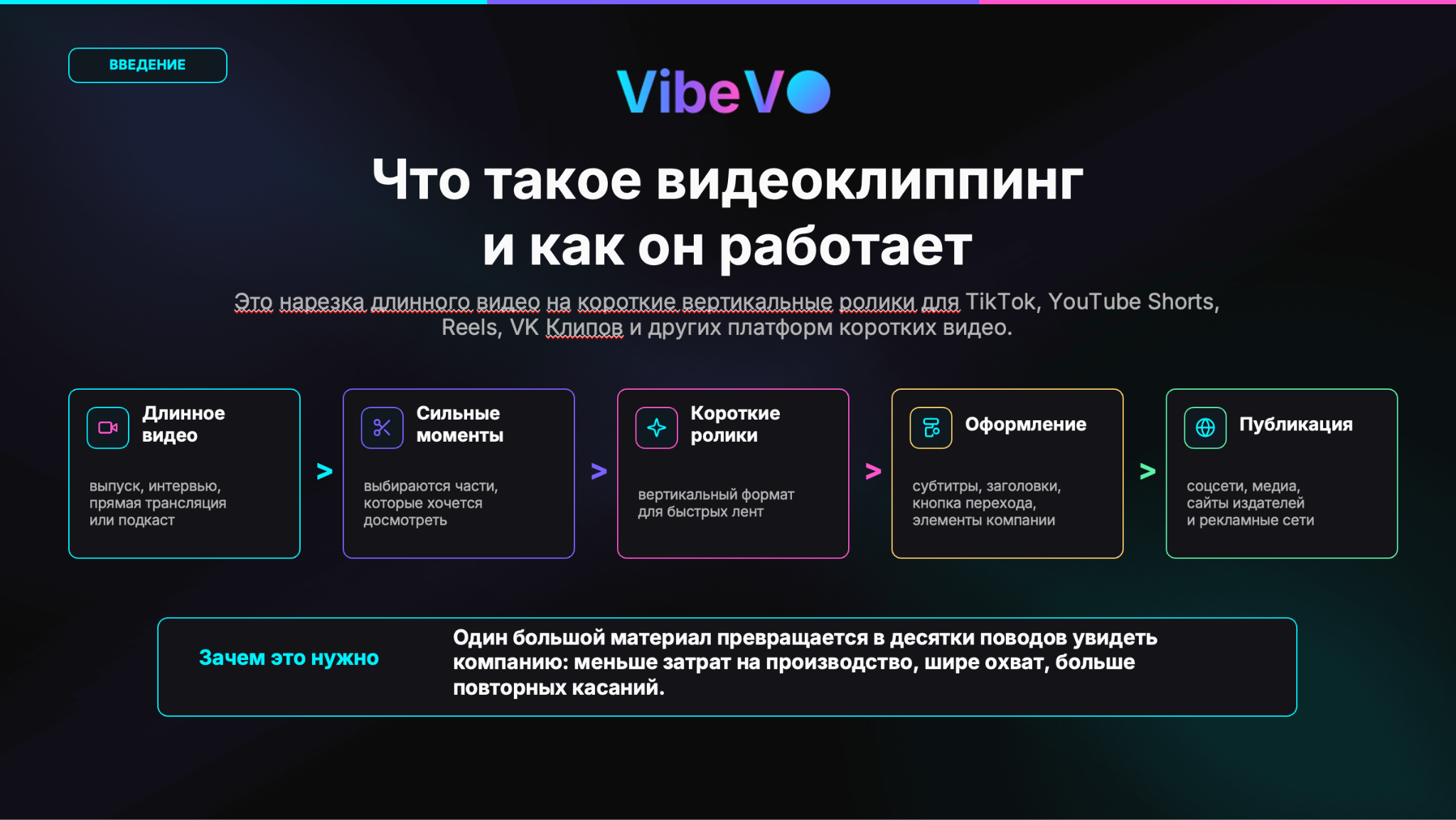
Video clipping is the transformation of long material into short vertical videos for recommendation feeds and author publications. The original video is broken down into strong moments, each fragment receives subtitles, a title, design elements, and a clear next step: go, save, watch to the end, take advantage of an offer, or learn more.
The economics of this approach are simple: one large piece of content provides dozens of reasons to re-engage with the audience. Instead of a one-off release, a company gets a series of repeated touchpoints, and platforms get content that is easier to distribute in fast feeds. Therefore, video clips are becoming not an auxiliary technique, but a separate way to buy attention.
External benchmarks in the presentation show why this shift has become widespread:
TikTok users spend an average of 95 minutes per day on the app.
Video advertising spending on the internet in the US exceeds 80 billion dollars.
Even if markets and platforms differ by country, the logic of consumption itself is already obvious: attention has shifted to short videos.
Chart 1. How video clipping works: the path from a long episode to a series of short videos. Source: VibeVO data, updated 08.06.2026. Click on the chart to open it in full size.
Overall picture: topics and platforms
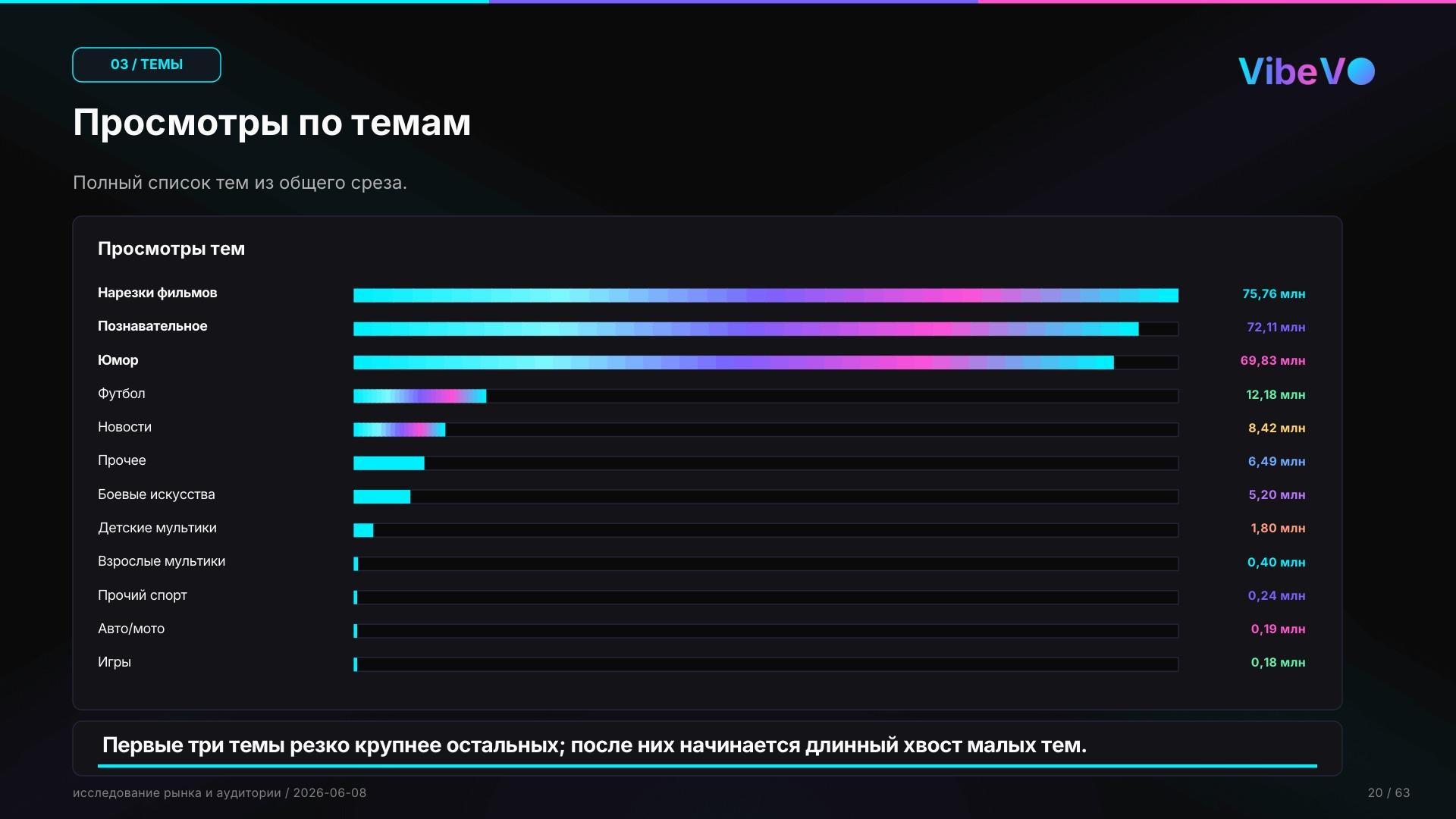
In the updated cut, the market looks concentrated. The three largest topics — movie clips, educational videos, and humor — account for 86.1% of the saved volume. Movie clips garnered 75.76 million views in 30 days, or 30.0%. Educational videos yielded 72.11 million views, which is 28.5%. Humor is almost at the same level: 69.83 million views, or 27.6%.
After the top three, a long tail begins: football — 12.18 million views, news — 8.42 million, other topics — 6.49 million, martial arts — 5.20 million. Children’s and adult cartoons, other sports, auto and moto, games are significantly less represented in the studied cut. This is an important caveat for placements: small topics cannot be generalized by the same rules as the largest ones.
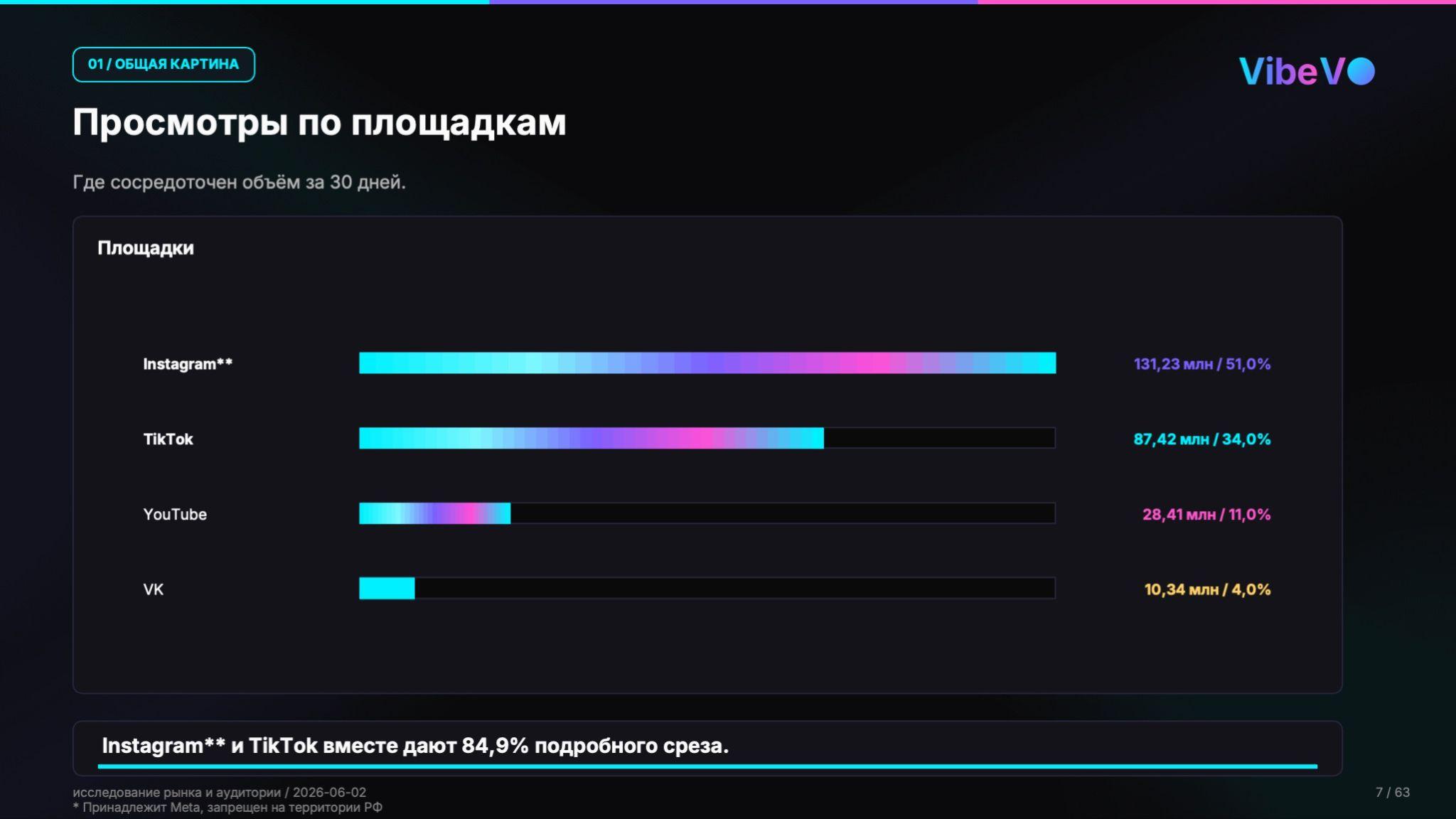
By platforms, Instagram* became the leader: 131.23 million views, or 51.0% of the detailed volume. TikTok yielded 87.42 million views, or 34.0%. Together, they form 84.9% of the detailed cut, but other platforms do not disappear: they can be important for individual topics, creators, and strong publications.
Chart 2. Views by topic over 30 days: the three largest topics are significantly larger than the rest. Source: VibeVO data, updated 08.06.2026. Click on the chart to open it in full size.Chart 3. Views by platform: Instagram* and TikTok form the bulk of views. Source: VibeVO data, updated 08.06.2026. Click on the chart to open it in full size.
Database size and strength of individual platforms
The database includes 4,224 videos with an active topic, 141 authors, 228 pages, and 16 advertising campaigns. This allows us to look not only at the overall volume but also at how platforms behave differently. Some provide scale, while others provide a stronger upper part of publications.
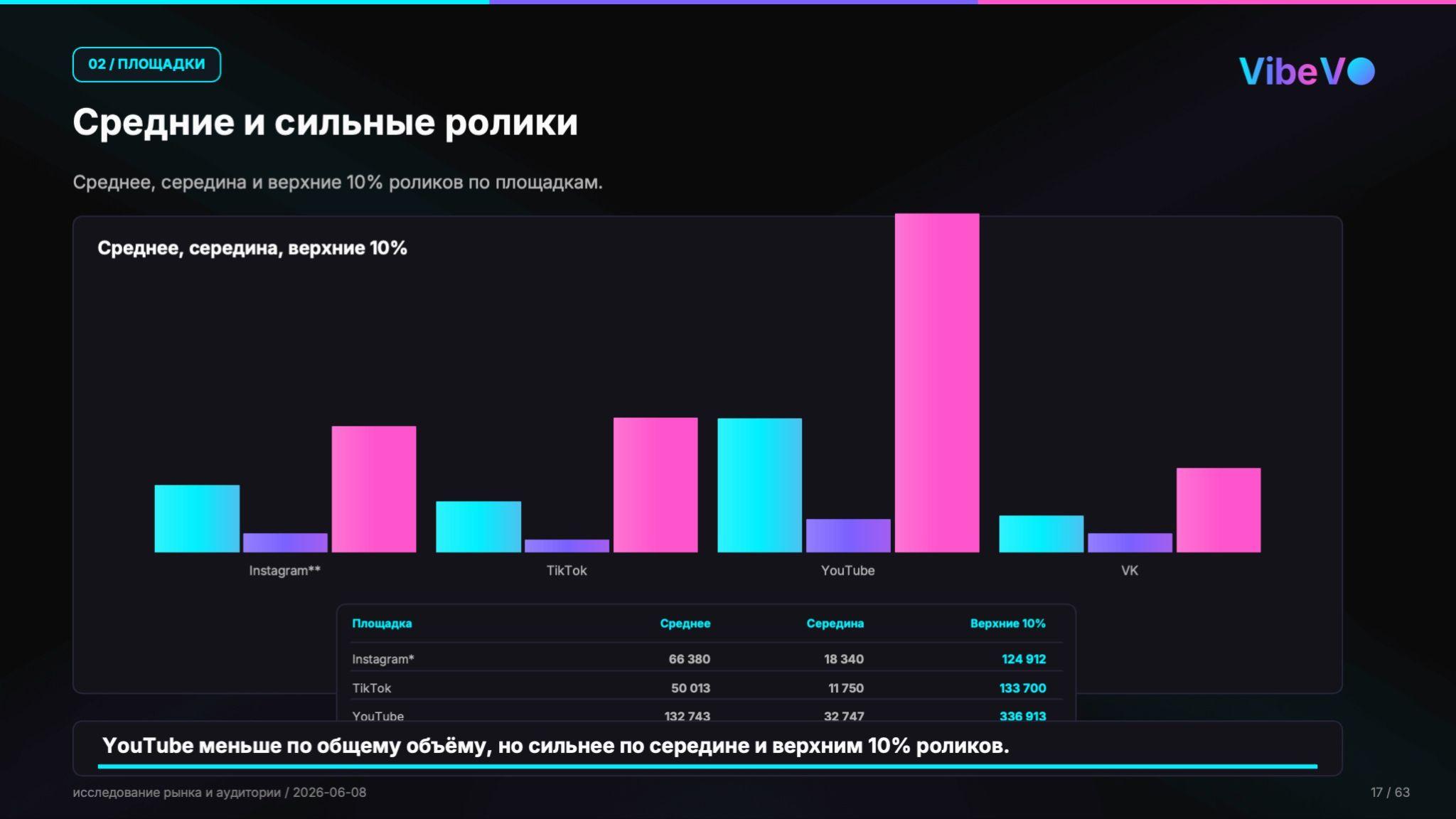
Instagram* leads in overall volume, but YouTube’s algorithms react more sharply to viral videos and give them a larger share of reach. On average, one video on YouTube received 132,743 views. For Instagram*, the average was 66,380, and for VK, it was 36,277.
Such a distribution changes the placement plan. Mass reach is logically sought in large Instagram* and TikTok bundles, but if there is viral content, YouTube can be a platform where it is easier to gain reach.
Chart 4. Distribution of reach among the top 10% most popular, median and average values by platform: YouTube is smaller in overall volume but stronger in the top 10%. Source: VibeVO data, updated 08.06.2026. Click on the chart to open it in full size.
It is better to analyze topics in bundles: topic plus platform
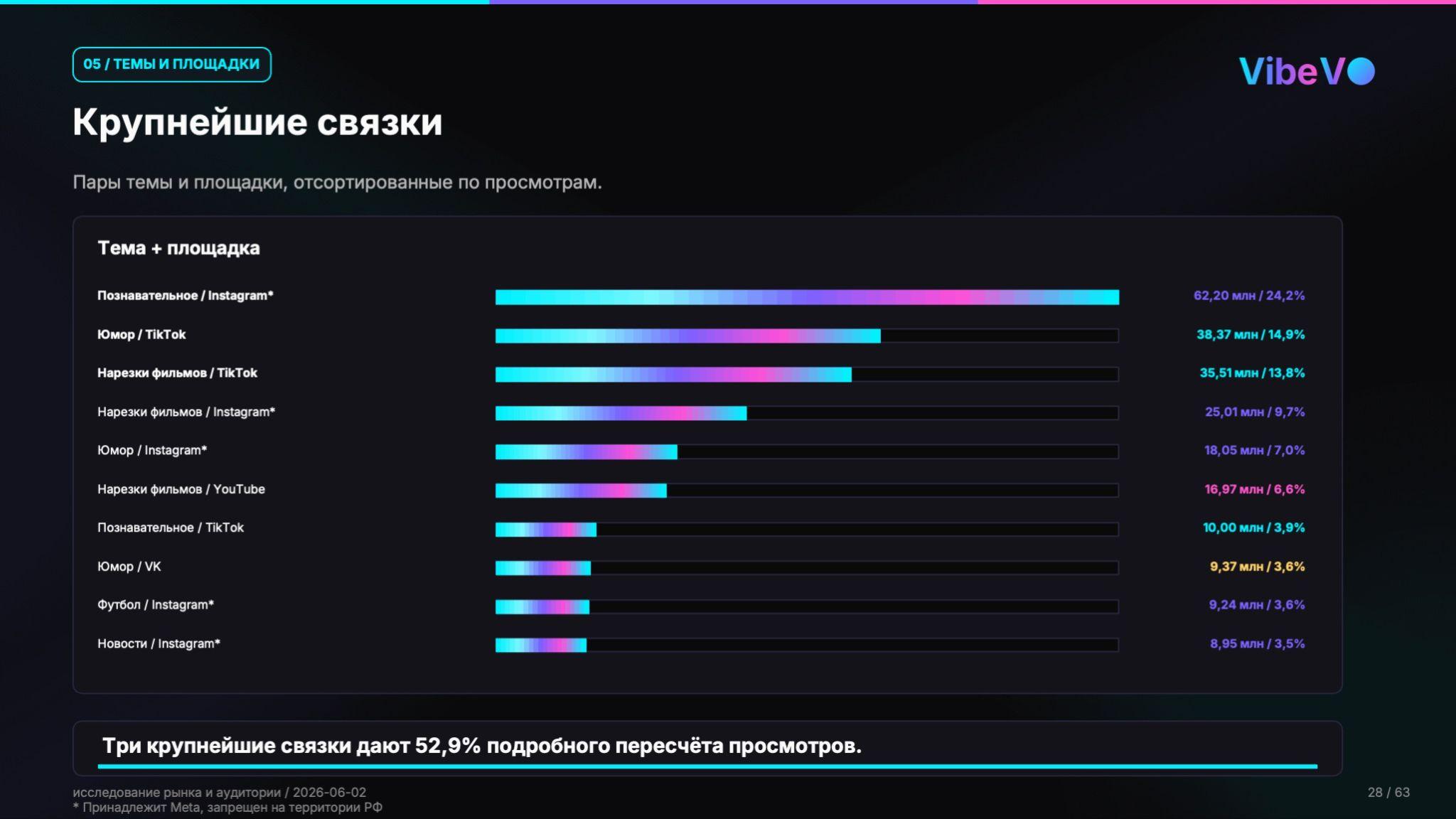
The total volume across the platform does not fully explain the market. The largest reach points occur where the topic and the distribution medium coincide. In the updated data, the largest combination is educational videos on Instagram*: 62.20 million views, or 24.2% of the detailed recalculation. This is followed by humor on TikTok – 38.37 million views, or 14.9%, and movie clips on TikTok – 35.51 million views, or 13.8%.
The three largest combinations account for 52.9% of the detailed recalculation of views.
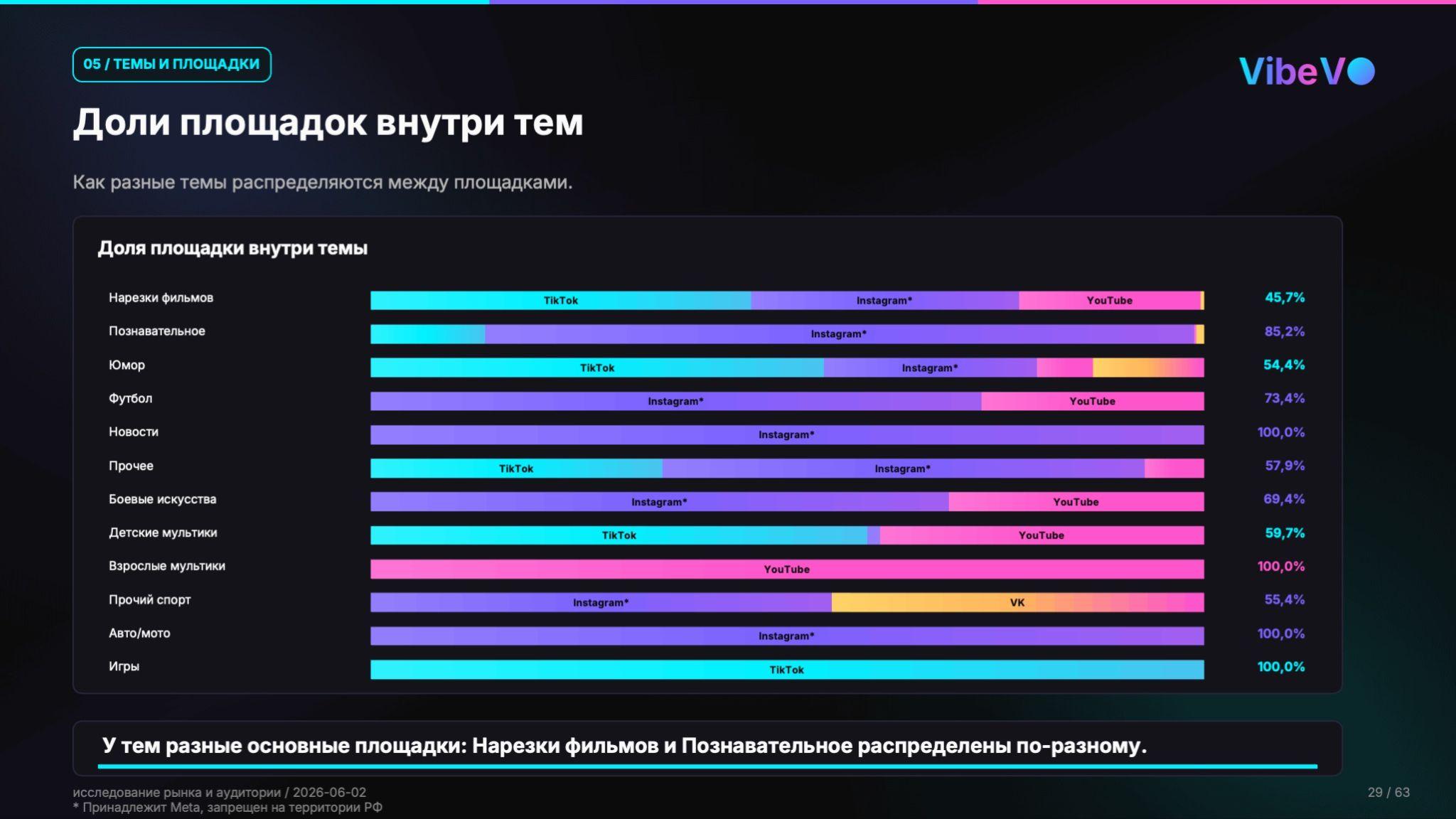
That is why video clipping cannot be launched using a single general grid for all tasks. For educational videos, auto/moto, Instagram* works better; humor, games, and movie clips rely heavily on TikTok; adult cartoons rely on YouTube. Different topics require different platforms, creators, and designs.
Chart 5. Largest topic and platform combinations: main volume arises from several combinations. Source: VibeVO data, updated 08.06.2026. Click on the chart to open it in full size.Chart 6. Platform shares within topics: different topics have different main platforms. Source: VibeVO data, updated 08.06.2026. Click on the chart to open it in full size.
Views are sharply distributed: the top portion of videos yields results
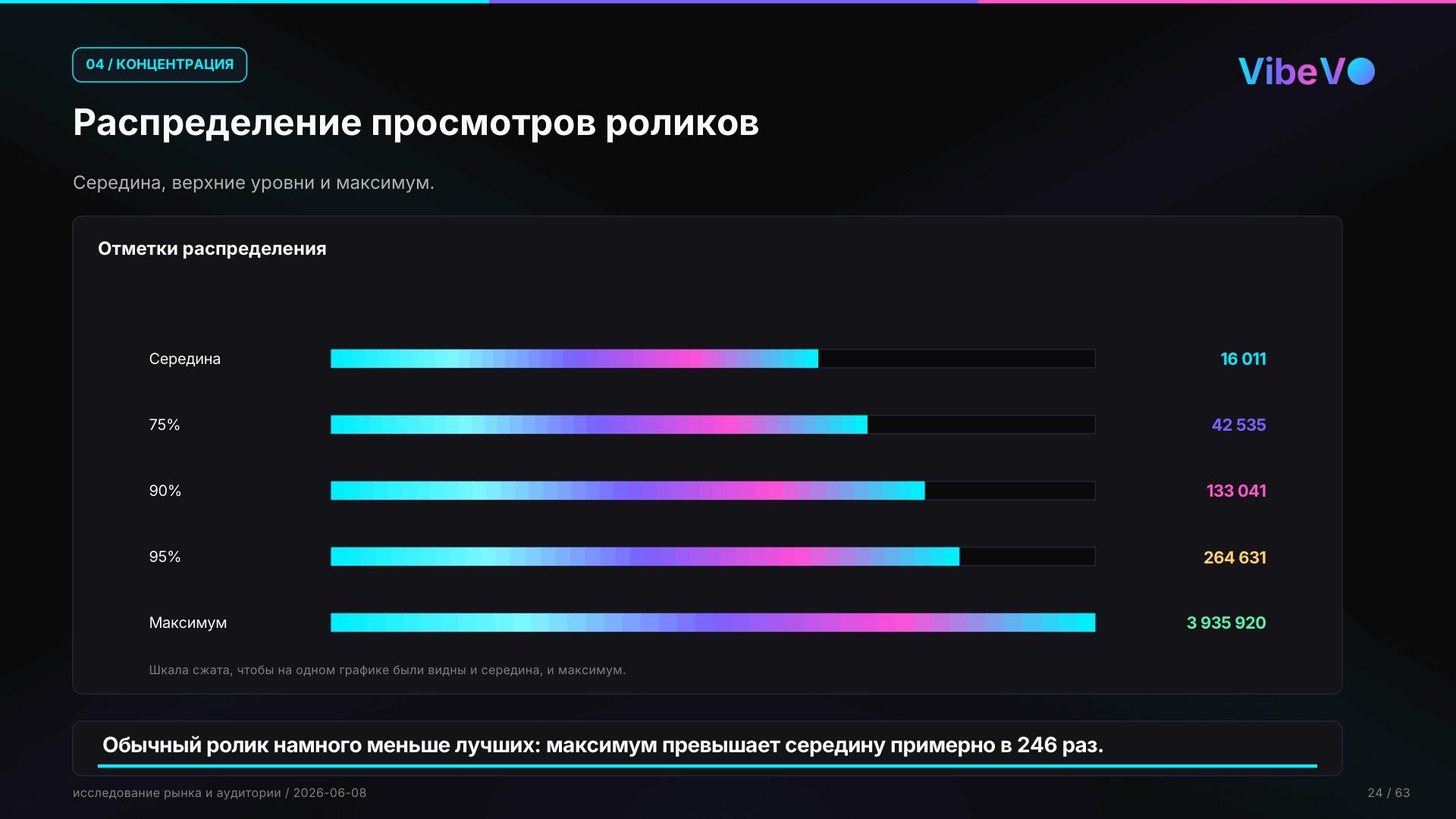
In short feeds, the average result hides a very strong unevenness. The average number of views is 16,011 views over 30 days. The 75th percentile is 42,535 views, the 90th percentile is 133,041. The maximum video garnered 3,935,920 views, which is approximately 246 times more than the median. As expected, the distribution is very uneven.
Even more illustrative is the share of the best publications. The top 10 videos generated 23.88 million views, or 9.3% of the volume. The top 50 videos – 62.48 million, or 24.3%. The top 10% of videos collected 165.54 million views, or 64.3% of all views. In other words, most views are generated by the top 5% of videos.
A practical conclusion for advertising in video clipping: you cannot rely on a single video. You need a set of video clips with different first seconds, titles, subtitles, overlays, and advertising message options. It’s not just the most beautiful video that wins, but a series of attempts where the best publications quickly gain more weight.
The era of traditional SEO, where CPM is profitable and hypothesis testing is cheap, is becoming a thing of the past. Today, buyers are increasingly turning to AI assistants, such as ChatGPT, Gemini, or Perplexity, to get direct answers to their questions. This changes the rules of the game for marketing teams and requires a re-evaluation of budgets. If your company is not mentioned in these AI answers, you are losing potential customers.
Why the old marketing structure doesn’t work?
Traditional marketing department structures were geared towards ranking in Google. SEO specialists were responsible for positions, content teams generated articles based on keywords, and paid advertising filled the gaps in organic traffic.
All of this assumed that the buyer would see the results page and click on a link. However, today many skip this page, directly asking AI questions. For example, the query “best contract management software for mid-market legal teams” now yields a list of three vendors. If you’re not there, you’re out of the game.
“I asked one question: which department is responsible for ChatGPT recommending you? No one had an answer, because the answer was — no one.”
Ranking does not guarantee citation
Companies with first-page Google rankings are often mentioned in only a few of the 20 answers from AI assistants.
One of our clients with 14 keywords on Google’s first page was mentioned in only 4 of 20 AI answers.
Work that ensures AI citation, such as creating consistent entity signals, third-party endorsements, and structured original content, is often not part of anyone’s job description.
Because budgets follow organizational structure, money continues to be spent on methods that AI models no longer reward. Planning a year in advance only exacerbates the problem, locking in old bets.
Three role changes to adapt to AI search
You probably don’t need new employees. You need three changes in areas of responsibility and a clear answer to the question of ownership.
Usually, it’s the same person. Their task expands from “where do we rank” to “where are we cited.” This means managing the brand entity everywhere AI models read information: your website, LinkedIn, G2, Crunchbase, Reddit, industry directories.
Entity fragmentation is the most common problem. Different brand names, domains, conflicting descriptions — AI perceives this as several weak companies instead of one strong one. A single owner can fix this in a quarter, and it costs almost nothing but attention.
2. The content team shifts from volume to evidence
Halve your publishing calendar. Redirect those hours to creating content that can be cited by AI: original data, customer results with specific numbers, expert comments from company employees, and pages structured to extract clear statements.
Eight general posts a month lose to one article with unique data. Evaluate the team not by volume, but by the number of citations received and the impact on the sales funnel.
3. Digital PR moves from the brand budget to the performance budget
AI models reward consistency of information from independent sources. Mentions in industry publications, review platforms, and communities now do the same work that backlinks did a decade ago.
This means PR stops being a “soft” expense item that can be cut in a bad quarter and becomes an acquisition channel with quarterly goals and KPIs. CPM cheaper than 50 rubles is possible through PR with clear metrics.
Budget Math: How to Reallocate Funds
Consider an example of a client who spent $60,000 per month on marketing. Price comparison before and after restructuring:
Before restructuring:
Paid Search: $30,000
Content Production: $12,000
SEO Retainer: $8,000
Brand & PR: $5,000
Tools: $5,000
After one quarter:
Paid Search: $24,000 (20% reduction, to protect branded queries and converting non-branded campaigns)
Content: $10,000 (fewer articles, but with more substantial evidence)
AI Search Program: $10,000 (entity cleanup, structured data, measurements)
Digital PR with targeted citation metrics: $10,000
Tools: $6,000 (added AI visibility tracker, e.g., Peec AI or Semrush AI toolkit)
Don’t completely abandon paid search. It’s the purest source of data on buyer intent, which is necessary for testing AI assistants. The rule is simple: move 15-20% of the budget in the first quarter, then let the evidence guide the rest. No one should stop a working paid program “on faith.”
90-Day Action Plan
Don’t reorganize the team on day one. First, measure, then experiment, then scale what works.
Weeks 1-4: Baseline
Test 20 of your key buyer queries in four major AI assistants.
Record every answer, every mention, every competitor.
Fix entity fragmentation. It costs nothing and has a cumulative effect.
Weeks 5-8: Pilot Launch
Create a small team: an AI search leader, one content specialist, and a portion of the PR budget focused on a single product line.
Everything else operates as usual, providing a control group and reassuring the rest of the team.
Weeks 9-12: Compare and Scale
Compare citation rates for test queries, referral traffic from AI assistants, and the number of inbound deals that mentioned discovering you through an AI tool.
Move budget where the evidence points. Reorganization follows results, not the other way around.
Three Mistakes That Burn Budget
Hiring an AI specialist before conducting baseline measurement. It’s impossible to write a job description until you know where your citation gaps are.
Completely cutting classic SEO. AI assistants still rely on search indexes. Well-ranked pages are more often read by models. This is a rebalancing, not a burial.
Launching AI search as a side project. If it doesn’t have a separate line in the budget, it doesn’t have an owner, and work without an owner doesn’t move. Allocate a budget, even a small one, and assign responsibility.
Six months after restructuring, the mentioned software company increased its mentions in AI responses from three to 12 out of 20. Demo requests received through AI assistants are now tracked in their CRM. The size of the marketing team has not changed. Only the direction of investment has changed, aligning with current buyer behavior. Your organizational structure is a bet on how buyers will find you. Most structures still bet on the search results page, which fewer buyers are viewing each month. It’s time to change that bet.
Frequently Asked Questions
What is the role of an SEO specialist in the era of AI search?
The role of an SEO specialist expands: they become an AI search leader, responsible not only for ranking but also for the brand’s citation by AI models across all relevant platforms and directories. This includes managing brand entity and eliminating information fragmentation.
What’s cheaper: a banner or a blogger?
In the context of AI search, what’s cheaper: a banner or a blogger is an outdated question. More important is which channel provides citation and evidence for AI models. Digital PR, aimed at getting mentions in authoritative sources, can be more effective than direct advertising or influencers, as AI values consistency from independent sources.
What CPM should be considered profitable for AI-oriented marketing?
What CPM should be considered profitable now depends on citations. If you get a CPM cheaper than 50 rubles through Digital PR, which leads to mentions in AI responses and, as a result, to leads, this is more profitable than a high CPM in traditional advertising without such an effect.
Is AI worth it?
Yes, AI is worth it if you want to remain competitive. AI search is not just a trend, but a new reality. Investing in adapting your marketing strategy to AI search allows for cheap hypothesis testing and ensures visibility where your customers are.
How to measure the effectiveness of investments in AI search?
Effectiveness is measured by several indicators: the citation level of the brand by AI assistants, referral traffic from these assistants, and the number of inbound deals that indicate AI as the source of discovery. These metrics help to understand how much money each ruble spent will bring.
Conclusion
The marketing landscape is changing. The focus is shifting from traditional SEO to AI search, where price vs. result is evaluated by citation and impact on the sales funnel. Reallocate your budget, change roles, and test hypotheses to stay in the game. Your organizational structure should reflect how customers search for and find information today. Learn more about our AI marketing strategy.
This week, the SEO world is buzzing with activity: a judge questions Google’s monopoly on AI content, a spam update pulls the rug out from under automated publications, and the old debate about geotargeting flares up again. Let’s break down what this means for your cache, especially in the context of Google AI.
Legal Battles: Google AI and “Unfair” Content Usage
A federal judge questioned Google’s practice of using web content for its AI overviews, calling it “grossly unfair.” This jeopardizes the current “traffic in exchange for content” model.
Details of Penske Media vs. Google Case
During the antitrust hearing for Penske Media, Judge Amit Mehta questioned whether Google’s AI overviews could be considered a “product improvement.”
Digital Content Next CEO Jason Kint quoted the judge, who called the situation “really unfair” and noted that the improvement is being developed “at the expense of publishers.”
Judge Mehta has not yet ruled on Google’s motion to dismiss the lawsuit.
“Publishers have no control over how Google uses their content,” Kint noted, emphasizing that opting out of Google indexing is not a realistic choice for publishers dependent on search traffic.
Google Spam Update: A Blow to AI Publications
Although Google has not officially stated that it is targeting AI-generated content in the August spam update, reports from website owners indicate problems for automated publications. Is cheap AI content worth such risks?
Initial Observations and Conclusions
Roger Montti collected examples where fully automated sites lost visibility, while resources using AI with human refinement suffered less.
These are currently anecdotal reports, not official confirmation of changes in Google’s algorithms.
Google released the S-CTS system to detect coordinated synthetic abuse on video platforms, but this is not related to Google Search.
The mere fact of AI authorship is not a reason for a drop in rankings. Google’s policy concerns large-scale content created to manipulate rankings, regardless of the author.
SEO consultant Takuma Oka warns that his sample is small and the conclusions are not definitive. What matters is not the AI itself, but the method and purpose of mass production.
SEO vs. GEO: What John Mueller Says
John Mueller from Google once again commented on the “SEO vs. GEO” discussion, clarifying that there are no special requirements for generative AI answers in search. That is, testing hypotheses cheaply does not mean that basic principles can be forgotten.
Nuances for AI Answers
Mueller stated that Google sees nothing special that needs to be done for generative AI answers in search.
This applies to Google Search, not to ChatGPT, Perplexity, or other AI systems.
If you are already optimizing your site for Google, Mueller does not offer a new technical checklist for AI overviews.
Dan Akedju summarized: “The fundamentals are the same. The extraction level is different.” This is a key point: favorable CPM only when the platform’s features are taken into account.
AI Recommendations: Brands are Recommended, but Others are Cited
New data shows that a brand recommendation in an AI answer does not guarantee a direct link to your site. This affects ROI and requires a review of metrics.
Shero Commerce Analysis
Shero Commerce analyzed 1,851 citations in Google AI Mode, ChatGPT, and Perplexity.
Brand-owned pages received only 2.8% of citations.
When a brand was recommended by name, its own page received a citation in only 31% of cases. Third-party resources were often cited.
Aleyda Solis emphasized: “Your brand may be recommended in the answer… while the citation (and click) goes to a magazine or marketplace.” This means that the cost of uniqueizing one video or the price of generating 100 AI videos should pay off not only with mentions but also with direct links.
ChatGPT and Reddit: Complex Citation Dynamics
Promptwatch data showed a sharp drop in Reddit’s citation share in ChatGPT in mid-August, but new tests show that Reddit still plays an important role in the information extraction process.
Variability of ChatGPT Behavior
In one query, ChatGPT purposefully searched for information on r/whatnotapp: out of 71 extracted pages, 48 were Reddit threads, and 6 out of 8 final citations went to the subreddit.
Four days earlier, Suganthan Mohanadasan found that ChatGPT extracted 84 Reddit threads for another query but did not cite any.
Mohanadasan summarized: “Reddit citations were not simply ‘turned off.’ They seem to be query-dependent.” This demonstrates that price comparison of various sources and their citability is a dynamic process and requires constant monitoring.
Conclusion: Visibility vs. Value – New Metrics
This week, it became clear that visibility and real value are beginning to diverge. Publishers share information, but don’t always get traffic. Brands receive recommendations, but links go to others. Reddit may be a data source for AI, but not appear in final citations. “AI visibility” is becoming too broad a concept, requiring more precise metrics to assess ROI.
It’s important not only to be indexed, but also to get a mention, a citation, a click, and ultimately, a conversion. How much money will each dollar spent bring – that’s the main question. Re-evaluate your strategies and metrics to avoid wasting your budget.
Frequently Asked Questions
What is “unfair” use of content by Google AI?
Judge Amit Mehta opined that Google, by using publishers’ content for its AI overviews without adequate compensation or control from publishers, creates an unfair advantage, as publishers cannot opt out of Google indexing without losing traffic.
Is Google’s spam update really targeting AI-generated content?
Google has not officially confirmed this. However, according to reports from website owners, resources that use fully automated content generation have lost visibility. At the same time, sites where AI content was refined by humans suffered less. The focus is on large-scale content created to manipulate rankings, regardless of the generation method.
What does John Mueller advise regarding SEO for AI answers?
Mueller states that there are no special requirements for generative AI answers in Google Search. If you are already optimizing your site for Google, no additional technical checklists are needed for AI overviews. However, it is important to remember that different AI systems extract and select sources differently.
Why might a brand be recommended by AI, but the link goes to another site?
Shero Commerce research showed that AI systems often recommend brands by name, but cite third-party resources (e.g., magazines or marketplaces) instead of the brand’s official pages. This means that brand visibility does not always convert into direct clicks and traffic to your resource.
How has ChatGPT’s behavior regarding Reddit citations changed?
Data shows that Reddit citations in ChatGPT have become more complex and depend on the specific query. In some cases, Reddit is actively used and cited, in others, a lot of data is extracted, but there are no citations. This indicates the dynamism of algorithms and the need for constant analysis of sources that AI systems prefer for specific topics.
Yandex is opening a new sales channel for sellers without their own online stores, offering a unique opportunity to achieve a profitable CPM. Now their products are available in Search and chat with Alice AI, and purchases happen in one click. Connecting to the service is free, which makes it potentially beneficial for cheap hypothesis testing and finding new traffic sources. It’s important to calculate unit economics to maximize profit.
What does Yandex offer sellers without a website?
The new feature allows sellers without their own website to place products in Yandex search results and Alice AI. This expands opportunities to reach an audience without significant investment in developing an e-commerce platform.
How does it work?
Yandex Commerce Protocol (YCP): the neural network selects relevant products, displaying them as cards.
Yandex Universal Checkout: users make purchases with a “Buy in one click” button.
Beta testing: the feature is currently in test mode.
“Traffic from Alice AI to Russian e-commerce has grown 4.6 times since the beginning of the year. These are not just numbers, this is sales growth potential that cannot be ignored,” — quote from an analytical report.
How much does it cost to connect and how to start selling?
Connecting to the service is free. The main costs will be associated with payment processing and logistics. This makes the offer an attractive budget alternative to seeding or expensive integrations with influencers.
Steps to start selling:
Yandex Products: submit an application for checkout connection.
Yandex KIT: upload assortment, specify prices, set up payment and delivery.
After these settings, products are automatically displayed in Yandex Search and Alice AI for relevant queries. This is a direct path to the buyer, bypassing the creation of an expensive website.
Logistics and analytics: counting cash
To fulfill orders, the seller can use various logistics options, which provides flexibility and allows for cost optimization. This is a key factor in achieving a profitable CPM.
Analysts note that traffic from Alice AI to Russian e-commerce has grown by 358% since the beginning of the year. This is not just statistics, it is an indicator of a growing audience that can be converted into sales. How much money will it bring for every ruble spent – that’s a question for your unit economics.
Frequently asked questions
What CPM can be considered profitable when working with Yandex?
A profitable CPM is one that provides a positive ROI. In this case, with free connection, the cost will be formed from payment commissions and logistics. It is necessary to conduct test sales to determine the optimal CPM for your product.
Sales via Yandex Search and Alice AI can be significantly cheaper than traditional banner advertising, especially at the initial stage. The absence of a connection fee and the possibility of cheap hypothesis testing makes this channel attractive for small and medium businesses. Banner advertising requires large budgets and does not always guarantee a direct transition to purchase.
Is it worth investing in AI sales channels without your own website?
Yes, it is. Especially for a quick start and demand verification. Yandex provides ready-made infrastructure for accepting payments and delivery, which lowers entry barriers. This allows you to focus on the product and marketing, rather than the technical side of e-commerce.
Conclusion: cash or lost opportunity?
The new sales channel from Yandex is not just an option, it is an opportunity for sellers without a website to gain access to millions of potential buyers. Free connection and flexible logistics conditions allow you to compare prices with other channels and, possibly, find that very profitable CPM. Don’t miss the chance to test hypotheses cheaply.
Start accepting applications and uploading your assortment today to assess the real potential of this sales channel and turn it into a significant source of income for your business.
Nvidia continues to actively invest in the development of artificial intelligence infrastructure, which directly impacts its revenues. The company recently announced a strategic partnership with Cloverleaf Infrastructure. This deal could change the landscape of the AI infrastructure market and potentially reduce the cost of deploying new capacities.
Nvidia’s Investments: Facts and Figures
Cloverleaf Infrastructure, founded in 2024, specializes in creating foundational infrastructure for data centers. In its founding year, the company attracted $300 million in investments. Its key role is to mediate between utility providers and data centers, ensuring critical power sources and other elements for site development.
How much did Nvidia invest in Cloverleaf?
The terms of the deal have not been disclosed.
According to The Wall Street Journal, Nvidia’s investment in Cloverleaf is likely to be several hundred million dollars.
Reuters reports that the chipmaker now owns a minority stake in Cloverleaf.
“Nvidia is increasingly involved in financing and developing AI data centers, which, in turn, purchase its AI systems,” analysts note.
Nvidia’s Strategy: AI Flywheel and Unit Economics
This deal is part of Nvidia’s broader strategy to reinvest its enormous profits into maintaining the “AI flywheel.” The goal is to ensure continuous demand for its high-performance chips and systems. The company aims not only to sell hardware but also to actively participate in creating conditions for its large-scale use.
Specific examples of investments in AI infrastructure
Earlier this week, Nvidia announced another major investment:
$1.5 billion in SB Energy.
This is a data center project associated with OpenAI, located in Ohio.
Such investments show that Nvidia is not just waiting for the market to develop but is actively shaping it. For arbitrageurs and marketers, this means a potential reduction in CPM costs due to increased availability of computing power and, consequently, more favorable conditions for cheap hypothesis testing on large volumes of data.
Frequently Asked Questions
How profitable will CPM be thanks to these investments?
The direct impact on CPM is still difficult to assess, but increased availability and reduced cost of AI computing infrastructure can make advertising platforms more efficient. This could potentially lower the costs of data processing and content generation, which will ultimately affect the cost per thousand impressions.
Given the active investments of giants like Nvidia in AI infrastructure, the market is becoming more stable and predictable. This is a favorable time to consider investments in AI solutions, as entry barriers and operating costs may decrease.
Conclusion: Cash and Prospects
Nvidia’s investments in Cloverleaf Infrastructure and SB Energy are not just financial operations, but strategic steps to strengthen its dominant position in the AI sector. The company aims to create an ecosystem where its chips will be indispensable. For businesses, this means a potential reduction in AI development and operating costs, opening up new opportunities to optimize unit economics and generate more profit from every dollar invested. We are watching the numbers and preparing for new opportunities that this “AI flywheel” will bring.