Tag: video content strategy

  • Video Production for Agencies: Build, Partner, or White Label?

    Video Production for Agencies: Build, Partner, or White Label?

    In 2026, as clients continue to demand video content, marketing agencies face a critical choice: how to effectively produce video? This choice often becomes a headache, as not only revenue but also reputation depends on it. You have three main paths: building your own team, collaborating with external production companies, or using white-label subscription services. But which option will be the most profitable and least costly for your business?

    Strategic Video Production Models for Agencies

    Marketing agencies that integrate video into their services can be divided into three main categories, each with its own characteristics and economic models.

    Full-Service Agencies with In-House Production Teams

    These agencies view video production as a full-fledged revenue stream. Their staff can include up to 25 employees, including two full-time editors, a producer, and a videographer, as well as an extensive equipment fleet.

    The cost of a 60-second branded social media video at such agencies ranges from $4,000 to $8,000 USD. Video services here are usually included in larger retainer agreements, making them a profitable center.

    Agencies Using Subcontractors (White Label)

    This model implies that the agency develops the strategy but outsources the execution of all visual aspects of the project to an external contractor. As ALM Corp notes, “white-label video production means the agency retains the client relationship, strategy, positioning, and commercial terms, while the production partner discreetly performs part or all of the implementation process for the client.”

    This allows the agency to offer highly effective digital content without significant overhead costs for equipment.

    Boutique Agencies with Niche Video Offerings

    These agencies specialize in specific verticals (e.g., B2B SaaS, real estate, e-commerce) and offer unique video products. Each product has its own price category and a set of services provided by freelancers.

    This model allows for flexible adaptation to market needs and offers specialized solutions.

    Choosing a Model: Build vs. Partner

    The main question when choosing a model is the identity of your agency. If your strength lies in strategic planning and media buying, then building your own production department might put you in direct competition with something you never intended to compete with in the first place.

    Production companies have decades of experience and streamlined processes, making them formidable competitors.

    “While demand for video content continues to grow, building your own production team is expensive, takes too much time, and is usually an operational mess. Furthermore, hiring an in-house videographer doesn’t solve the problem entirely. One person cannot handle scriptwriting, pre-production, creative direction, lighting, sound, editing, motion graphics, formatting, versioning, quality control, and distribution strategy,” — ALM Corp.

    Most agencies choose to partner because it allows them to scale video capabilities without significant internal investment. This is especially true when it comes to high-margin opportunities, such as integrating video into existing budgets for paid social advertising, content marketing, and sales support.

    When should you hire in-house staff for production?

    Hiring an in-house producer and/or editor is only worthwhile if all four of the following conditions are met:

    1. The volume of video production is high.
    2. The volume of production is predictable.
    3. Video is strategically important to the agency.
    4. You are ready for the largest operational commitments.

    If at least one of these conditions is not met, you risk incurring fixed costs in conditions of variable demand, which will inevitably lead to a loss of profit. An in-house team provides maximum control but requires a stable flow of orders.

    When to use a project-based partnership with a production company?

    Project-based collaboration with a production company is ideal for:

    • Content requiring high creativity.
    • A relatively small amount of material.
    • Creating brand films, key commercials, or main video assets that the client will use for a long time.

    Here you are buying creativity, not bandwidth. According to Viva Media, in 2026, daily rates range from $600 to $1200, reaching up to $2000-3500 per day for high-end specialists. This allows for high-quality content while avoiding constant fixed costs.

    When to apply a White Label subscription for editing?

    The white-label subscription model is an optimal solution for large volumes of repetitive work that requires significant post-production. Examples include weekly short videos for social media, vertical videos, testimonial editing, turning podcasts into shorts.

    Видеопродакшн для агентств: строить, партнерствовать или использовать White Label? — illustration 2

    This is an ideal option when the client has source materials and requires continuous finishing.

    This model offers a fixed monthly fee, unlimited revisions (one material at a time), and turnaround times measured in business days. Vidpros, for example, offers such services, allowing agencies to fill the editing gap without hiring in-house staff. ALM Corp emphasizes: “White-label partners are in the middle. They provide more structure than using freelancers on an ad-hoc basis and more flexibility than hiring an in-house department.”

    How to choose a reliable video production partner?

    Choosing a contractor for full-cycle short video production or social media content outsourcing is no easy task. Here’s what’s really important:

    1. Evaluate full works, not just reels. Reels are just a collection of the best five-second clips. Ask for three complete projects done for clients in the last 12-18 months that are similar to your tasks.
    2. Use a paid sample to test the process. Before signing a long-term contract, order one real piece of content from a potential partner. Track response time, number of revisions, and adaptation to changes in the brief.
    3. Get the pricing structure in writing. Make sure you understand what’s included in the cost, what constitutes an “overrun,” and how the price is calculated (per minute, per material, fixed monthly fee, daily rate). This will help avoid payment misunderstandings in the future.

    What to look for when choosing a partner:

    • Lack of transparency in revisions. If a partner cannot clearly explain the revision process, it can lead to payment conflicts.
    • Reliance on portfolio, not workflow. Talent without a clear workflow leads to low quality.
    • Attempts to contact your client. True white-label partners remain invisible. As Fractional CTO Solutions notes: “90% of agencies selling white label lie about what it is.”
    • Suspiciously low prices. This could indicate offshore production, expensive revisions, or deliberate underpricing to get the order and then raise prices.
    • Monotony of past work. If all projects look the same, the partner may be inflexible in adapting to your client’s unique brand.

    Economic analysis: what is more profitable?

    How to Choose the Right Video Production Model for Your Agency

    Let’s consider an agency that sells 20 video projects per month at an average cost of $2500 per project, generating $50,000 in monthly revenue.

    Option A: In-house Team

    • Fixed Costs: Producer ($9500), Editor ($7500), Equipment/Software ($1200), Studio Rental ($1500) = ~$19,700 per month.
    • Variable Costs (20 projects): Talent/Locations/Music/Stock Footage ($200 per project) = ~$4000.
    • Total Costs: ~$23,700.
    • Margin: $26,300 or 52.6%.

    Problem: With less than 14 projects, fixed costs significantly reduce the margin. Salaries are paid regardless of sales volume.

    Option B: Project-based Partnership

    • Partner Cost (20 projects): $1400 per project = $28,000.
    • Additional Costs: Account Management ($2000).
    • Total Costs: ~$30,000.
    • Margin: $20,000 or 40%.

    Advantage: Lower margin, but significantly less risk from fixed costs. Scaling occurs without hiring new employees.

    Option C: White Label Subscription for Editing

    • Subscription Cost (20 projects): For example, $800 per completed project = $16,000.
    • Additional Costs: Raw footage capture and other variables (music/talent) ($200 per project) = $4000. Account Management ($2000).
    • Total Costs: ~$22,000.
    • Margin: $28,000 or 56%.

    Advantage: Highest margin at this volume and no fixed cost risk if clients churn. This model is ideal for most agencies doing less than 25 projects per month.

    Practical Example

    A 25-person digital marketing firm in 2025 sold video as an add-on to retainers for $2500. For 8 months, they unsuccessfully tried to find an in-house editor, facing constant freelancer turnover.

    By transferring 15 out of 18 monthly tasks to the white-label service Vidpros and leaving 3 creative projects to a boutique production house, they achieved a 58% margin. Video revenue doubled, as the agency could now take on all retainer expansions that were previously declined due to capacity limitations.

    Conclusion: Your Path to Efficient Video Production

    Choosing the right video production model is not just a tactical decision, but a strategic step that determines your agency’s competitiveness. If you are looking for budget and stress savings, as well as the ability to order everything in one place, white-label solutions can be your panacea.

    They allow you to focus on comprehensive promotion through short videos, delegating routine tasks to a reliable partner. Remember that replacing your SMM team or outsourcing content for social networks with white-label services is not just a trend, but a proven business model that provides flexibility and high profitability. Carefully choose a partner, relying on real case studies and transparent pricing, to avoid pitfalls and ensure stable growth for your business.

    Frequently asked questions

    What is “full-cycle short video production”?

    This is a service that covers all stages of creating short videos: from idea and script to shooting, editing, color correction, adding graphics, sound design, and final publication on various platforms. As part of this service, you can order a banner, a cut, and posting, receiving ready-made content on a turnkey basis.

    Is content uniqueization or new filming worth it?

    The choice between repurposing (uniqueization) existing content and shooting from scratch depends on your goals and budget. Repurposing is often cheaper and faster, allowing you to create many short videos from one long piece of material. Shooting new content gives full control over creativity but requires greater investment. White-label services are excellent for repurposing and mass cutting.

    How to choose a contractor for video cutting or AI advertising?

    When choosing a contractor for cutting services or ordering AI advertising, pay attention to the following quality criteria: availability of complete cases (not just reels), transparent pricing policy, willingness to perform a paid test project, clear and well-established workflow, and a guarantee of confidentiality of your client relationships.

    What is cheaper: AI or real editing?

    What is cheaper – AI or real editing, depends on the complexity of the task and the volume. For simple, repetitive tasks with a large volume, AI tools can be more economical. However, for creative, complex projects requiring fine-tuning and a human touch, real editing remains more cost-effective, especially when using a white-label subscription, which offers an optimal price-quality ratio for mass tasks.


  • Case study: Instantly — daily show turns into a stock of useful short videos

    Case study: Instantly — daily show turns into a stock of useful short videos

    Campaign Metrics

    Metric Value Explanation
    Views 622,870 accumulated campaign counter.
    Declared Fund $7,000 rewards budget.
    Approved Works 26 separate content counter.
    Authors 19 by published counter.
    CPM by Terms $2.50 rate per 1,000 counted views.
    CPV by Rate $0.00250 equivalent per 1 counted view.

    Cut-off 03.09.2026. CPV = CPM ÷ 1,000. These are rates with admission conditions and limits; the fund is not equal to expenses, and CPV does not show the full cost of the campaign. Views are a total counter, not unique reach. Approvals are counted separately. Views are not equal to unique reach or sales. Conclusions about marketing mechanics are an editorial analysis; the presence of a campaign around a brand does not necessarily mean its direct placement.

    AI and promotion news, a conversation with the founder, and then a breakdown of the work right on screen — this is how the source material for the Instantly campaign is structured. On weekdays, the brand releases a live show; in many episodes, a guest assembles a workflow or campaign in front of the audience. Authors of short videos have access to full episodes and individual segments. The audience is specifically defined: entrepreneurs, marketers, sales specialists, and agency leaders.

    Cutting long videos into short ones here can highlight both an idea from an interview and a complete practical step. Video clipping gets a regularly updated source, where different episodes address different professional interests. For a B2B brand, it is useful to maintain the independent value of the fragment: the viewer should understand the idea or action without watching the entire show. Then a short video introduces the company’s approach through specific useful material and provides a reason to refer to the full episode.

    Instantly — daily show turns into a stock of useful short videos — illustration 2

    Do you host expert broadcasts with interviews and practical analyses? Launch a video clipping campaign on VibeVO so that authors can find independent useful fragments in each episode.

  • Video Clipping Market: Short Videos Become a New Channel for Advertising Reach

    Video Clipping Market: Short Videos Become a New Channel for Advertising Reach

    The video clipping market is rapidly developing, transforming from a simple video cutting tool into a powerful channel for advertising reach. A joint study by VibeVO, a video clipping platform, and Go Influence, an influencer agency, sheds light on the current state of the short video, video clipping, and social media banner advertising market, demonstrating how these formats are becoming key for brand promotion.

    Short vertical videos have long ceased to be just entertainment. For companies, it is already an independent promotion environment. A single episode, interview, live broadcast, review, or conversational recording turns into a series of short videos, each of which can become a separate point of contact with the audience.

    This study was prepared by VibeVO and Go Influence based on VibeVO data for the last 30 days as of June 8, 2026. The indicators describe the studied array of short videos and do not claim to evaluate the entire internet. However, the database is large enough to see the main patterns: concentration of views, differences in platforms, thematic cores, and audience within topics.

    A brief version of the study is published on Sostav.

    Key figures of the study

    Indicator Value
    Views in the saved 30-day volume 252.81 million
    Videos 4,224
    Authors in the database 141
    Pages in the database 228
    Ad launches 16
    Share of the three main topics 86.1%
    Audience coverage 99.2%
    Graphs from the updated table 29

    Main conclusion: the video clipping market can no longer be described only as mechanical video cutting. It is developing as a tool for managed advertising reach, where the topic, platform, author, release speed, design, placement environment safety, and result measurement are important. Banner advertising in social networks also changes its role: it works not separately from the video, but during viewing or next to it.

    Why short video has become a mass format

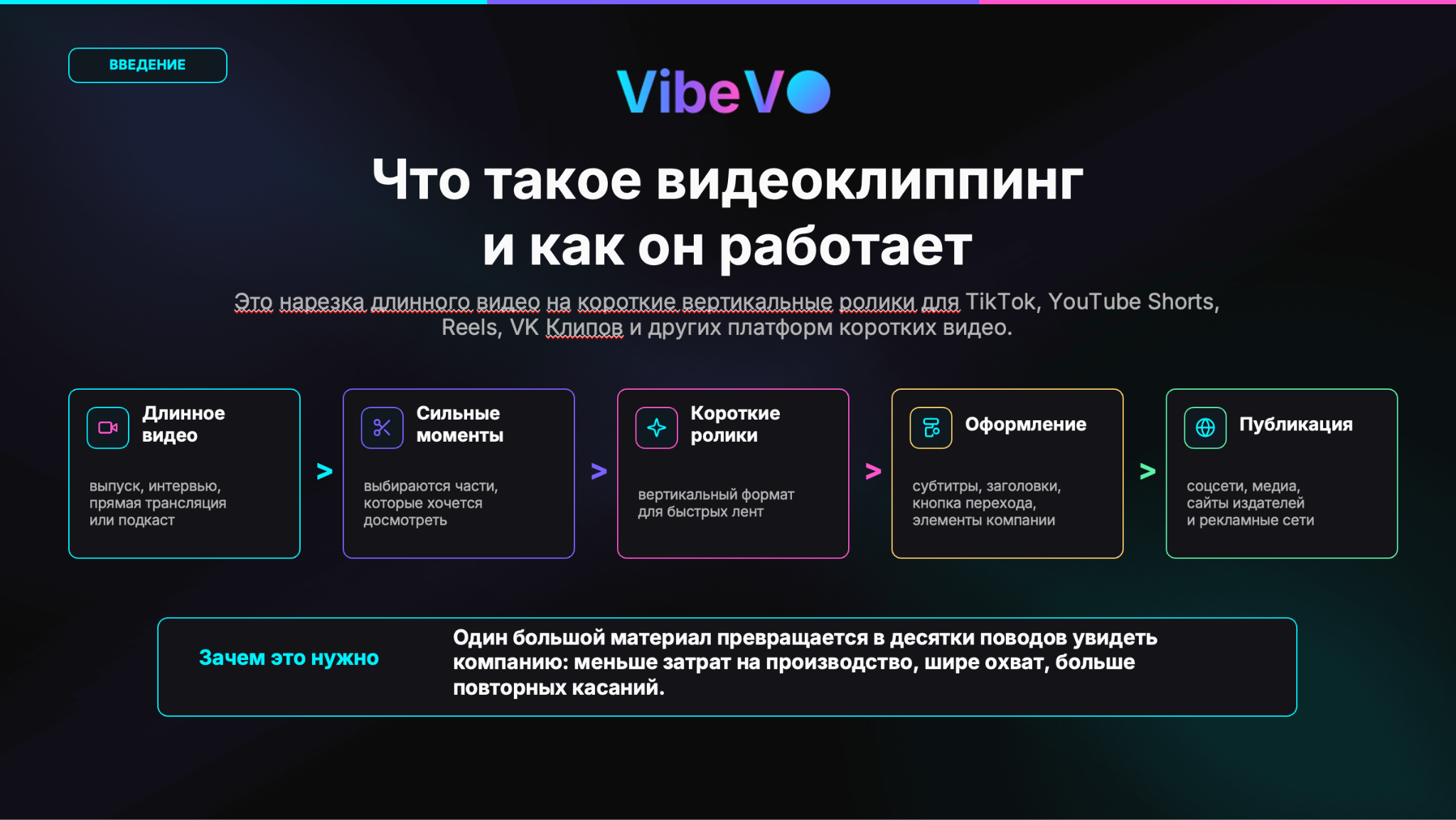
    Video clipping is the transformation of long material into short vertical videos for recommendation feeds and author publications. The original video is broken down into strong moments, each fragment receives subtitles, a title, design elements, and a clear next step: go, save, watch to the end, take advantage of an offer, or learn more.

    The economics of this approach are simple: one large piece of content provides dozens of reasons to re-engage with the audience. Instead of a one-off release, a company gets a series of repeated touchpoints, and platforms get content that is easier to distribute in fast feeds. Therefore, video clips are becoming not an auxiliary technique, but a separate way to buy attention.

    External benchmarks in the presentation show why this shift has become widespread:

    Illustration 1

    Even if markets and platforms differ by country, the logic of consumption itself is already obvious: attention has shifted to short videos.

    How video clipping works: the path from a long episode to a series of short videos
    Chart 1. How video clipping works: the path from a long episode to a series of short videos.
    Source: VibeVO data, updated 08.06.2026. Click on the chart to open it in full size.

    Overall picture: topics and platforms

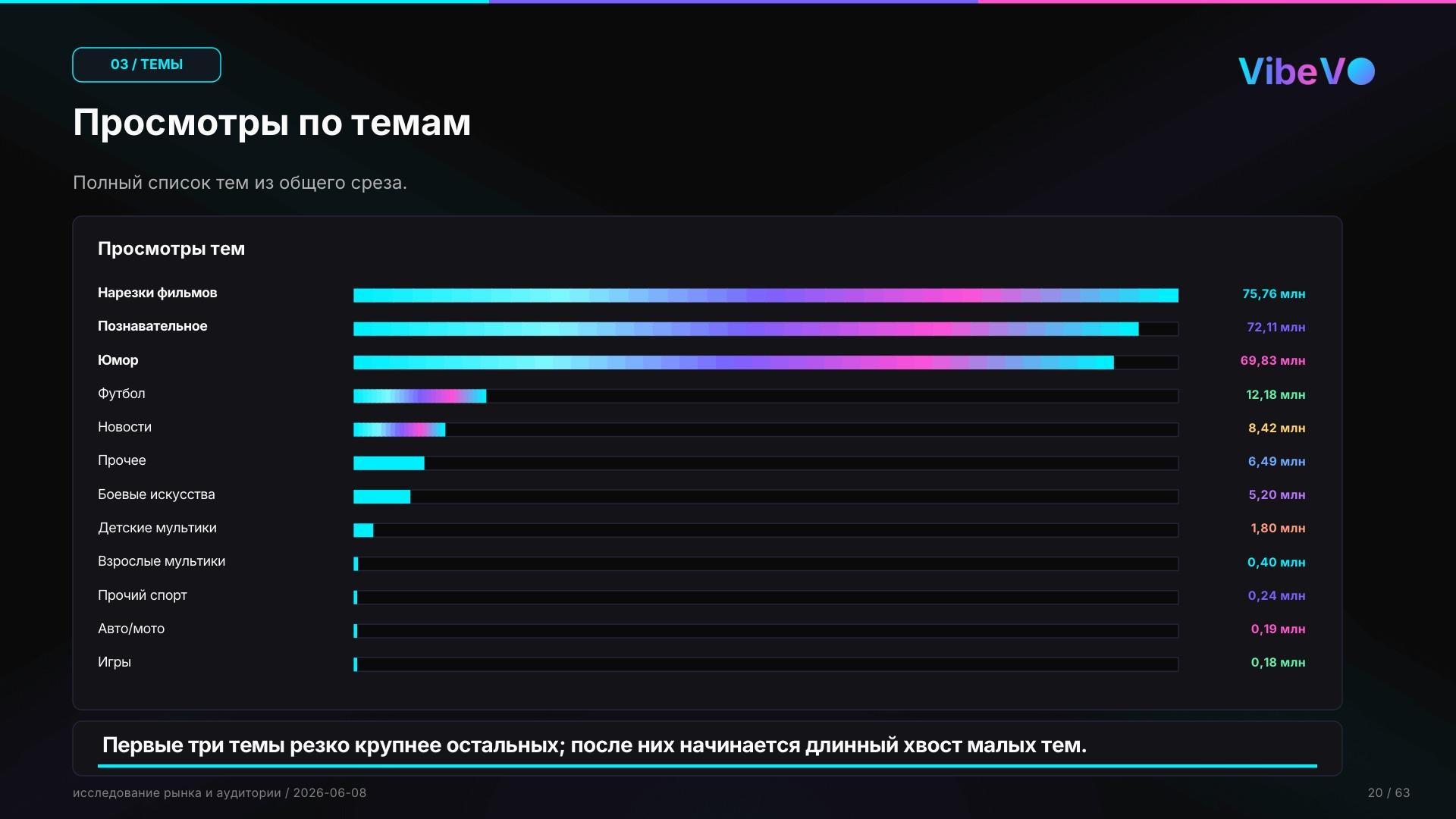
    In the updated cut, the market looks concentrated. The three largest topics — movie clips, educational videos, and humor — account for 86.1% of the saved volume. Movie clips garnered 75.76 million views in 30 days, or 30.0%. Educational videos yielded 72.11 million views, which is 28.5%. Humor is almost at the same level: 69.83 million views, or 27.6%.

    After the top three, a long tail begins: football — 12.18 million views, news — 8.42 million, other topics — 6.49 million, martial arts — 5.20 million. Children’s and adult cartoons, other sports, auto and moto, games are significantly less represented in the studied cut. This is an important caveat for placements: small topics cannot be generalized by the same rules as the largest ones.

    Illustration 2

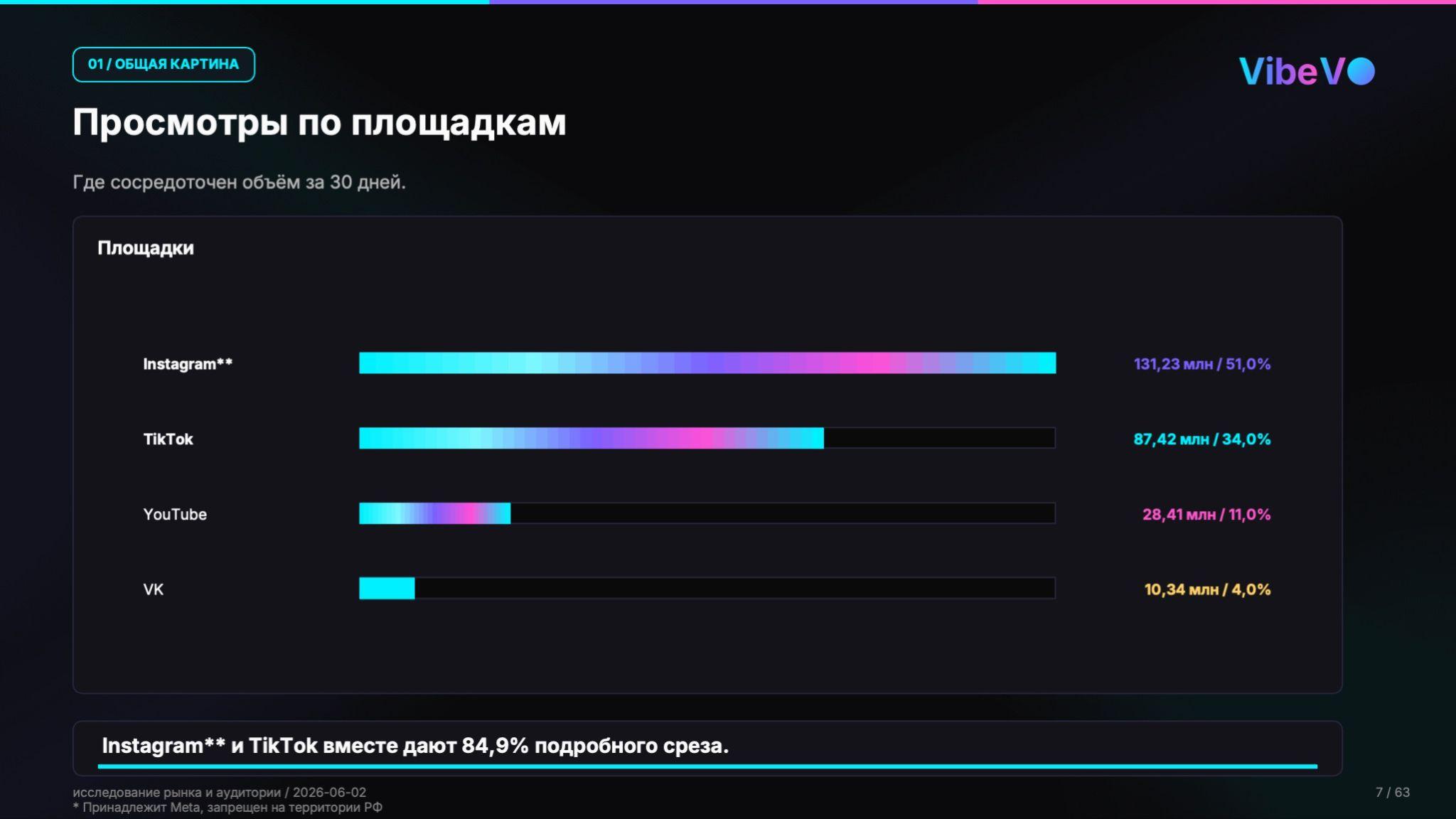
    By platforms, Instagram* became the leader: 131.23 million views, or 51.0% of the detailed volume. TikTok yielded 87.42 million views, or 34.0%. Together, they form 84.9% of the detailed cut, but other platforms do not disappear: they can be important for individual topics, creators, and strong publications.

    Просмотры по темам за 30 дней: три крупнейшие темы резко крупнее остальных
    Chart 2. Views by topic over 30 days: the three largest topics are significantly larger than the rest.
    Source: VibeVO data, updated 08.06.2026. Click on the chart to open it in full size.
    Просмотры по площадкам: Instagram* и TikTok формируют основную массу просмотров
    Chart 3. Views by platform: Instagram* and TikTok form the bulk of views.
    Source: VibeVO data, updated 08.06.2026. Click on the chart to open it in full size.

    Database size and strength of individual platforms

    The database includes 4,224 videos with an active topic, 141 authors, 228 pages, and 16 advertising campaigns. This allows us to look not only at the overall volume but also at how platforms behave differently. Some provide scale, while others provide a stronger upper part of publications.

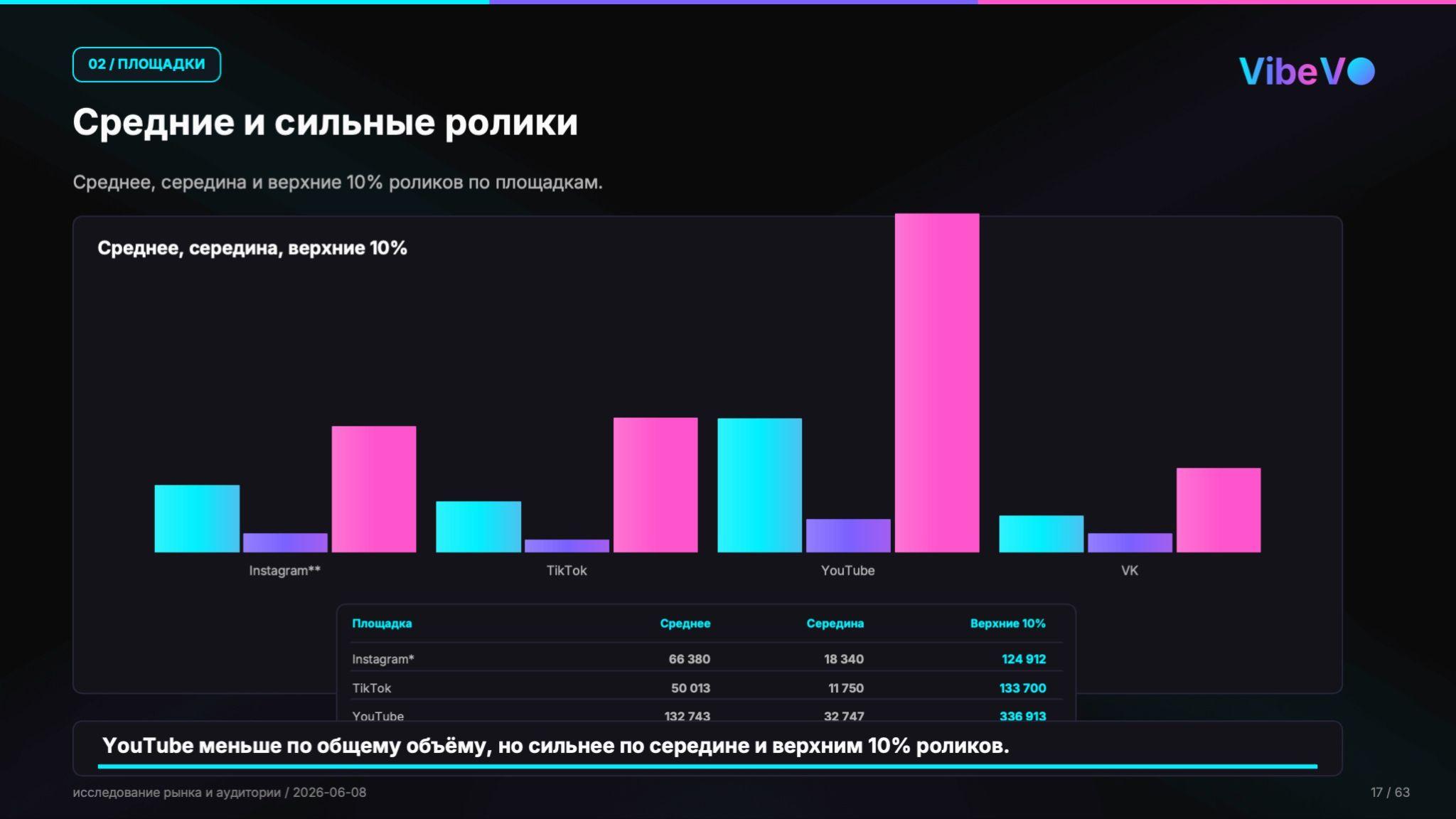
    Instagram* leads in overall volume, but YouTube’s algorithms react more sharply to viral videos and give them a larger share of reach. On average, one video on YouTube received 132,743 views. For Instagram*, the average was 66,380, and for VK, it was 36,277.

    Such a distribution changes the placement plan. Mass reach is logically sought in large Instagram* and TikTok bundles, but if there is viral content, YouTube can be a platform where it is easier to gain reach.

    Illustration 3
    Распределение охватов среди топ 10% самых популярных, медианы и среднее значение по площадкам: YouTube меньше по общему объему, но сильнее по верхним 10%
    Chart 4. Distribution of reach among the top 10% most popular, median and average values by platform: YouTube is smaller in overall volume but stronger in the top 10%.
    Source: VibeVO data, updated 08.06.2026. Click on the chart to open it in full size.

    It is better to analyze topics in bundles: topic plus platform

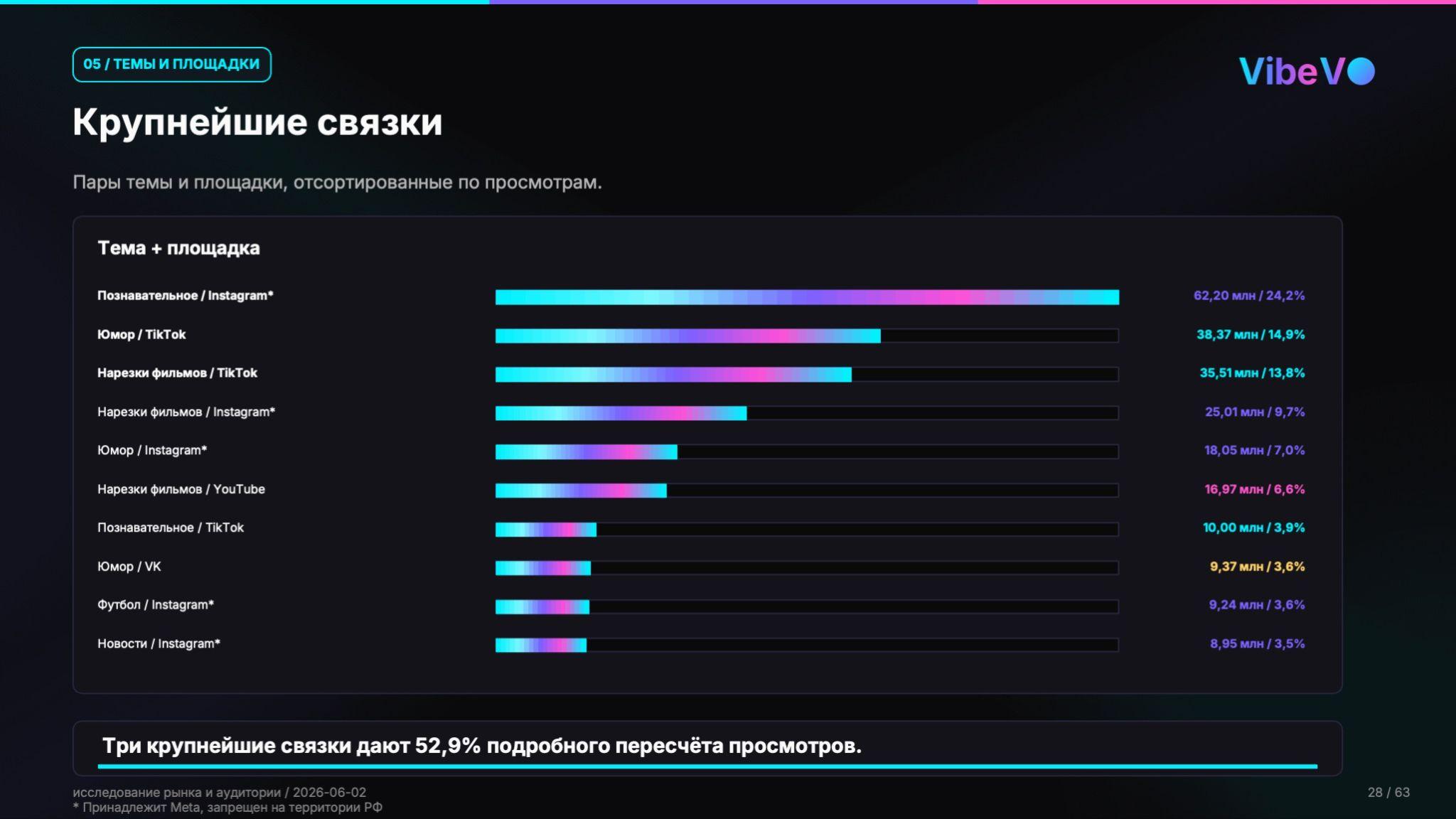
    The total volume across the platform does not fully explain the market. The largest reach points occur where the topic and the distribution medium coincide. In the updated data, the largest combination is educational videos on Instagram*: 62.20 million views, or 24.2% of the detailed recalculation. This is followed by humor on TikTok – 38.37 million views, or 14.9%, and movie clips on TikTok – 35.51 million views, or 13.8%.

    The three largest combinations account for 52.9% of the detailed recalculation of views.

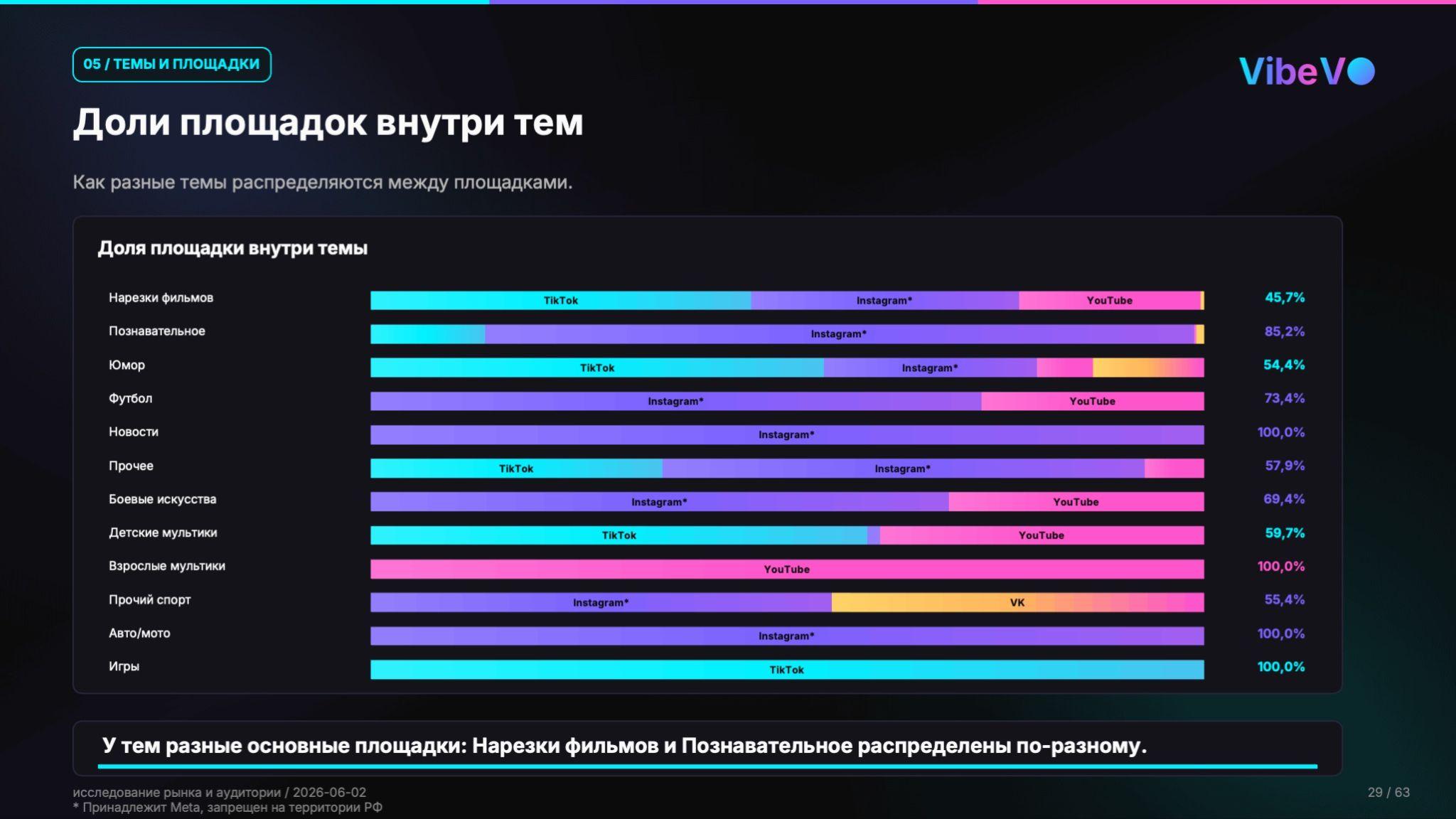
    That is why video clipping cannot be launched using a single general grid for all tasks. For educational videos, auto/moto, Instagram* works better; humor, games, and movie clips rely heavily on TikTok; adult cartoons rely on YouTube. Different topics require different platforms, creators, and designs.

    Illustration 4
    Largest topic and platform combinations: main volume arises from several combinations
    Chart 5. Largest topic and platform combinations: main volume arises from several combinations.
    Source: VibeVO data, updated 08.06.2026. Click on the chart to open it in full size.
    Platform shares within topics: different topics have different main platforms
    Chart 6. Platform shares within topics: different topics have different main platforms.
    Source: VibeVO data, updated 08.06.2026. Click on the chart to open it in full size.

    Views are sharply distributed: the top portion of videos yields results

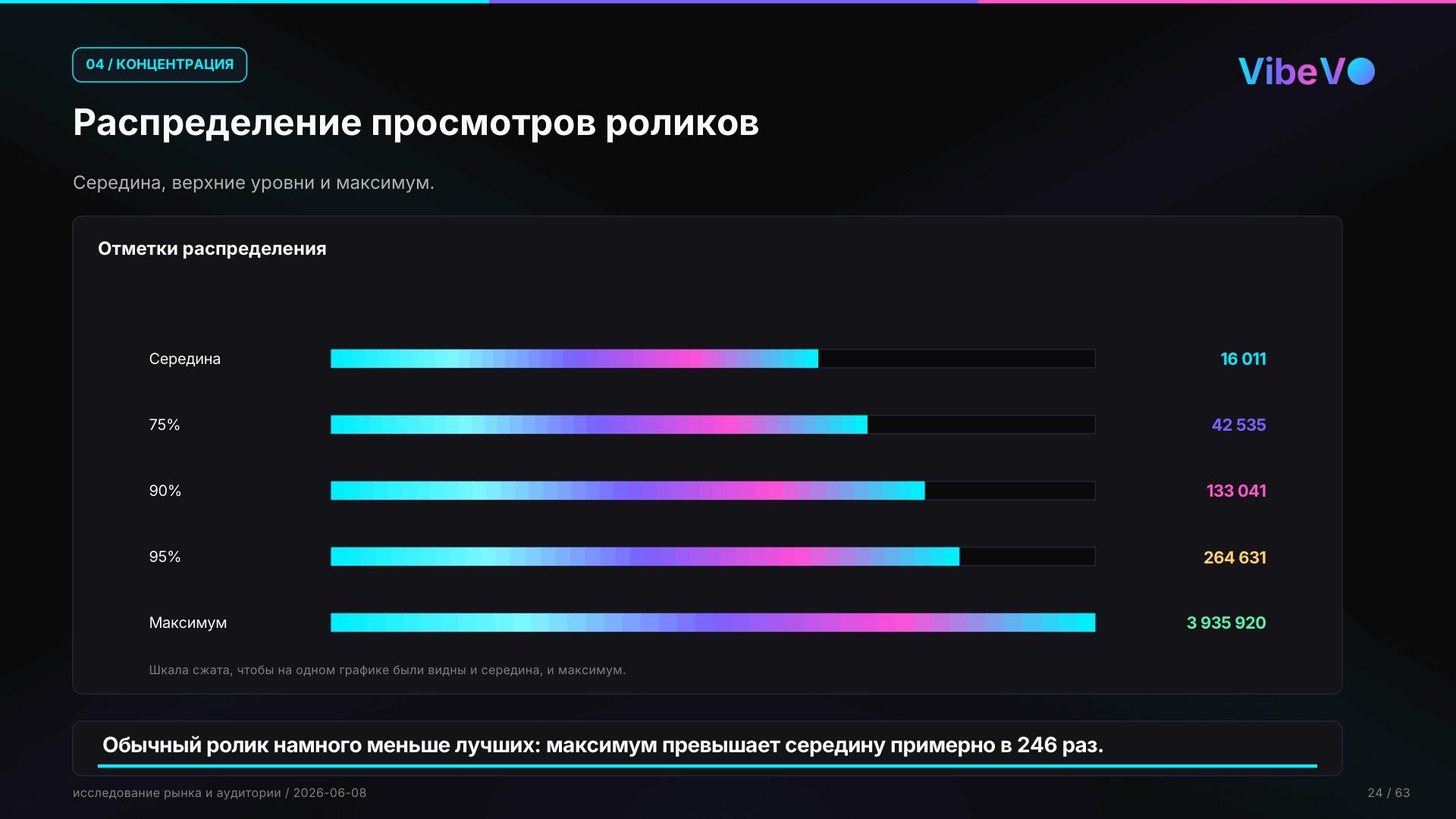
    In short feeds, the average result hides a very strong unevenness. The average number of views is 16,011 views over 30 days. The 75th percentile is 42,535 views, the 90th percentile is 133,041. The maximum video garnered 3,935,920 views, which is approximately 246 times more than the median. As expected, the distribution is very uneven.

    Even more illustrative is the share of the best publications. The top 10 videos generated 23.88 million views, or 9.3% of the volume. The top 50 videos – 62.48 million, or 24.3%. The top 10% of videos collected 165.54 million views, or 64.3% of all views. In other words, most views are generated by the top 5% of videos.

    A practical conclusion for advertising in video clipping: you cannot rely on a single video. You need a set of video clips with different first seconds, titles, subtitles, overlays, and advertising message options. It’s not just the most beautiful video that wins, but a series of attempts where the best publications quickly gain more weight.

  • Content Repurposing: How to Create 100 Unique Creatives from One Video

    Content Repurposing: How to Create 100 Unique Creatives from One Video

    Stop creating new content! It’s time to learn how to effectively use what you already have. Look into your team’s shared folders: there’s probably a dusty branded video that took six weeks and a five-figure budget to create, or a webinar recording with a minuscule number of views. Perhaps there’s a product landing page that has never been attached to an email by the sales department, or a transcript of a customer interview read only once. All this work wasn’t bad, but it stopped immediately after publication. In this article, we’ll explore how content repurposing can help you turn one video into 100 unique creatives.

    Meanwhile, your quarterly plan demands even more: more materials, more channels, higher speed. You continue to create, the folder grows, and the true measure of team effectiveness is not the volume produced, but how much of it actually works. This gap costs real money, and it’s easy to overlook.

    Video DNA: How to Break Down Content into “Molecules”

    Blythe Morrow, VP of Product Marketing, directly addresses the math of channels: your buyer may be active on twenty channels, but “you can only fund and support content, communications, and the social aspect on five of them.” Everything you create for the other fifteen must spread further than just the “publish” button.

    This issue surfaced in three recent conversations on the Supercharge Marketing podcast with experts who approach it from different angles:

    • Caroline Crawford, CEO and Founder of Cultiveight Communications, rebuilds content strategies for B2B teams.
    • Francisco Chamorro, Director of Marketing and Communications at BBSI, views content distribution as an operational task.
    • Blythe Morrow, an expert with seventeen years of experience in product marketing.

    Plan the “Splitting” Before Creation

    “They always talk about the ‘what,’ but not enough about the ‘why’ and ‘how it will be distributed,’” says Caroline, describing a typical content meeting.

    The team discusses whether to make branded videos, ads, or blogs. But no one thinks about what will happen the next day. She has seen the end of this story many times: a company spends fifteen thousand dollars on branded videos, publishes them on social media, and, in her words, “tens of thousands of dollars go down the drain.”

    The failure is not in the video, but in the fact that all the budget and energy went into its completion. “All the energy went into making it, and they think that in itself will bring success,” Caroline says. “But it doesn’t. It’s about how you apply it and how you maximize your investment.”

    The solution is a planning stage that costs nothing and is almost always skipped: before starting production, think about how the finished material will be “taken apart.” One long article becomes the source for a lead magnet, a series of newsletters, a set of social media posts, and a video. One recorded conversation can provide material for weeks. Caroline describes this as “repackaging” content into “little pieces that tell your story in different ways.” Planning ahead allows you to shape what you film, write, and structure from the outset.

    First Scale, Then Clone

    Francisco comes to the same conclusion from the operational side. His advice to his past self: “if you’re going to build something, build it so it’s repeatable before you scale.” If you work too hard on one big launch, you get one launch. If you create a format your team can use again, the second time will be many times cheaper.

    Repetition Matrix: No One Saw It the First Time

    Most content is “retired” after one publication, based on the unspoken assumption that the audience has seen it and moved on. Francisco believes this assumption is flawed. “If you spend time and value this material, know that it won’t be seen 100% the first time,” he says. “Therefore, it’s important to reschedule it.”

    “Your job is to give content the longest possible life support,” — Francisco Chamorro.

    This means that cadence (publication frequency) is part of the asset, not just a nice-to-have. Francisco applies this same concept internally and externally, based on two principles: consistency and relevance. “People love repetition.” Communications go out on a predictable day, so the audience forms expectations. And the calendar is edited by data, not opinions: “When we create a topic that works well, we do more of that. When a topic doesn’t work, we discard it.”

    Caroline adds that this doesn’t turn into spam if the content is created with intent. Many B2B teams are so afraid of being “noise” that they publish every two months, draining their funnel. She argues that noise is a function of sameness, not frequency. Repeat the same message in the same format, and people will tune out. Repeat the same message, but “repackaged,” and it will feel new. That’s why the planning stage mentioned earlier is so important. A team that has planned six formats in advance has six legitimate ways to repeat the same thing.

    Expert Approach: Creating “Raw” Material

    In the Room with Clients: Capture Live Video-DNA

    Blythe’s answer to “what to do next” is to stop guessing. Product marketers, she says, “get into their own echo chamber,” and then “play broken telephone with sales,” where sales gives feedback to customers, and marketing gives it to product, and the original words are lost by the second stage.

    Her recipe: get out of the office, talk to sales, sit in on customer calls. Instead of webinars, which she describes as “one-to-many lectures,” she runs small workshops. About twelve people. Cameras on. An honest conversation about what’s happening in their industry, not a product presentation. Product managers and customer success are present and listening.

    Running these meetings regularly yields quick results: 150-160 people a year with whom you’ve had a real conversation, who then populate your LinkedIn and Slack communities and amplify your message publicly. Each sales manager is assigned one roundtable, and the follow-up call becomes “warm” because, as Blythe says, “they are much more likely to pick up the phone and talk to you because you’ve already shown that you value them.”

    And the content problem solves itself as a side effect. Each workshop, she says, “creates incredible content that you can then give to the demand generation team to slice and dice 100 different ways and use for the many campaigns we’re trying to run at the same time.”

    The raw material, created in the language of real customers, is the one that will be used because it already sounds like the market.

    Internal Audit: If Sales Doesn’t Use It, It’s Not Content, It’s a Warehouse

    Francisco is direct about priorities: “I don’t care how cool your video or campaign is, your internal users have to believe in it first. If not, it won’t be successful.” Beautifully crafted material without internal adoption has an audience of zero, so “spending the time and effort to make sure what you’re doing helps your sales team is critical.”

    Repurposing content: how to make 100 unique creatives from one video — illustration 2

    Blythe agrees and clarifies: product marketing is “the custodian of the message, the words we use to describe what we sell.” And the artifact that makes this real is a detailed, open-to-use messaging guide. Her guide covers long and short-form positioning, industry tailwinds and headwinds, every persona (where they live, what they struggle with), and the same depth on competitors. Then the part most teams miss: “keep it updated, share it often, refer to it constantly, and keep adding to that library.”

    She also names a failure mode that’s worse than a vague message. Confused copy at least announces itself. “When it gets specific but in the wrong way because you haven’t thought about who you’re selling to, then that becomes dangerous,” she says, “because you don’t know if it’s working or not.” This is the asset that gets created, approved, published, and quietly underperforms for a year while everyone assumes the channel is the problem.

    Reverse-Engineering the Path: From Clip to Conversion

    Content that never converts isn’t always left unseen. Sometimes it’s seen, then abandoned because the reader has nowhere to go. Caroline’s version of the question: you’ve published repurposed clips, so “what’s the path back to you?” If you haven’t built a route from the public channel to your website, trial, or sales team, “then you’re making it up as you go,” and that’s where the cracks appear.

    She’s equally direct about the order in which teams work. “I think people do it backwards,” she says. “They say, ‘Oh, let’s make this lead magnet, and then we’ll figure out the email.’” Flip that. Decide what the email program is for, then build the lead magnet that feeds it. Her core principle applies to every step of the journey: “the more thought effort it takes for them to do what you want, the less they’re going to do what you want.”

    The same discipline applies to your tech stack, and this is where Francisco is most helpful. He sees two traps in almost every team: “One is that they let the tools drive their strategy. And the other is that they don’t use their tools to their full potential.” Before buying anything, he offers one question: “if you’re paying for software, make sure to ask yourself, am I using it to its full potential?” And about the integrations everyone builds because they can, his rule is worth writing down: “integrating for the sake of integrating is not something I would spend my efforts on.”

    Blythe would add that none of this is cause to be ashamed of a lack of resources. “Everybody is under-resourced,” she says. The teams that get ahead aren’t the ones with more people, but the ones whose existing work covers more of the channels where their buyers are.

    The Bottom Line: How to Cheat the Algorithms and Scale Content

    Don’t start by planning a new asset. Start by auditing last quarter. For each piece of content, ask three questions:

    1. Was it ever republished after the first week?
    2. Was it ever used by sales?
    3. Was it ever cut into a second format?

    Anything that scored zero on all three isn’t a content problem. It’s a distribution and adoption problem, and creating new won’t solve it. Then, pick one asset that deserved better, and give it the second life it never got.

    For more in-depth conversations, listen to Caroline Crawford on intentional marketing for lean marketers, Francisco Chamorro on the science and art of marketing, and Blythe Morrow on how product marketing shapes strategy from messaging to sales alignment.

    Turning one asset into many is exactly what Lumen5 is built for. Teams use it to transform articles, transcripts, and documents they already have into polished video, with brand kits that keep colors, fonts, and logos consistent no matter who on the team is making it. That means less time rebuilding from scratch and more control over how your brand shows up on every channel.

    Ready to dive deeper into what full-funnel B2B marketing looks like at scale? Listen to the full conversations on the Supercharge Marketing podcast, available everywhere you listen to podcasts.

    Lumen5 helps B2B marketing teams produce more video content faster and at a fraction of traditional production costs. Learn more or book a demo.

    Frequently Asked Questions

    What is content repurposing?

    Content repurposing is the process of re-adapting existing content into new formats or for new audiences to maximize its value and reach. For example, a webinar can be turned into articles, short videos for social media, podcasts, and infographics.

    How to make 100 unique videos from one?

    To create many unique videos from a single source, use cutting, reformatting, and adding new elements techniques. For example, from a long webinar, you can cut dozens of short clips for TikTok, Shorts, or Reels, changing the background, adding subtitles, voiceovers, or musical accompaniment. Tools like Lumen5 automate this process.

    Does repurposing help bypass ad bans?

    Yes, content uniqueization through repurposing can help bypass ad bans. Publishing the same creative on different platforms or repeatedly using the same “clone” increases the risk of a ban. Creating variations with altered “video DNA” (visual elements, voice timbre, structure) helps anti-fraud algorithms perceive them as new content.

    Should I order new content or repurpose old content?

    It is optimal to combine both approaches. Creating new, high-quality “raw” material, specifically designed for subsequent “splitting” into many unique units, is the most effective strategy. This allows for significant budget and time savings compared to constantly creating content from scratch.

    How does repurposing affect SEO?

    Content repurposing positively affects SEO because it allows you to create more relevant content on key topics, increase the number of internal and external links, improve behavioral factors (due to format diversity), and enhance visibility in search engines. It also helps reach different audience segments who prefer various information consumption formats.