Additional example from a separately published analysis; checked 03.09.2026. This is repurposing an event archive into short videos. The figures are for a three-month channel development period and do not prove that all growth is due solely to snippets. The budget is not published, so CPM and CPV are not calculated. Views are not equal to unique reach. Views are not equal to unique reach or sales. Conclusions about marketing mechanics are an editorial analysis; the presence of a campaign around a brand does not necessarily mean its direct placement.
An event archive can hold powerful ideas that new viewers never discovered. GitHub used recordings of long talks and events as material for short videos to introduce itself to a new audience of developers. The published analysis describes the repurposing of the accumulated archive and the sequential release of materials. This is a story of working with proprietary branded content; a contest for authors or payment for views is not described in it.
Cutting long videos into short ones gives a single presentation several independent entry points. Video clipping helps select a specific idea or fragment that is interesting without watching the entire event recording. For a technology brand, this is a useful way to bring already created material back into use and present it to people who are not yet familiar with the full archive. The published metrics relate to the period of implementing this approach. They should be read as general dynamics, not attributing every view and subscription exclusively to short videos.
Do you have recordings of conferences, presentations, or meetings with experts? Launch a video clipping campaign on VibeVO to have authors help find stories in your archive for a first introduction to your brand.
Data cut-off 03.09.2026. CPV = CPM ÷ 1,000. This is the reward rate with eligibility conditions and limits, not the actual cost of the entire campaign. Fund does not equal expenses. Views are a total counter, not unique reach; approved works are counted separately. The range reflects different distribution conditions. Views do not equal unique reach or sales. Conclusions about marketing mechanics are an editorial analysis; the presence of a campaign around a brand does not necessarily mean its direct placement.
Basketball author Jesser has familiar material — complex shots, challenges, and Bucketsquad content. In the campaign, editors were invited to work with his new video: select fragments, publish short versions, and receive remuneration for views. The connection to the fresh release was important: additional videos were supposed to support the author’s current story, not a random cut from the archive.
Data cut 09/03/2026. CPV = CPM ÷ 1,000. This is a reward rate with eligibility conditions and limits, not the actual cost of the entire campaign. The fund does not equal expenses. Views are a total counter, not unique reach; approved works are counted separately. The range reflects different distribution conditions. Views do not equal unique reach or sales. Conclusions about marketing mechanics are an editorial analysis; the presence of a campaign around a brand does not necessarily mean its direct placement.
The Persona 4 Revival campaign for the North American audience was built around a story trailer and the upcoming Microsoft broadcast. Authors were invited to release short content that supports anticipation and interest in the game. Thus, clipping found its place between two information occasions: there is already material for discussion, and ahead is an event to which attention can be directed.
Video clipping can connect two information occasions: analyze already published material and support anticipation for the next event. The task of turning a long video into cuts here acquires a clear meaning — to give the audience separate topics for attention between major announcements. Different authors choose different scenes, so reminders do not have to repeat the same video. For a marketer, the general guideline is important: each short story should relate to the current stage of promotion and maintain a connection with what is yet to be seen.
Data snapshot 03.09.2026. CPV = CPM ÷ 1,000. This is a reward rate with admission conditions and limits, not the actual cost of the entire campaign. Fund does not equal expenses. Views are a total counter, not unique reach; approved works are counted separately. The range reflects different distribution conditions. Views do not equal unique reach or sales. Conclusions about marketing mechanics are an editorial analysis; the presence of a campaign around a brand does not necessarily mean its direct placement.
A new game world cannot be fully explained in a short video, but it can spark a desire to learn more. In the Metaphor: ReFantazio campaign, official trailers served as the source. Authors were offered to cut fragments from them and publish short versions; the task itself was related to pre-orders and themes of battles and adventure. This set a general direction while preserving space for choosing individual scenes.
Cutting long videos into short ones gives a complex game world several first impressions. Video clipping allows one video to focus on action, another on atmosphere, while maintaining a common source in official materials. The viewer gets a small, understandable scene and can decide if they are interested in learning more. For promoting a rich product, this is a useful principle: the first acquaintance does not have to contain everything. Selecting a fragment becomes a way to choose one reason to take a closer look at the game and give that reason enough space in the frame.
Does your project have many stories and visual details? Launch a video clipping campaign on VibeVO so that authors can find different first scenes to introduce this world.
Data cut-off 03.09.2026. CPV = CPM ÷ 1,000. This is a reward rate with admission terms and limits, not the actual cost of the entire campaign. Fund does not equal expenses. Views are a total counter, not unique reach; approved works are counted separately. Views do not equal unique reach or sales. Conclusions about marketing mechanics are an editorial analysis; the presence of a campaign around a brand does not necessarily mean its direct placement.
The title already evokes associations, and the documentary format offers an additional reason to take a closer look: to hear from the people who lived this story themselves. In The Real Wolf of Wall Street campaign, the material for clipping included episodes of the show, exclusive behind-the-scenes footage with participants, and podcast snippets. This combination allowed for short videos to be made around different levels of access to the same story.
Video clipping uses the gap between a familiar title and unknown details of the real story. Cutting podcasts into short videos complements show scenes and behind-the-scenes footage: each type of material promises its own level of access to the participants of the events. The editor can choose one answer or episode that raises a specific question, leaving the full story outside the video. For a documentary project, this is a natural mechanism for introduction. A short fragment shows what new perspective the viewer can gain if they decide to watch the whole story.
Do you have a documentary project, interviews with participants, or behind-the-scenes footage? Launch a video clipping campaign on VibeVO so that each such material becomes an independent reason to learn the whole story.
Data snapshot 09/03/2026. CPV = CPM ÷ 1,000. This is a reward rate with admission terms and limits, not the actual cost of the entire campaign. Fund does not equal expenses. Views are a total counter, not unique reach; approved works are counted separately. Views do not equal unique reach or sales. Conclusions about marketing mechanics are an editorial analysis; the presence of a campaign around a brand does not necessarily mean its direct placement.
Boxabl’s product itself contains a scene for a short video: the Casita house is delivered folded and unfolded on site. In the campaign, authors were offered pre-approved materials — production tours, house reviews, and footage with famous participants. From this array, they had to select moments capable of quickly showing the product’s uniqueness and generating interest in the brand.
Cutting long videos into short ones is especially interesting where the product requires explanation. Videoclipping allows you to choose one illustrative scene: the transformation attracts attention, and a tour fragment answers the question that arises. Different videos can show different sides of a complex subject, maintaining a clear focus for each video. For a marketer, the demonstration material itself is valuable here. If the device’s mechanism is visible in the frame, the author only needs to choose the moment and present it so that the viewer has time to be surprised and understand what happened.
Do you shoot tours, reviews, or demonstrations of your product? Launch a campaign on VibeVO and invite authors to turn these materials into short, clear stories about how it works.
Data cut-off 03.09.2026. CPV = CPM ÷ 1,000. This is a reward rate with eligibility conditions and limits, not the actual cost of the entire campaign. Fund does not equal expenses. Views are a total counter, not unique reach; approved works are counted separately. Views do not equal unique reach or sales. Conclusions about marketing mechanics are editorial analysis; the presence of a campaign around a brand does not necessarily mean direct placement by the brand.
A pack of collectible cards opens in a few seconds. But for an avid collector, these seconds contain an entire drama: what will be inside? In the campaign for eBay Live sellers, the source material was recordings of such unboxings. Editors were offered to extract the most expressive finds and reactions from long broadcasts, turning them into short, emotional stories.
Such cutting of long videos into short ones preserves the most emotional part of the broadcast: anticipation, discovery, and reaction. For sellers, video clipping can be a way to explain the appeal of collecting without a long lecture about card series. Highlight editing is especially useful when the pleasure of a product is hard to describe in words but easy to see on a person’s face. It’s important to leave enough context so that the good fortune is understandable to a new viewer, and the emotional episode is linked to the process of buying and opening itself.
Are there recordings of unboxings or demonstrations where viewers are genuinely surprised? Use them as the basis for a campaign on VibeVO: a short story can begin precisely with this reaction.
The video clipping market is rapidly developing, transforming from a simple video cutting tool into a powerful channel for advertising reach. A joint study by VibeVO, a video clipping platform, and Go Influence, an influencer agency, sheds light on the current state of the short video, video clipping, and social media banner advertising market, demonstrating how these formats are becoming key for brand promotion.
Short vertical videos have long ceased to be just entertainment. For companies, it is already an independent promotion environment. A single episode, interview, live broadcast, review, or conversational recording turns into a series of short videos, each of which can become a separate point of contact with the audience.
This study was prepared by VibeVO and Go Influence based on VibeVO data for the last 30 days as of June 8, 2026. The indicators describe the studied array of short videos and do not claim to evaluate the entire internet. However, the database is large enough to see the main patterns: concentration of views, differences in platforms, thematic cores, and audience within topics.
A brief version of the study is published on Sostav.
Key figures of the study
Indicator
Value
Views in the saved 30-day volume
252.81 million
Videos
4,224
Authors in the database
141
Pages in the database
228
Ad launches
16
Share of the three main topics
86.1%
Audience coverage
99.2%
Graphs from the updated table
29
Main conclusion: the video clipping market can no longer be described only as mechanical video cutting. It is developing as a tool for managed advertising reach, where the topic, platform, author, release speed, design, placement environment safety, and result measurement are important. Banner advertising in social networks also changes its role: it works not separately from the video, but during viewing or next to it.
Why short video has become a mass format
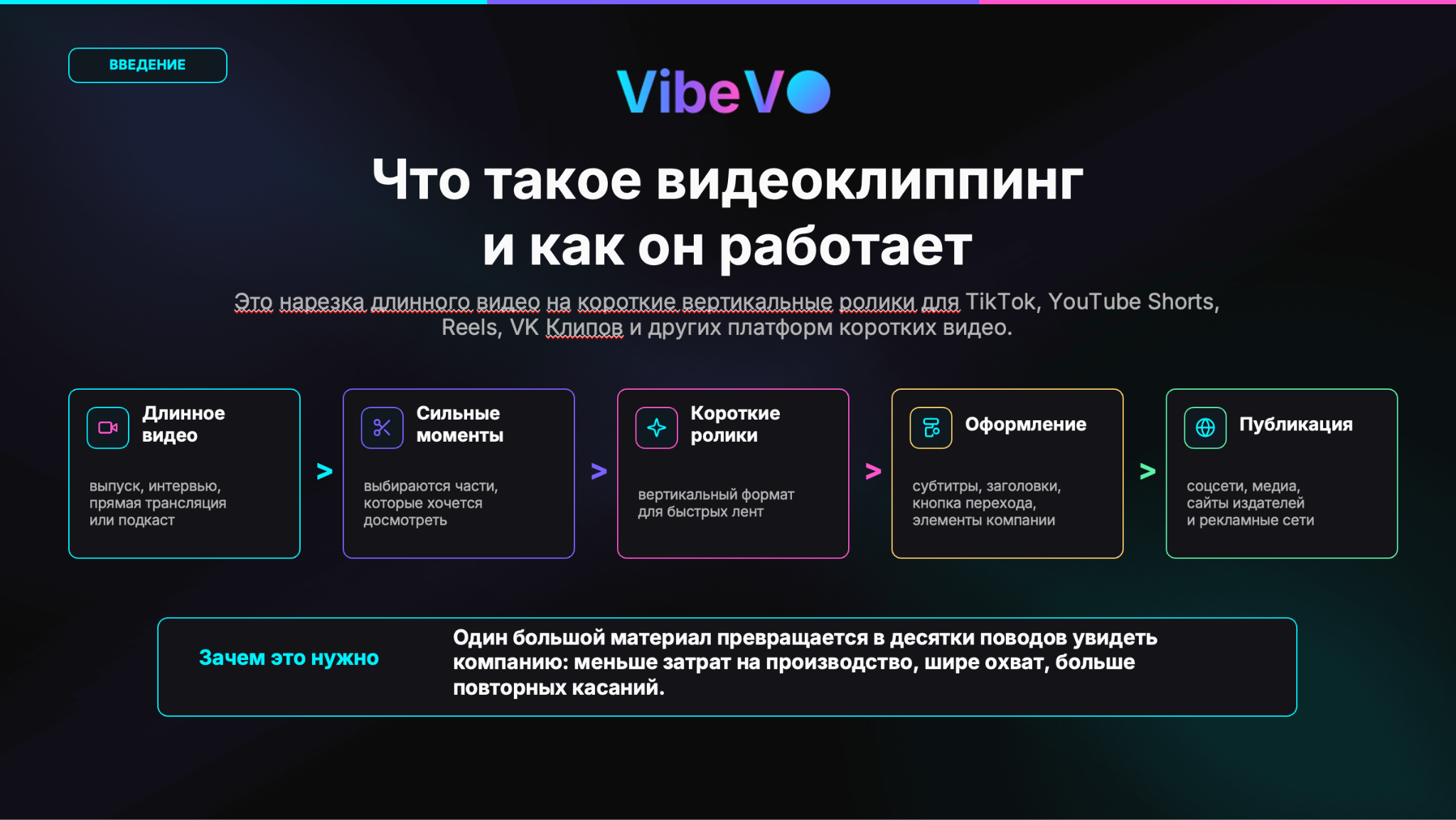
Video clipping is the transformation of long material into short vertical videos for recommendation feeds and author publications. The original video is broken down into strong moments, each fragment receives subtitles, a title, design elements, and a clear next step: go, save, watch to the end, take advantage of an offer, or learn more.
The economics of this approach are simple: one large piece of content provides dozens of reasons to re-engage with the audience. Instead of a one-off release, a company gets a series of repeated touchpoints, and platforms get content that is easier to distribute in fast feeds. Therefore, video clips are becoming not an auxiliary technique, but a separate way to buy attention.
External benchmarks in the presentation show why this shift has become widespread:
TikTok users spend an average of 95 minutes per day on the app.
Video advertising spending on the internet in the US exceeds 80 billion dollars.
Even if markets and platforms differ by country, the logic of consumption itself is already obvious: attention has shifted to short videos.
Chart 1. How video clipping works: the path from a long episode to a series of short videos. Source: VibeVO data, updated 08.06.2026. Click on the chart to open it in full size.
Overall picture: topics and platforms
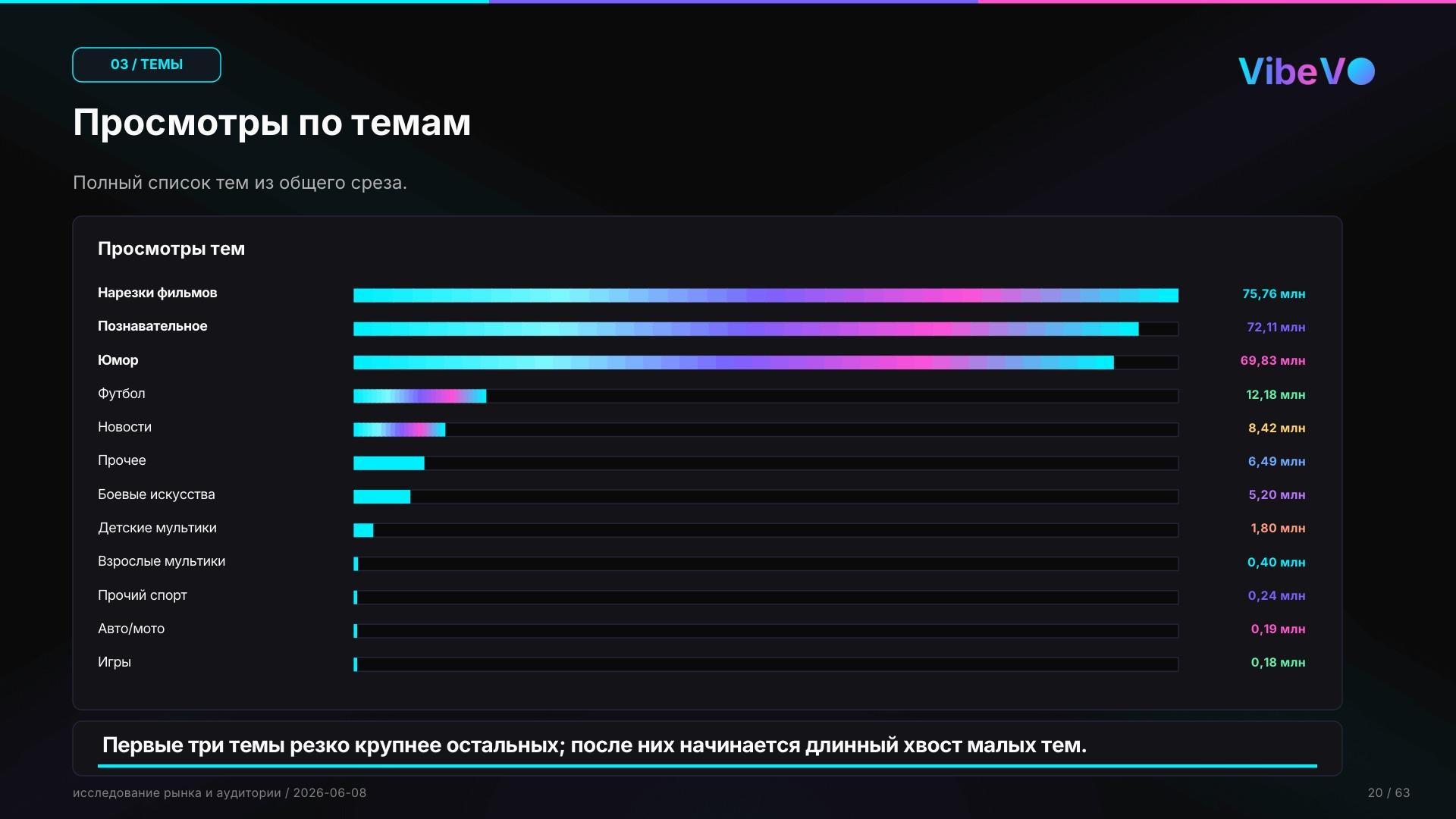
In the updated cut, the market looks concentrated. The three largest topics — movie clips, educational videos, and humor — account for 86.1% of the saved volume. Movie clips garnered 75.76 million views in 30 days, or 30.0%. Educational videos yielded 72.11 million views, which is 28.5%. Humor is almost at the same level: 69.83 million views, or 27.6%.
After the top three, a long tail begins: football — 12.18 million views, news — 8.42 million, other topics — 6.49 million, martial arts — 5.20 million. Children’s and adult cartoons, other sports, auto and moto, games are significantly less represented in the studied cut. This is an important caveat for placements: small topics cannot be generalized by the same rules as the largest ones.
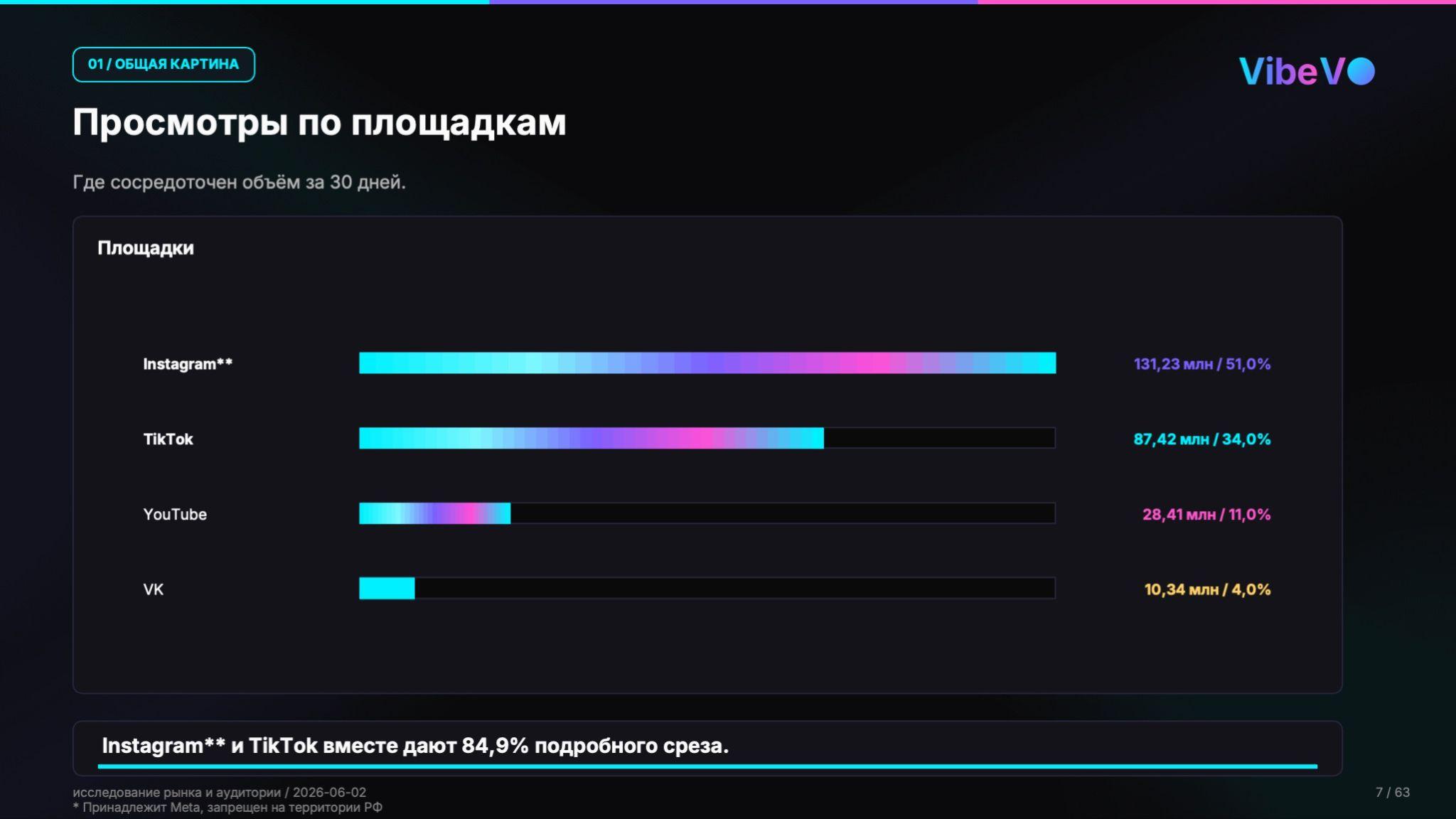
By platforms, Instagram* became the leader: 131.23 million views, or 51.0% of the detailed volume. TikTok yielded 87.42 million views, or 34.0%. Together, they form 84.9% of the detailed cut, but other platforms do not disappear: they can be important for individual topics, creators, and strong publications.
Chart 2. Views by topic over 30 days: the three largest topics are significantly larger than the rest. Source: VibeVO data, updated 08.06.2026. Click on the chart to open it in full size.Chart 3. Views by platform: Instagram* and TikTok form the bulk of views. Source: VibeVO data, updated 08.06.2026. Click on the chart to open it in full size.
Database size and strength of individual platforms
The database includes 4,224 videos with an active topic, 141 authors, 228 pages, and 16 advertising campaigns. This allows us to look not only at the overall volume but also at how platforms behave differently. Some provide scale, while others provide a stronger upper part of publications.
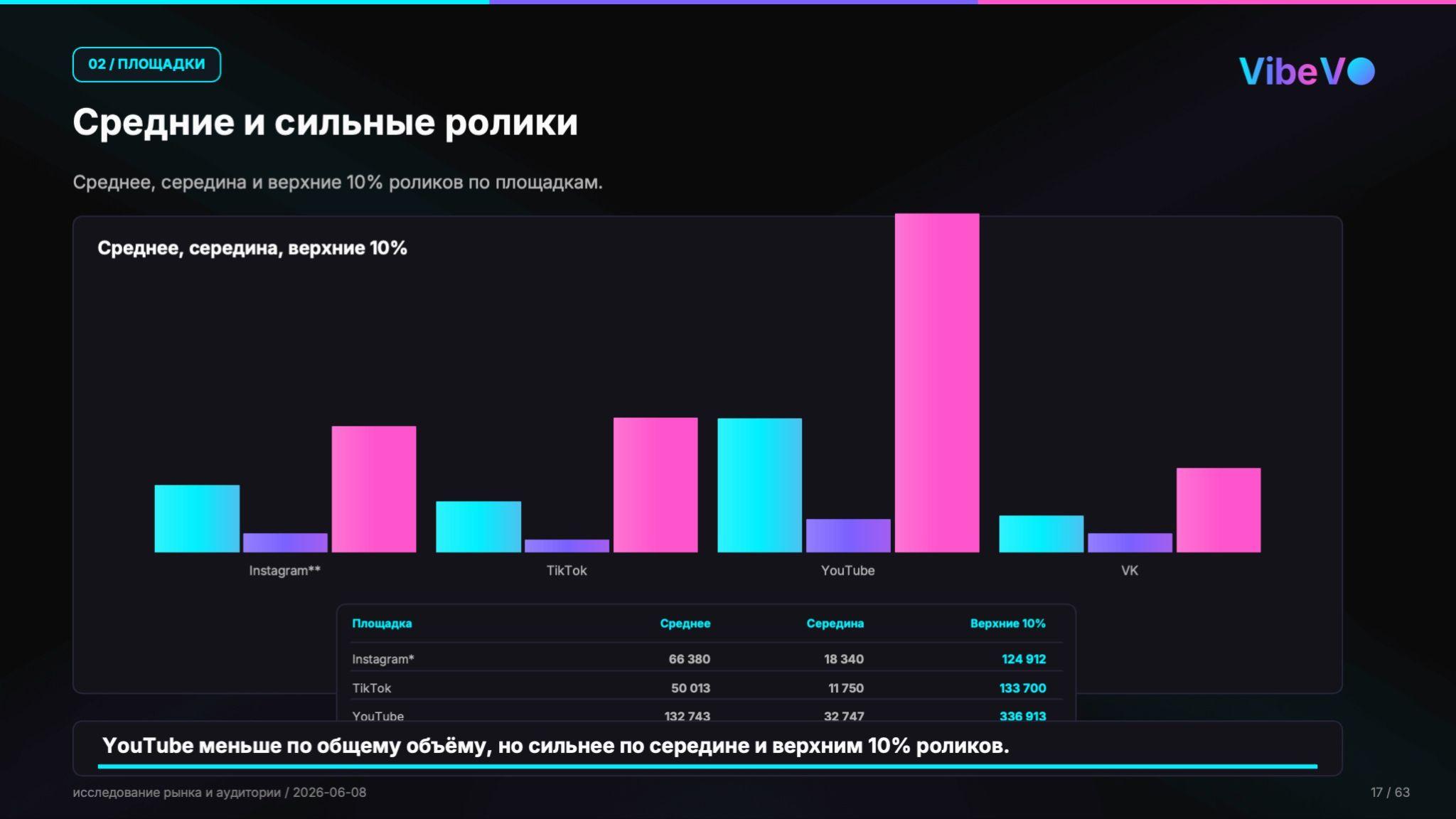
Instagram* leads in overall volume, but YouTube’s algorithms react more sharply to viral videos and give them a larger share of reach. On average, one video on YouTube received 132,743 views. For Instagram*, the average was 66,380, and for VK, it was 36,277.
Such a distribution changes the placement plan. Mass reach is logically sought in large Instagram* and TikTok bundles, but if there is viral content, YouTube can be a platform where it is easier to gain reach.
Chart 4. Distribution of reach among the top 10% most popular, median and average values by platform: YouTube is smaller in overall volume but stronger in the top 10%. Source: VibeVO data, updated 08.06.2026. Click on the chart to open it in full size.
It is better to analyze topics in bundles: topic plus platform
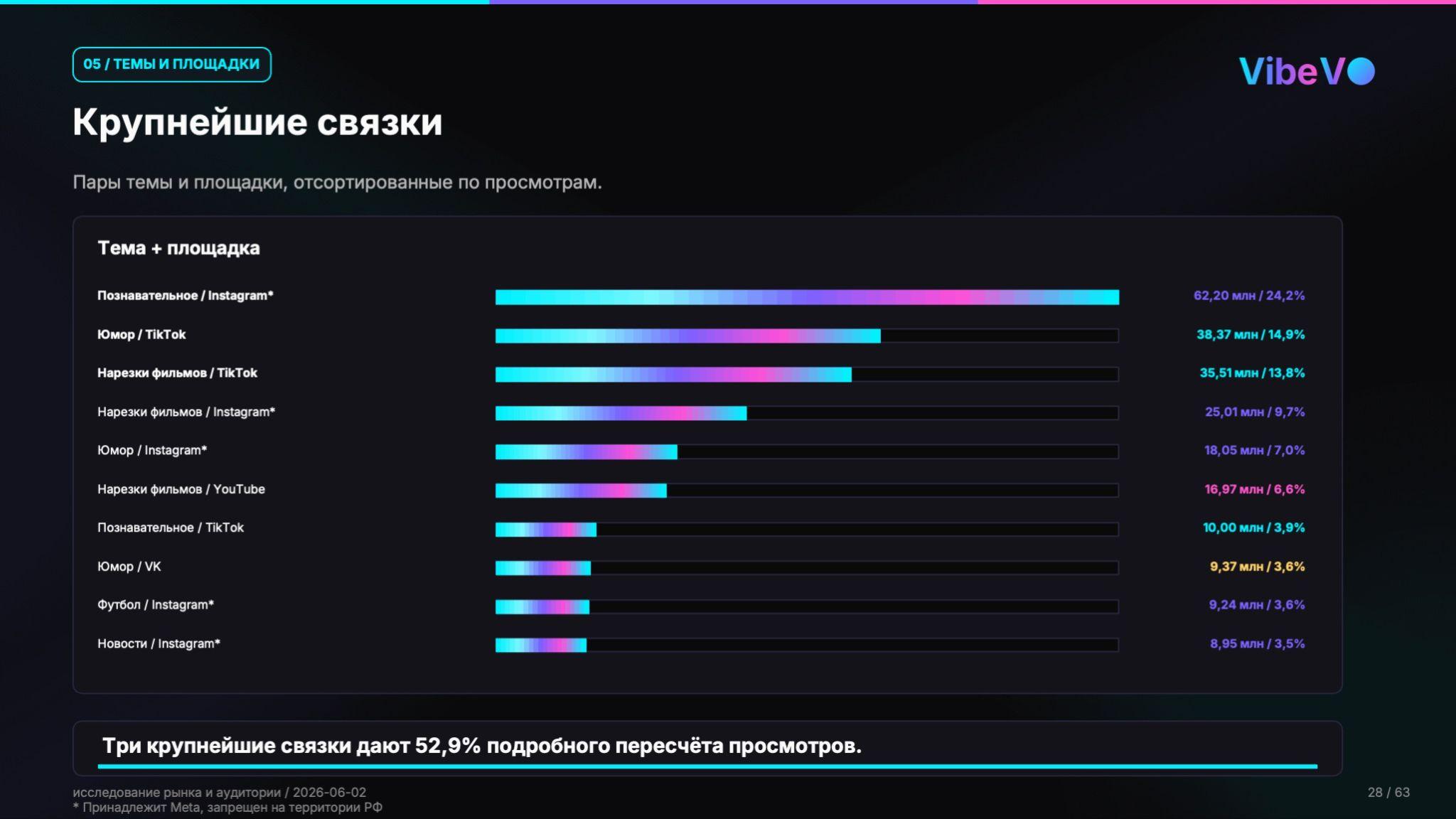
The total volume across the platform does not fully explain the market. The largest reach points occur where the topic and the distribution medium coincide. In the updated data, the largest combination is educational videos on Instagram*: 62.20 million views, or 24.2% of the detailed recalculation. This is followed by humor on TikTok – 38.37 million views, or 14.9%, and movie clips on TikTok – 35.51 million views, or 13.8%.
The three largest combinations account for 52.9% of the detailed recalculation of views.
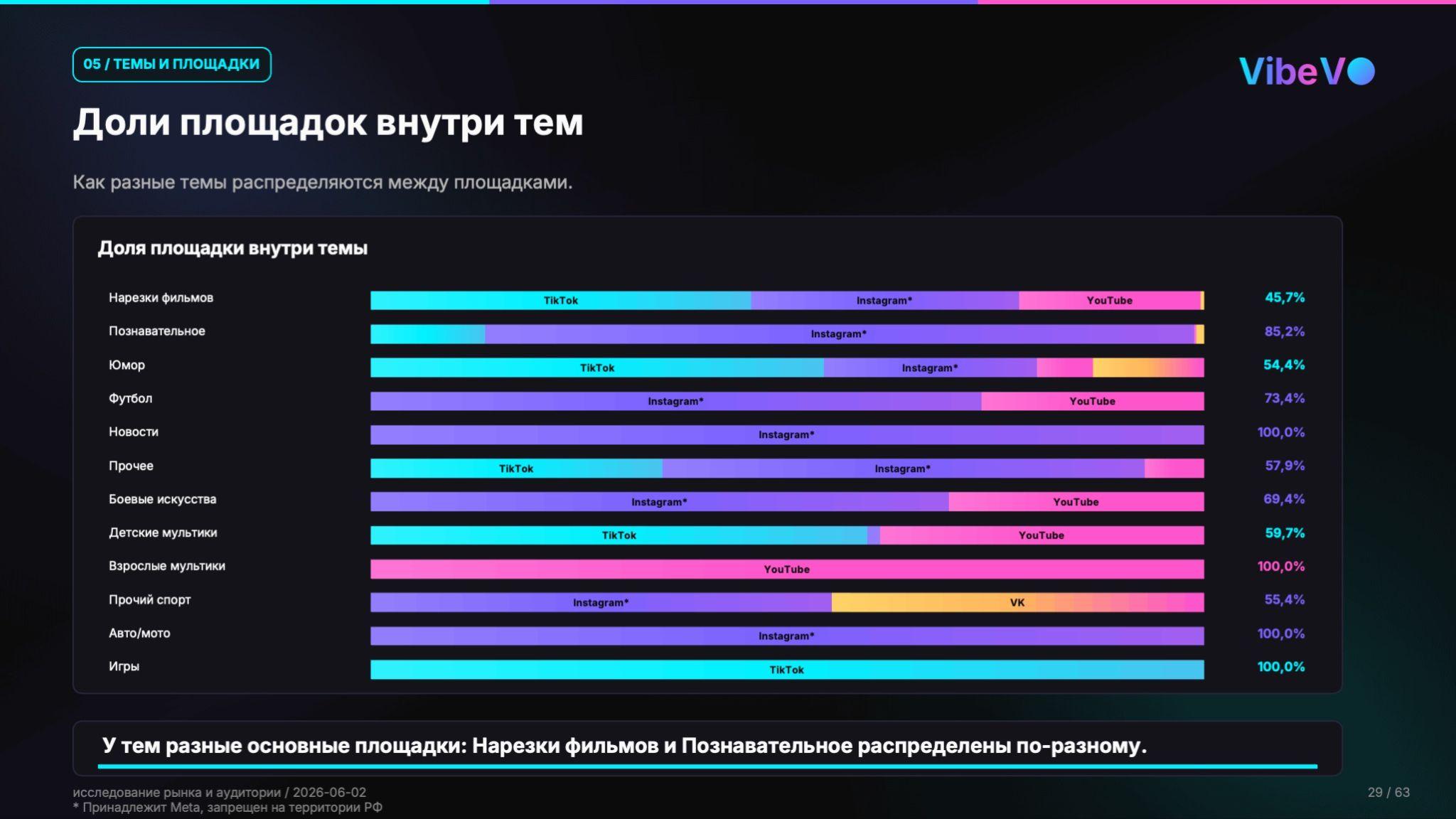
That is why video clipping cannot be launched using a single general grid for all tasks. For educational videos, auto/moto, Instagram* works better; humor, games, and movie clips rely heavily on TikTok; adult cartoons rely on YouTube. Different topics require different platforms, creators, and designs.
Chart 5. Largest topic and platform combinations: main volume arises from several combinations. Source: VibeVO data, updated 08.06.2026. Click on the chart to open it in full size.Chart 6. Platform shares within topics: different topics have different main platforms. Source: VibeVO data, updated 08.06.2026. Click on the chart to open it in full size.
Views are sharply distributed: the top portion of videos yields results
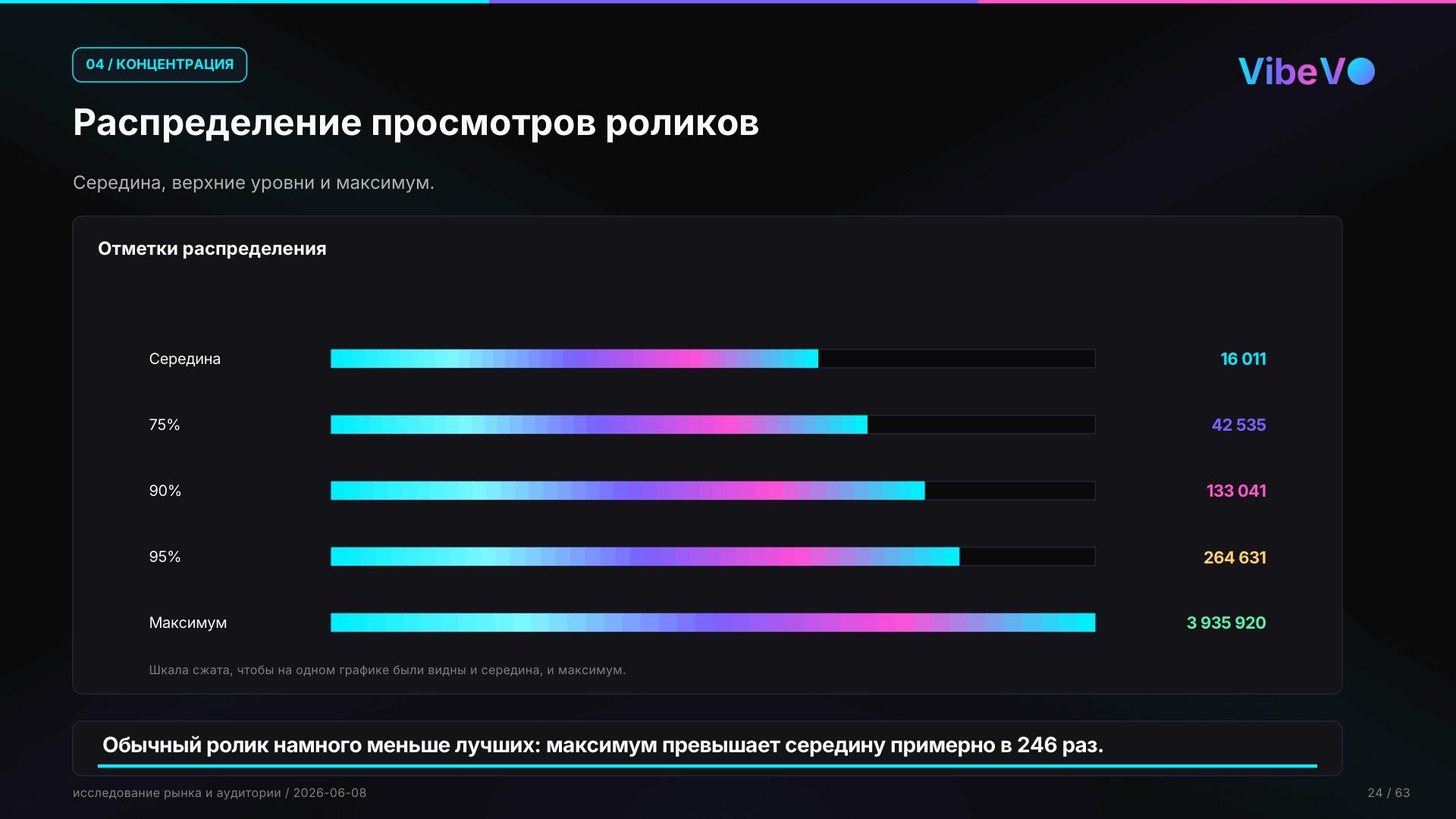
In short feeds, the average result hides a very strong unevenness. The average number of views is 16,011 views over 30 days. The 75th percentile is 42,535 views, the 90th percentile is 133,041. The maximum video garnered 3,935,920 views, which is approximately 246 times more than the median. As expected, the distribution is very uneven.
Even more illustrative is the share of the best publications. The top 10 videos generated 23.88 million views, or 9.3% of the volume. The top 50 videos – 62.48 million, or 24.3%. The top 10% of videos collected 165.54 million views, or 64.3% of all views. In other words, most views are generated by the top 5% of videos.
A practical conclusion for advertising in video clipping: you cannot rely on a single video. You need a set of video clips with different first seconds, titles, subtitles, overlays, and advertising message options. It’s not just the most beautiful video that wins, but a series of attempts where the best publications quickly gain more weight.
Forget about bloggers! A new “millionaire” has appeared on the market – micro-dramas. This is not just a trend, it’s real math: reach for pennies and transparent statistics. While Hollywood studios sign contracts and influencers try to fit in, we see how this format is blowing up the market. But is it worth the candle for an arbitrager?
Micro-dramas: Explosive Growth and Billion-Dollar Downloads
According to Mintegral, a platform that “turns engagement into growth with AI,” micro-drama app downloads reached 1.45 billion in the first half of 2026. This is a 95.5% increase from the previous year. In comparison, non-gaming apps showed an average growth of only 16.6%.
Market leaders: FreeReals (195.8 million downloads) and NetShort (98.9 million downloads).
Market context: Educational apps grew by 25.3%, while e-commerce was the only category that showed a decline of 4.4%.
The most interesting thing for us, arbitragers: ad density. Although e-commerce apps showed a larger volume of advertising (13.3 million ads in 12,800 apps), micro-dramas surpassed them in density.
During the same period, 1,887 micro-drama apps placed 3 million ads.
“Micro-dramas had an ad density of 1,100 in Europe, Southeast Asia, and Asia-Pacific, making it the only category to reach that level of density across three regions,” reports Marketing Dive.
In North America, ad density in micro-dramas was 977 ads per app. For comparison, for e-commerce, this figure was 545 in Europe, 804 in Southeast Asia, and 581 in Asia-Pacific.
This suggests that in micro-dramas, banner advertising in video is an unskippable format with huge potential.
Such ad density means that buying reach without creating a video, simply by placing a banner for infobusiness or promoting mobile applications, becomes extremely profitable. This is the lowest CPM in shorts you can find.
Real Math: Watch Time Is More Important Than Downloads
Downloads are good, but for us, reach and watch time are important. An Omdia study in February showed that apps like ReelShort, DramaBox, and FlickReels outperform Netflix, Prime Video, and Disney+ in daily usage time per user.
This means that mass reach for pennies is not a myth, but a reality.
Our experience confirms that testing hypotheses for 1000 rubles in this segment allows you to quickly find working bundles. CPM cheaper than 50 rubles is not fantasy. We are talking about programmatic video banners and automatic placement on hundreds of videos, where a banner without filming becomes your main tool.
Frequently Asked Questions
What are micro-dramas and why are they so popular?
Micro-dramas are short series, often in vertical format, created for viewing on mobile devices. Their popularity is due to the fast pace of life, the convenience of consuming content “on the go,” and a high level of engagement.
How to place banner advertising in micro-dramas?
Banner advertising in micro-dramas is placed through specialized platforms and advertising networks that offer programmatic tools for targeting and automatic placement. This allows you to effectively order banner advertising and get cheap reach.
Can micro-dramas be used to advertise crypto projects?
Yes, high ad density and an active audience make micro-dramas an attractive platform for advertising crypto projects, mobile applications, and infobusiness. The main thing is to choose the right creative and target audience.
Conclusion: Don’t Miss Your Million
Micro-dramas are not just hype, they are a real opportunity for a digital arbitrager to get reach that would have cost a fortune before. Forget about overpaying influencers.
Here, a native banner in Shorts or overlay advertising brings traffic at a CPM cheaper than 50. These are white schemes that work. Start testing hypotheses today before the market overheats. Your next million could be right here. Contact us to find out how we can help you with banner advertising in short videos.
Banner advertising in short videos is not magic, but pure math. While influencers ask for millions for a single video, you can buy a million impressions for less than lunch in the capital. CPM below 50 rubles, reach for pennies, and hypothesis testing for 1000 rubles. Forget about bloggers and filming days: we break down how this works using TikTok, Reels, and YouTube Shorts as examples.
What is banner advertising in short videos
This is overlay advertising: a static or animated banner on top of a video. You don’t pay for content production—only for impressions. You can place a banner in TikTok or Reels through programmatic platforms that automatically distribute your creative across hundreds of videos.
The main advantage is transparent statistics. You see real reach, CPM, and CTR in real time. No inflated numbers or “gray” schemes—only white-hat platforms.
Why this is more profitable than influencers
An influencer with a million followers charges 100–300 thousand rubles for a single video. And reach is not guaranteed. banner advertising in video gives a CPM from 30 to 50 rubles. For 10,000 rubles, you get 200–300 thousand impressions. The math is obvious.
I tested both schemes: with bloggers, I burned my budget without results, and with banners, I got a steady flow of leads at a price 5 times lower. That’s why arbitrage specialists are switching to automated placement.
Where to place: TikTok, Reels, YouTube Shorts
Each platform has its own features. On TikTok, banners are shown in the recommendation feed, on Reels—inside stories, on YouTube Shorts—in the vertical player. CPM varies everywhere, but on average stays within 30–50 rubles per thousand impressions.
For info-business, mobile apps, and crypto projects, this is an ideal channel: mass reach for pennies. Automated placement on hundreds of videos allows scaling without manual work.
How to launch banner advertising without filming
You don’t need production. One static banner in JPG or PNG format is enough. Platforms will select sites and videos for your audience themselves. The whole process takes 15 minutes.
Hypothesis testing for 1000 rubles is real. Launch 2–3 creatives with different offers, look at the statistics, and scale the winner. This way, you avoid wasting your budget on ineffective formats.
Case studies: who is already making money on banners
Info-business promotes webinars with a CPM of 40 rubles. Mobile games get installs for 15 rubles each. Crypto projects collect ICO applications. All this—without a single video.
One of my clients, an info-businessman, invested 50,000 rubles and got 1.2 million impressions in a week. CTR 1.5%, lead price—80 rubles. With influencers, he would have spent the same money on one video with a dubious result.
Frequently asked questions
How much does banner advertising cost on TikTok?
CPM on TikTok ranges from 30 to 70 rubles depending on geo and targeting. On average—50 rubles. This is tens of times cheaper than with bloggers.
Can I place a banner without creating a video?
Yes, this is the main scenario. You upload a banner, choose an audience, and launch the campaign. The platform itself finds videos for display.
What statistics are available?
Transparent: impressions, clicks, CTR, CPM, conversions. You see everything in real time and can optimize the campaign on the fly.
Conclusion
Banner advertising in short videos is the lowest CPM in shorts. Forget about bloggers and filming: the real math speaks for itself. Don’t pay an influencer—buy reach for pennies. Order banner advertising today and get the first results within an hour.