Tag: influencer marketing

  • Molson Coors: How to Speed Up Marketing and Quadruple Engagement with Content Creators

    Molson Coors: How to Speed Up Marketing and Quadruple Engagement with Content Creators

    Major beverage producer Molson Coors is radically changing its approach to interacting with content creators, abandoning outdated approval processes characteristic of the television era. The company is now focusing on speed and flexibility, which has led to a fourfold increase in audience engagement. This decision is particularly relevant for companies seeking to optimize their marketing budgets and maximize returns on investment in content marketing.

    Molson Coors’ new approach: “freedom within boundaries” for creativity

    Since March, Molson Coors, in partnership with The Shake Squad consulting group from Movers+Shakers agency, has begun implementing an updated strategy. Justin Stauffer, Senior Director of Creative Effectiveness at Molson Coors, did not disclose commercial figures but noted that the new system has been scaled to 230 marketers working with over 100 brands in the US and Canada, including Miller High Life, Fever Tree, and Zoa energy drinks.

    “We’re moving much faster than we were before because our legal team has been involved in the process from the beginning, they better understand the ecosystem and consumer behavior in this space,” says Stauffer.

    The problem of outdated thinking and its solution

    Evan Horowitz, CEO of Movers+Shakers, emphasizes that Molson Coors’ main problem is typical for many large companies: senior marketers grew up in a “television” world. This mindset was passed down to junior specialists.

    “The world has changed dramatically,” Horowitz notes. “The ecosystem has become much more complex, and brands that still use a television strategy have a broadcast mentality. They talk to customers without understanding that there are hundreds of parallel dialogues. This requires a fundamentally different approach to brand building.”

    To address this problem, Molson Coors introduced a “freedom within boundaries” system with the legal department. It classifies potential solutions into three categories:

    • Fast track: for quick approvals.
    • Requires discussion: for issues needing additional analysis.
    • Categorical refusal: for unacceptable proposals.

    Less is more: abandoning “TV campaigns” on social media

    The second key element of Molson Coors’ strategy is reducing the importance of individual publications and abandoning the treatment of organic social content as a “high-budget TV campaign.”

    Influencers vs. creators: what’s the difference?

    Horowitz notes: “There is no better platform, no better creator; there is only the question: ‘what audience is this brand trying to reach?’”. Stauffer and Horowitz distinguish between influencers and content creators:

    • Influencers: community and reach-oriented.
    • Content creators: focused on craft and creativity.

    This helps in drafting briefs: creators can receive more open-ended assignments, which requires some adaptation from a large company like Molson Coors.

    Measuring effectiveness and trusting new approaches

    For large companies, one of the challenges is the “measurement gap” in creator performance. “Marketing budgets don’t change as fast as consumer attention. Many large companies underfund organic social content and creator work because they can’t prove ROI, while their competitors allocate funds on faith and see results,” comments Horowitz.

    Experimental approach to content

    Horowitz’s team helped Molson Coors rethink its approach to measurement and content itself. “It has to be experimental. It has to be a place where we can test, learn, observe signals, learn about our communities, and build our brands from fans for the feed,” says Stauffer.

    The Shake Squad developed a training system for the entire organization, tailored to each brand and their “consumer cohorts.” This allowed Molson Coors to understand how each brand is represented in these groups’ social feeds. “We could see what was in the feed every day for a core Miller Lite consumer,” Stauffer adds.

    This culture-first approach helped shape briefs and embrace the power of “lo-fi” content, which feels more authentic and less polished.

    “We really had to redefine content quality in this space differently than we were used to doing for other channels,” Stauffer emphasizes.
    Molson Coors: how to accelerate marketing and quadruple engagement with content creators — illustration 2

    Trust as the foundation of success

    The last, and perhaps most crucial, element of a successful new social strategy for a company worth over $7 billion is trust. Trust in The Shake Squad’s advice and belief that a company that has existed for hundreds of years (Molson and Coors merged in 2005) can radically change its marketing strategy, becoming more agile and responsive.

    Molson Coors’ marketing team worked closely with The Shake Squad for several months, applying their research, advice, and expertise to develop a new approach. Horowitz noted that marketing executives approached the collaboration with a humility not common to all large companies, which made the process smoother and more experimental.

    According to Stauffer, this humility led to a complete overhaul: fewer restrictions, less hesitation, more focus on culture-centric content.

    Perhaps the future of Molson Coors’ marketing strategy will be more like e.l.f. — a cosmetics brand that Movers+Shakers helped grow from $220 million to $1.5 billion and become the number one brand among Alpha, Gen Z, and millennial generations in seven years. This “social-first” brand does not have a traditional marketing agency and only occasionally uses TV ads to create buzz.

    “They completely flipped the script,” Horowitz concludes.

    Frequently Asked Questions

    Why did Molson Coors change its marketing strategy?

    Molson Coors sought to adapt to the rapidly changing digital landscape, where traditional “TV-first” content alignment methods were outdated. The goal was to accelerate processes, increase flexibility, and boost audience engagement through collaboration with content creators.

    What is the “freedom within a framework” system?

    This is a new content alignment system with Molson Coors’ legal department that categorizes decisions into three categories: fast track, requires discussion, and outright rejection. It significantly speeds up approval processes and increases interaction efficiency.

    What is the difference between an influencer and a content creator?

    According to Molson Coors and Movers+Shakers, influencers are focused on reach and community, while content creators are focused on producing high-quality and creative material. This approach helps to create more precise briefs for different types of collaborations.

    How does Molson Coors measure the effectiveness of the new strategy?

    The company is moving towards an experimental approach where content is seen as an opportunity for testing and learning. The emphasis is on observing signals from communities and building brands “from fans for the feed,” which allows for a better understanding of the audience and the creation of culture-centric content.

    What benefits does a company gain by ordering “turnkey” video production?

    Ordering full-cycle video production allows a business to get all necessary services in one place, which significantly saves time and hassle. This eliminates the need to coordinate multiple contractors, reduces risks, and ensures a unified vision for the project from idea to implementation, which is critical for obtaining high-quality and effective content, as Molson Coors’ experience has shown.

    Conclusion

    Molson Coors’ experience demonstrates that for successful marketing in today’s digital world, it is necessary to abandon outdated approaches and trust new strategies. A comprehensive approach to content production, which includes not only creation but also strategic planning and adaptation to platform specifics, is key to increasing engagement and effectiveness.

    If you strive for the same results and want to optimize your marketing efforts, consider ordering full-cycle video production, which will allow your company to move at the speed of creators and reach new heights.

  • MrBeast and Google: A Multi-Year Partnership to Promote Gemini, Health, and Fitbit

    MrBeast and Google: A Multi-Year Partnership to Promote Gemini, Health, and Fitbit

    The largest YouTube blogger MrBeast, whose real name is Jimmy Donaldson, has signed a multi-year agreement with Google. This partnership aims to promote the company’s key products: the Gemini chatbot, the Google Health platform, and Fitbit wearables. For many businesses facing the challenge of choosing a contractor for integrated promotion, this approach demonstrates a “one-stop shop” model, where all services can be ordered in one place.

    According to an official Google statement, Donaldson, as the first creator to reach 500 million YouTube subscribers, constantly pushes the boundaries of what’s possible. Now he will use Gemini to realize his ambitious ideas, showing the audience how artificial intelligence can help bring the most incredible concepts to life. In addition, the blogger will demonstrate how Google Health supports fitness and wellness goals.

    Partnership Details: How MrBeast Will Promote Google

    The partnership kicks off on September 5 with a video in which MrBeast and his team will attempt to survive in the Earth’s most extreme conditions: the Arctic, jungles, and desert. In this challenge, they will rely on Gemini, which will help them identify dangers, cope with sudden weather changes, and stay one step ahead. This is an excellent example of how to use content outsourcing for social media, entrusting the production of large-scale projects to external specialists.

    Gemini as a Tool for Logistics and Survival

    • Danger Identification: The chatbot will provide information about potential threats in extreme conditions.
    • Weather Forecasting: Gemini will help the team adapt to changing weather conditions.
    • Project Logistics: Donaldson will also be the face of a new Gemini campaign, demonstrating how the app helps him organize and execute his large-scale stunts.

    “Jimmy Donaldson, better known as MrBeast, is always pushing the boundaries of what’s possible. Now he’s using Gemini to realize the boldest concepts, showing his fans how they can use AI to bring incredibly big ideas to life,” Google stated.

    Promoting Fitbit and Google Health

    In an upcoming video on his channel, MrBeast will use a Fitbit Air device, highlighting its functionality in everyday life and during challenging trials. This demonstrates integrated promotion through short videos, where each product is integrated into the natural context of the content.

    Why did Google choose MrBeast?

    The choice of MrBeast as a partner is no accident. He is the most popular content creator on YouTube with over 515 million subscribers and generates 4 to 6 billion views per month on his main channel. His participation in advertising campaigns for brands such as Disney, Lowe’s, and Jack Links, as well as his appearance in a Salesforce Super Bowl commercial, underscores his influence.

    Strategic importance of the partnership for Google

    While Google sometimes collaborates with YouTubers to promote products or events, this level of long-term commitment is unusual. This could be part of YouTube’s strategy to retain leading content creators who might otherwise move to other platforms, such as Netflix, which offer lucrative deals. For businesses, this is a lesson in the importance of long-term relationships with key partners and investing in them.

    MrBeast and Google: multi-year partnership to promote Gemini, Health and Fitbit — illustration 2

    Prospects for cooperation and ROI

    Google promises that this is just the beginning of their collaboration with MrBeast. Such a partnership provides high audience reach and demonstrates the potential of full-cycle short video production for promoting complex technological products. For those wondering what is cheaper – AI or real clipping, or whether uniqueization or new production is worth it, Google’s example shows that investments in high-quality, organically integrated content always pay off.

    Frequently Asked Questions

    How to choose a contractor for video content creation?

    When choosing a contractor for video production, especially for full-cycle short video production, pay attention to their portfolio, experience with similar projects, and their ability to offer comprehensive solutions from idea to posting. It is important that the contractor understands your business goals and can provide a replacement for an SMM team, taking on the entire process.

    What’s better: using AI for content creation or shooting from scratch?

    The choice between AI generation and shooting from scratch depends on your goals and budget. AI can be effective for quickly generating a large volume of content or repurposing, but for unique, high-quality, and emotionally rich stories, like MrBeast’s, shooting from scratch or deep uniqueization remain preferable. It’s important to find a balance between economy and quality so that the content truly captivates the audience.

    How to evaluate the effectiveness of mass posting?

    Evaluating the effectiveness of mass posting involves analyzing metrics such as reach, engagement, click-through rate, and conversions. It is important to track which types of content and platforms yield the best results to optimize the strategy. Content quality, even with mass distribution, plays a key role in achieving high performance.

    Conclusion

    The partnership between Google and MrBeast is a prime example of how large companies leverage the influence of popular personalities to promote their products. For businesses looking for effective solutions to order everything in one place — from video creation to its promotion, this model demonstrates the potential of a comprehensive approach. Remember that investing in quality content and strategic partnerships can significantly increase brand awareness and audience loyalty. If you feel that your current SMM team is not coping with the tasks, consider outsourcing content for social networks to get the maximum return on your marketing efforts.

  • Case study: Cornetto — ice cream becomes part of your own Italian summer

    Case study: Cornetto — ice cream becomes part of your own Italian summer

    Campaign Figures

    Metric Value Explanation
    Views 17 148 accumulated campaign counter.
    Claimed Fund $1 029 rewards budget.
    Approved Works 0 separate content counter.
    Authors 0 by published counter.
    CPM by terms €3,50 rate per 1,000 counted views.
    CPV by rate €0,00350 equivalent per 1 counted view.

    Cut-off 03.09.2026. CPV = CPM ÷ 1,000. These are rates with admission terms and limits; the fund is not equal to expenses, and CPV does not show the full campaign cost. Views are a total counter, not unique reach. Approvals are counted separately. CPM and CPV are given in euros according to the campaign title, the fund in dollars. The rewards table shows CPM $4.00. Purchase reimbursement up to €2 is not included in CPV. Views are not equal to unique reach or sales. Conclusions about marketing mechanics are an editorial analysis; the presence of a campaign around a brand does not necessarily mean its direct placement.

    Linen, a romantic stroll, soft summer light, and an image inspired by ice cream: the Cornetto campaign invited creators to film their own “Italian summer.” This was the production of original user videos. The product was to be integrated into a personal day’s story and its mood. The preferred duration was 15–30 seconds; the brief also specified the Dutch language and an audience predominantly from the Netherlands. The purchase of ice cream could be partially compensated after the video was approved.

    The role of the product itself is interesting: it becomes a detail of a desired lifestyle that is easy to imagine in one’s own day. The creator is offered a clear mood and space for personal interpretation. For seasonal marketing, this is a useful link between a general theme and the different stories of participants. It is important that Cornetto remains distinguishable within the beautiful scene. Open data allows for an analysis of this creative mechanism, but not for establishing its impact on sales.

    Cornetto — мороженое становится частью собственного итальянского лета — illustration 2

    Launch your seasonal campaign on VibeVO and invite creators to show the product within a personal story. Subsequently, video clipping and highlight editing can give approved footage additional life.

  • Case study: KATSEYE × Never Have I Ever — a collaboration worth considering

    Case study: KATSEYE × Never Have I Ever — a collaboration worth considering

    Campaign Figures

    Metric Value Explanation
    Views 655 339 accumulated campaign counter.
    Stated Fund $1 000 rewards budget.
    Approved Works 24 separate content counter.
    Authors 9 by published counter.
    CPM by Terms $1.50 rate per 1,000 counted views.
    CPV by Rate $0.00150 equivalent per 1 counted view.

    Data cut-off 03.09.2026. CPV = CPM ÷ 1,000. This is a reward rate with admission conditions and limits, not the actual cost of the entire campaign. Fund does not equal expenses. Views are a total counter, not unique reach; approved works are counted separately. Views do not equal unique reach or sales. Conclusions about marketing mechanics are an editorial analysis; the presence of a campaign around a brand does not necessarily mean its direct placement.

    A music group and nail design appear in the frame much more naturally than it might seem. In this campaign, Never Have I Ever is a press-on nail brand that teamed up with KATSEYE. Authors were invited to create short content about the collaboration and showcase the designs created. The task of editing was to connect the artists’ recognition with a specific item that the viewer might want to try on.

    For this collaboration, video clipping must maintain a balance between the artists’ recognition and the distinctiveness of the design. Highlight editing can begin with a familiar face, but the product needs to get its own expressive moment. Otherwise, the viewer will remember the celebrity and miss the collaboration item. In a short video, it’s convenient to focus on one detail, gesture, or impression of the image. This approach helps turn news of a partnership into a personal question for the viewer: how will this design look on me, and will I want to try it on?

    KATSEYE × Never Have I Ever — a collaboration worth considering — illustration 2

    Are you preparing a collaboration and want to showcase its product in detail? Launch a campaign on VibeVO so that short videos reveal both the idea of the collaboration and what can be chosen for oneself.

  • Video Clipping Market: Short Videos Become a New Channel for Advertising Reach

    Video Clipping Market: Short Videos Become a New Channel for Advertising Reach

    The video clipping market is rapidly developing, transforming from a simple video cutting tool into a powerful channel for advertising reach. A joint study by VibeVO, a video clipping platform, and Go Influence, an influencer agency, sheds light on the current state of the short video, video clipping, and social media banner advertising market, demonstrating how these formats are becoming key for brand promotion.

    Short vertical videos have long ceased to be just entertainment. For companies, it is already an independent promotion environment. A single episode, interview, live broadcast, review, or conversational recording turns into a series of short videos, each of which can become a separate point of contact with the audience.

    This study was prepared by VibeVO and Go Influence based on VibeVO data for the last 30 days as of June 8, 2026. The indicators describe the studied array of short videos and do not claim to evaluate the entire internet. However, the database is large enough to see the main patterns: concentration of views, differences in platforms, thematic cores, and audience within topics.

    A brief version of the study is published on Sostav.

    Key figures of the study

    Indicator Value
    Views in the saved 30-day volume 252.81 million
    Videos 4,224
    Authors in the database 141
    Pages in the database 228
    Ad launches 16
    Share of the three main topics 86.1%
    Audience coverage 99.2%
    Graphs from the updated table 29

    Main conclusion: the video clipping market can no longer be described only as mechanical video cutting. It is developing as a tool for managed advertising reach, where the topic, platform, author, release speed, design, placement environment safety, and result measurement are important. Banner advertising in social networks also changes its role: it works not separately from the video, but during viewing or next to it.

    Why short video has become a mass format

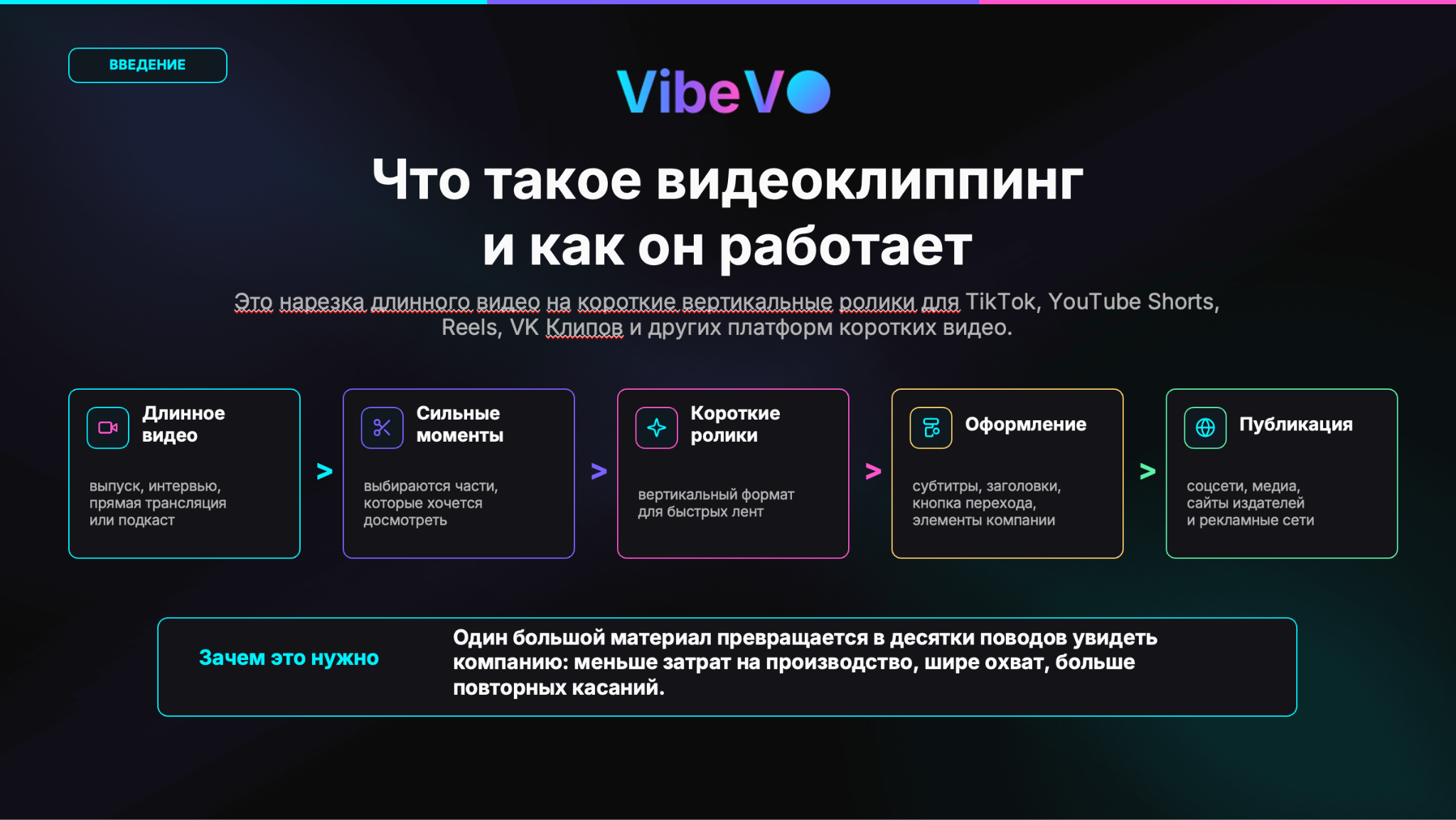
    Video clipping is the transformation of long material into short vertical videos for recommendation feeds and author publications. The original video is broken down into strong moments, each fragment receives subtitles, a title, design elements, and a clear next step: go, save, watch to the end, take advantage of an offer, or learn more.

    The economics of this approach are simple: one large piece of content provides dozens of reasons to re-engage with the audience. Instead of a one-off release, a company gets a series of repeated touchpoints, and platforms get content that is easier to distribute in fast feeds. Therefore, video clips are becoming not an auxiliary technique, but a separate way to buy attention.

    External benchmarks in the presentation show why this shift has become widespread:

    Illustration 1

    Even if markets and platforms differ by country, the logic of consumption itself is already obvious: attention has shifted to short videos.

    How video clipping works: the path from a long episode to a series of short videos
    Chart 1. How video clipping works: the path from a long episode to a series of short videos.
    Source: VibeVO data, updated 08.06.2026. Click on the chart to open it in full size.

    Overall picture: topics and platforms

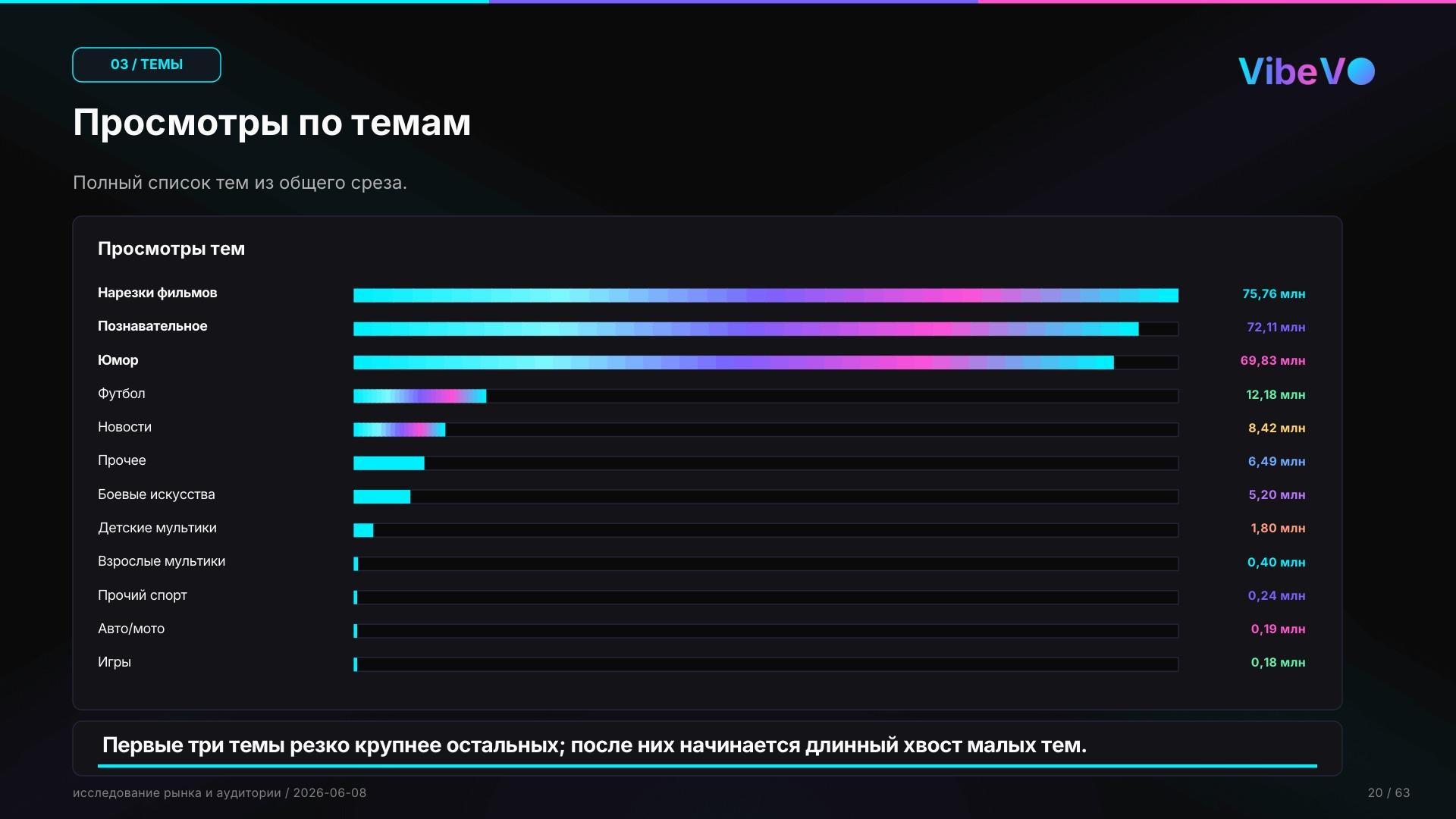
    In the updated cut, the market looks concentrated. The three largest topics — movie clips, educational videos, and humor — account for 86.1% of the saved volume. Movie clips garnered 75.76 million views in 30 days, or 30.0%. Educational videos yielded 72.11 million views, which is 28.5%. Humor is almost at the same level: 69.83 million views, or 27.6%.

    After the top three, a long tail begins: football — 12.18 million views, news — 8.42 million, other topics — 6.49 million, martial arts — 5.20 million. Children’s and adult cartoons, other sports, auto and moto, games are significantly less represented in the studied cut. This is an important caveat for placements: small topics cannot be generalized by the same rules as the largest ones.

    Illustration 2

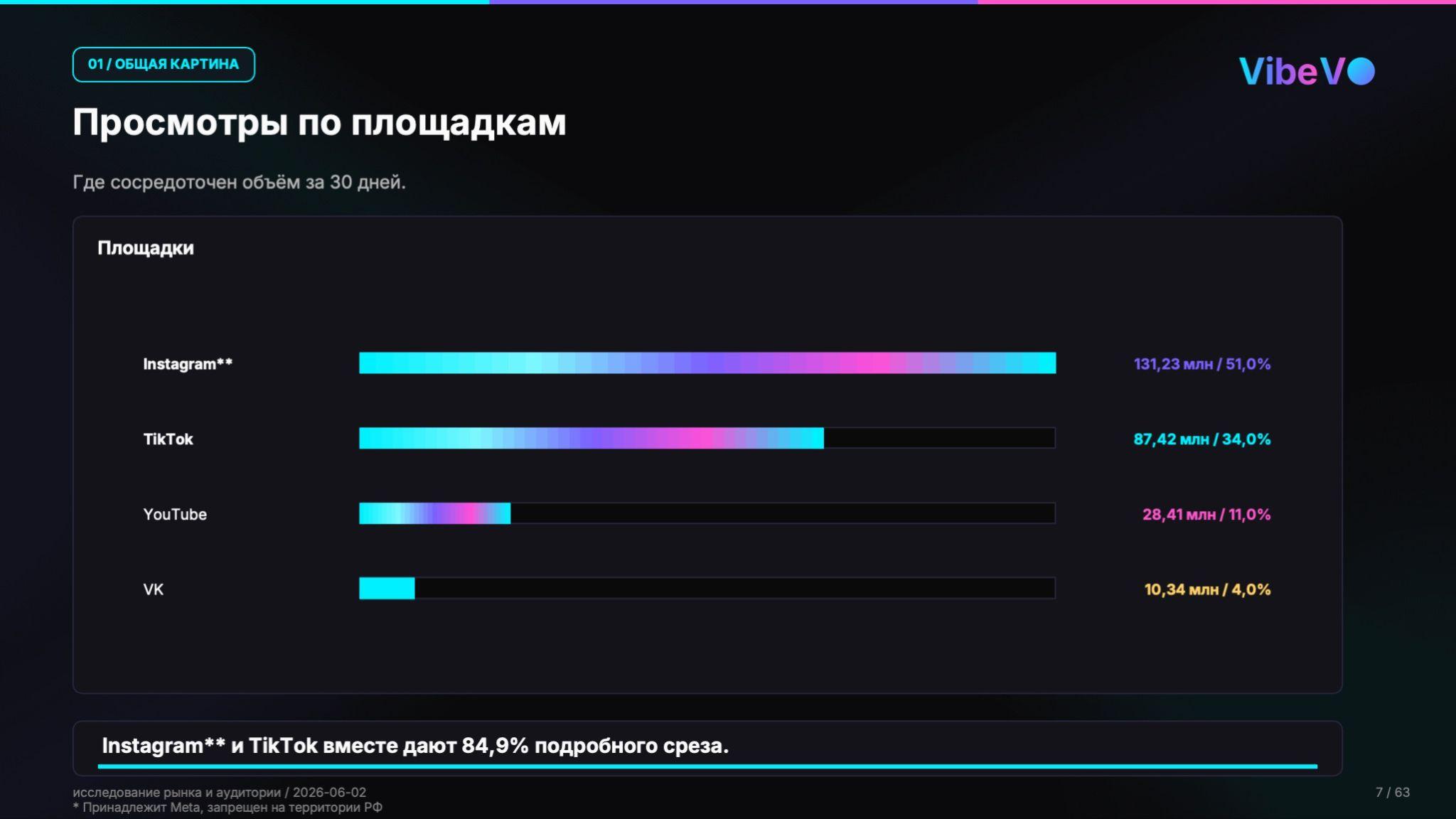
    By platforms, Instagram* became the leader: 131.23 million views, or 51.0% of the detailed volume. TikTok yielded 87.42 million views, or 34.0%. Together, they form 84.9% of the detailed cut, but other platforms do not disappear: they can be important for individual topics, creators, and strong publications.

    Просмотры по темам за 30 дней: три крупнейшие темы резко крупнее остальных
    Chart 2. Views by topic over 30 days: the three largest topics are significantly larger than the rest.
    Source: VibeVO data, updated 08.06.2026. Click on the chart to open it in full size.
    Просмотры по площадкам: Instagram* и TikTok формируют основную массу просмотров
    Chart 3. Views by platform: Instagram* and TikTok form the bulk of views.
    Source: VibeVO data, updated 08.06.2026. Click on the chart to open it in full size.

    Database size and strength of individual platforms

    The database includes 4,224 videos with an active topic, 141 authors, 228 pages, and 16 advertising campaigns. This allows us to look not only at the overall volume but also at how platforms behave differently. Some provide scale, while others provide a stronger upper part of publications.

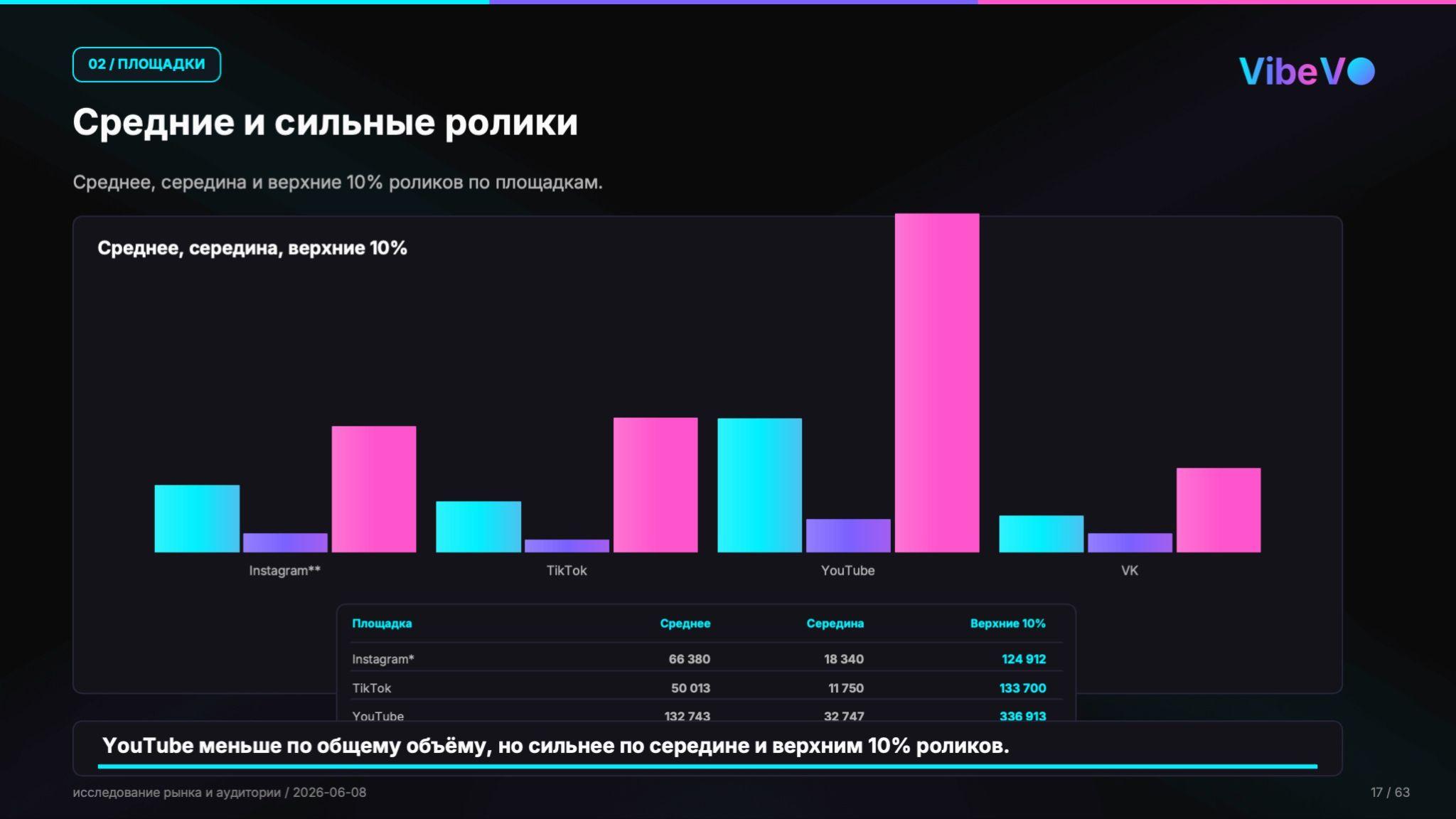
    Instagram* leads in overall volume, but YouTube’s algorithms react more sharply to viral videos and give them a larger share of reach. On average, one video on YouTube received 132,743 views. For Instagram*, the average was 66,380, and for VK, it was 36,277.

    Such a distribution changes the placement plan. Mass reach is logically sought in large Instagram* and TikTok bundles, but if there is viral content, YouTube can be a platform where it is easier to gain reach.

    Illustration 3
    Распределение охватов среди топ 10% самых популярных, медианы и среднее значение по площадкам: YouTube меньше по общему объему, но сильнее по верхним 10%
    Chart 4. Distribution of reach among the top 10% most popular, median and average values by platform: YouTube is smaller in overall volume but stronger in the top 10%.
    Source: VibeVO data, updated 08.06.2026. Click on the chart to open it in full size.

    It is better to analyze topics in bundles: topic plus platform

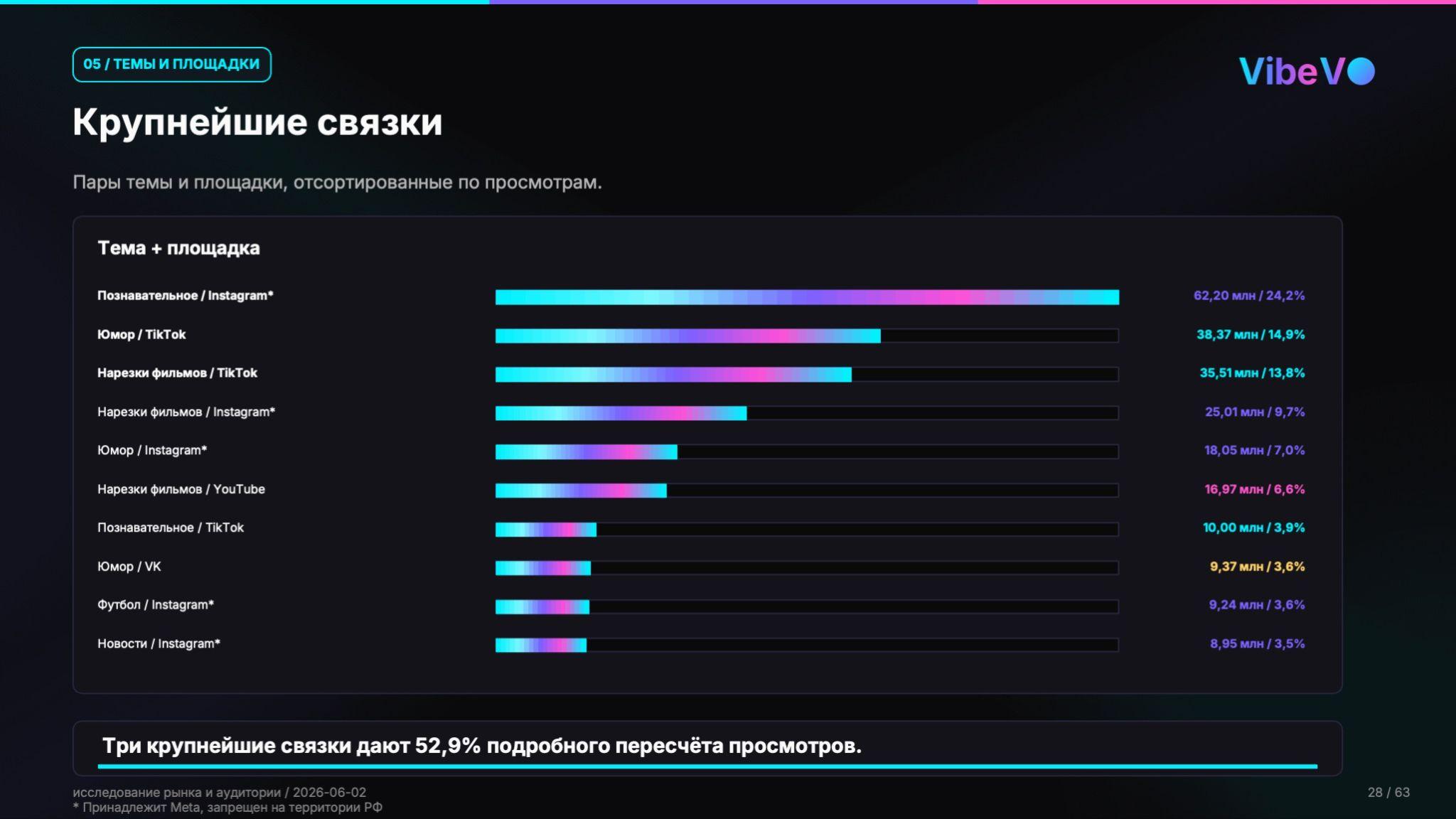
    The total volume across the platform does not fully explain the market. The largest reach points occur where the topic and the distribution medium coincide. In the updated data, the largest combination is educational videos on Instagram*: 62.20 million views, or 24.2% of the detailed recalculation. This is followed by humor on TikTok – 38.37 million views, or 14.9%, and movie clips on TikTok – 35.51 million views, or 13.8%.

    The three largest combinations account for 52.9% of the detailed recalculation of views.

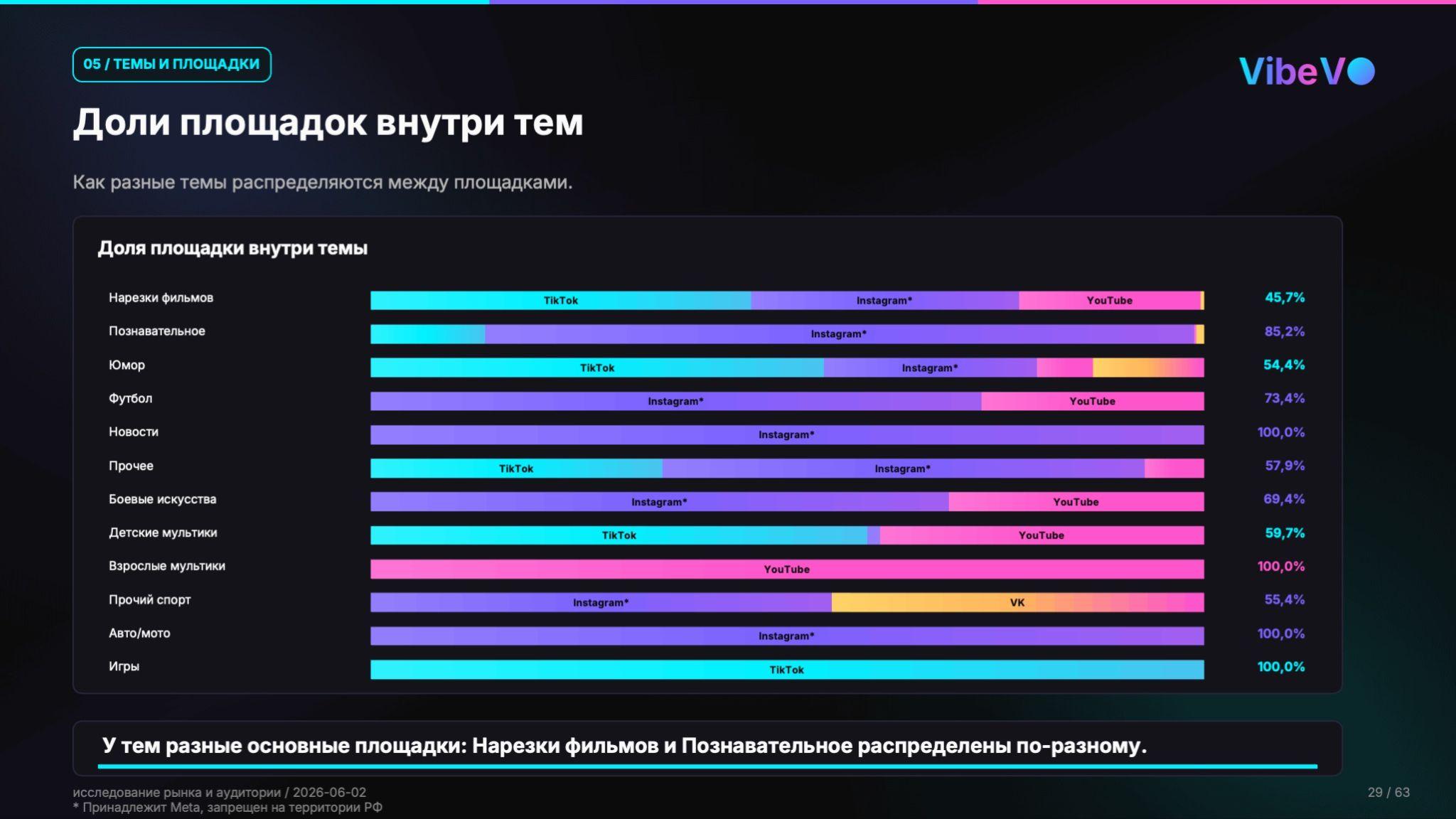
    That is why video clipping cannot be launched using a single general grid for all tasks. For educational videos, auto/moto, Instagram* works better; humor, games, and movie clips rely heavily on TikTok; adult cartoons rely on YouTube. Different topics require different platforms, creators, and designs.

    Illustration 4
    Largest topic and platform combinations: main volume arises from several combinations
    Chart 5. Largest topic and platform combinations: main volume arises from several combinations.
    Source: VibeVO data, updated 08.06.2026. Click on the chart to open it in full size.
    Platform shares within topics: different topics have different main platforms
    Chart 6. Platform shares within topics: different topics have different main platforms.
    Source: VibeVO data, updated 08.06.2026. Click on the chart to open it in full size.

    Views are sharply distributed: the top portion of videos yields results

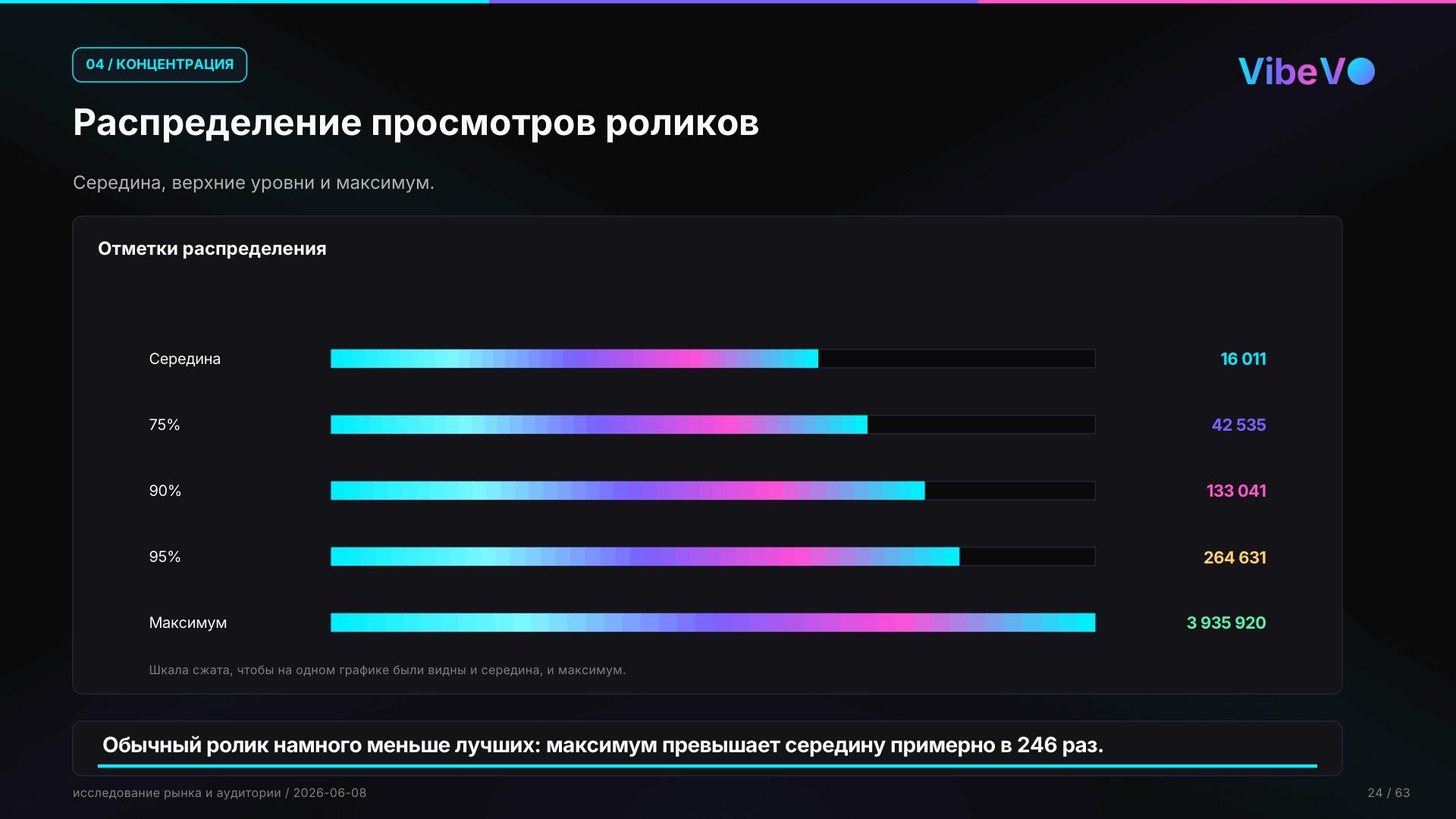
    In short feeds, the average result hides a very strong unevenness. The average number of views is 16,011 views over 30 days. The 75th percentile is 42,535 views, the 90th percentile is 133,041. The maximum video garnered 3,935,920 views, which is approximately 246 times more than the median. As expected, the distribution is very uneven.

    Even more illustrative is the share of the best publications. The top 10 videos generated 23.88 million views, or 9.3% of the volume. The top 50 videos – 62.48 million, or 24.3%. The top 10% of videos collected 165.54 million views, or 64.3% of all views. In other words, most views are generated by the top 5% of videos.

    A practical conclusion for advertising in video clipping: you cannot rely on a single video. You need a set of video clips with different first seconds, titles, subtitles, overlays, and advertising message options. It’s not just the most beautiful video that wins, but a series of attempts where the best publications quickly gain more weight.

  • D+ Research: Brands Expand Marketing Strategies with Content Creators

    D+ Research: Brands Expand Marketing Strategies with Content Creators

    Brands are increasingly engaging influencers not only to boost awareness but also for seasonal campaigns, product launches, and even co-development of products. According to a fresh Digiday+ study based on a survey of 125 professionals from brands and agencies, as well as interviews with marketing directors, marketing with content creators is becoming a key element of growth strategies. In this article, we will explore how companies are moving from one-off promotions to long-term partnerships and what trends are shaping the future of the industry.

    Seasonal campaigns and product launches

    88% of respondents said they collaborate with influencers for seasonal promotions, and 78% for launching new products. For example, in September 2025, Best Buy partnered with the Dude Perfect group for brand exposure during the NFL and holidays. That same month, Albertsons Media Collective, together with agency Linqia, ran a campaign dedicated to the Lunar New Year. The results are impressive: engagement on Instagram was three times higher, and on Facebook four times higher compared to benchmarks.

    Co-development of products

    Some marketers go further, co-developing product lines with creators. Home goods brand Ruggable created a collection with chef and influencer Dan Pelosi after the success of his ShopMy page. Lauren Sherman-Caud, CMO of Ruggable, noted: “ShopMy allowed us to scale our influencer program 20 times. We use this data for deeper collaborations, especially with micro-influencers.”

    Categorization of content creators

    Jeremy Lowenstein, CMO of Milani Cosmetics, divides creators into three groups:

    • Those who shape brand perception.
    • Those who educate consumers (e.g., makeup artists).
    • Affiliate creators focused on sales through livestream shopping.

    This approach helps more accurately select partners for campaign goals and improve influencer marketing effectiveness.

    Creator programs: long-term relationships

    Instead of one-off campaigns, brands are increasingly launching creator programs, offering training, commissions, and early access to promotions. For example, fitness app Strava requires that all partners genuinely use the service. Louise Vee, CMO of Strava, explained: “We work with those who have pro status or are verified. They create content that we use across different channels.”

    YouTube, with over 3 million creators in its partner program, emphasizes the importance of authenticity in marketing. Brian Albert, Managing Director of YouTube, noted: “When brands micromanage the script, the audience senses the ad and leaves. The marketer’s job is to set goals, not dictate words, and trust the creator.”

    In-house influencers

    Some brands use employees as content creators. Ulta Beauty, for example, has a program for both external influencers and its own associates. Kelly Mahoney, CMO of Ulta Beauty, said: “Our employees are already trusted experts; their authentic content deeply resonates with shoppers. And the Ulta Beauty team brings together external creators, helping us stay relevant in cultural and beauty trends.”

    Исследование D+: бренды расширяют стратегии маркетинга с создателями контента — illustration 2

    Milani Cosmetics also engages its own developers for educational content. Lowenstein added: “The influencer world organically and inorganically amplifies the brand’s message. We’ve entered cultural conversations because algorithmically it resonates on platforms.”

    Non-human influencers

    Duolingo uses its mascot—the owl Duo—as an influencer. Manu Orssow, CMO of Duolingo, explained: “We have our own influencer—the owl. Creators want to work with us because they see us not just as a brand, but as a good content creator. This changes the dynamic: we collaborate as two creators, not a brand and a creator.”

    Frequently asked questions

    What types of influencer campaigns are most popular?

    According to the survey, 88% of brands use influencers for seasonal campaigns, 78% for product launches, and many for awareness.

    How do brands select creators for programs?

    Criteria include authentic product use, expertise (e.g., Olympians for Strava), and the ability to create content that can be used across multiple channels.

    Why is authenticity so important in creator marketing?

    YouTube confirms that audiences sense “overproduced” content. Trust in the creator and natural brand integration improve effectiveness.

    Conclusion

    Marketing with content creators is evolving from one-off promotions to long-term programs, including co-development of products and using employees as influencers. Brands should invest in authentic partnerships and trust creators to achieve better engagement and sales. Want to learn how to implement such strategies in your business? Contact us for a consultation.

  • YouTube as a Full-Funnel Platform: Insights from SharkNinja and Adam W for Creator Marketing

    YouTube as a Full-Funnel Platform: Insights from SharkNinja and Adam W for Creator Marketing

    YouTube as a Full-Funnel Platform: Insights from SharkNinja and Adam W for Creator Marketing

    YouTube is becoming the most measurable platform in a brand’s creator mix. The combination of long-form, short-form, and content with cumulative value makes it a true full-funnel platform. At Cannes Lions 2026 in the Later Lounge, a session featuring Lyle Stevens (co-founder of Later), Mitun Shet (YouTube), Stacey Carpenter (SharkNinja), and creator Adam W discussed the future of creator-led marketing.

    YouTube is a Full-Funnel Platform: Data and Facts

    Mitun Shet noted that 76% of viewers on YouTube experience things they never thought they would experience thanks to the platform. Creator advertising is growing four times faster than the entire media market.

    45% of YouTube Shorts users do not use TikTok, and 65% do not use Instagram Reels. This is a significant audience accessible only through YouTube.

    YouTube as a Full-Funnel Platform: Insights from SharkNinja and Adam W for Creator Marketing

    Best Creative Partnerships Are Built on Storytelling

    Adam W builds content around human conflict: a recognizable problem, a dramatized story, the brand as a solution. He described a campaign with an auto brand where the concept was built on complaints about cars—viewers couldn’t believe it was an ad.

    Stacey Carpenter talked about SharkNinja Originals: content is created with creators as talents, not speakers, with unified IP for different markets. 70% of YouTube creators work with both Shorts and long-form content, allowing them to serve different stages of the funnel.

    Content on YouTube accumulates, but most brands don’t account for this

    30% of clicks and 40% of views on YouTube occur 30+ days after publication. Adam W gave an example: a video initially got 5 million views, and a year later—650 million. The new Dynamic Brand Segments feature allows brands to place ads in already successful videos post-factum, reducing risks.

    YouTube as a Full-Funnel Platform: Insights from SharkNinja and Adam W for Creator Marketing

    AI is changing search, and YouTube content is being cited

    According to Later, 90–95% of AI assistant responses reference creator content, not brand content. SharkNinja is building a creator ecosystem across three funnel levels: entertainment, education, and affiliate.

    YouTube tools (Inspiration Tab, Dream Screen, Omni) lower the barrier to producing content that AI models are most likely to cite.

    YouTube as a Full-Funnel Platform: Insights from SharkNinja and Adam W for Creator Marketing

    Conclusion: YouTube as Brand Infrastructure

    Creator content on YouTube builds a layer of third-party validation that AI uses for years. Brands that have stopped thinking of YouTube as a media buy and started viewing it as infrastructure are investing in long-term relationships with creators and content that accumulates value.

    The window for building such sustainable presence is closing. Ready to build a creator program with real sustainability? Explore Later’s influencer marketing services.

  • Fashion Marketing 2026: Channels, Video, and Budget

    Fashion Marketing 2026: Channels, Video, and Budget

    Fashion Marketing 2026: Channels, Video, and Budget — A Playbook for Brand Marketers

    Most articles about fashion marketing are written for students dreaming of getting into fashion school. This material is for the brand marketer who has a product launch in 8 weeks, a limited budget, and daily requests for new creatives pouring into Slack. At the end — our playbook.

    In 2026, speed in the fashion industry dictates the law of speed: your marketing must move faster or at least keep pace with the supply chain. Ultra-fast fashion has evolved from a niche segment into consumer expectation. The six-month campaign cycle is obsolete. Brands need to work like a newsroom, production studio, and data lab simultaneously.

    To succeed, you need to fundamentally redefine the concept of “creative.” Creative is no longer one billboard. Creative is 1000 relevant impressions. We will help you plan your team, allocate your budget, and understand the specifics of each social network to maximize Media Impact Value (MIV).

    Video as the Foundation of Fashion Marketing

    Traditional brand and performance marketing have merged into a single video stream. The reason is the “attention delta.” In 2022, a user could remember a brand from a static ad. In 2026, platforms like Instagram use a retention-based distribution model: if a user doesn’t watch a video for longer than 1.5 seconds, the platform stops showing it to similar users.

    Video creates more viewing time; each new frame (close-up of fabric, scene change) resets the attention timer. The first frame rule: never start a video with a black screen. The first frame is a billboard. If the user doesn’t understand the category (“this is a dress”) within 400 ms, they scroll past.

    According to Launchmetrics (2024), 44% of shoppers worldwide have purchased clothing through social media 3–7 times, and 24% have done so 8+ times. Influencer voice accounts for 75% of TikTok’s Media Impact Value. Social commerce revenue will exceed $1 trillion by 2028. For “strong buyers,” the funnel looks like this: watched a video → clicked on a product tag → confirmed purchase with biometrics. Traditional website navigation has disappeared. Every marketing dollar not invested in vertical video is structurally disadvantaged.

    Multidimensional Assets

    Static shows the appearance of a jacket; video shows how the lapels move, how the zipper sounds, how many pockets are inside. These “utility signals” convert buyers. If they are absent, the buyer is forced to guess — leading to a high cart abandonment rate.

    Team for a Fashion Brand in 2026

    A successful brand needs:

    • Merchandiser-Marketer: Tracks sales by SKU and updates the calendar based on return data. If a SKU has 40% returns due to sizing, the creative needs to be changed to save margins.
    • Editor: From one shoot day, produces 40+ vertical assets while maintaining the brand voice.
    • Visual Merchandising Lead: The guardian of the brand’s soul. Ensures the signature red doesn’t turn into orange on Pinterest. Guarantees the brand’s “vibe sovereignty” across all digital domains.

    Key Channels and Budget Allocation

    For a brand with an annual turnover of $5–30 million in 2026, four main channels work:

    • TikTok (30–40% of spend): Test at least 4 different creators, paying $200–500 per post. Spark Ads are the gold standard. CPM ranges from €25 to €45. Creator content dominates in the segment with an average order value up to $300 due to “low-quality trust”: Gen Z and Gen Alpha trust a person with a ring light in their bedroom more than a professional model.
    • Instagram Reels (20–30%): Responsible for visual branding and aesthetics. CPM is €25–45, creator fees are €10–50.
    • YouTube Shorts (10–15%): An underrated channel. The same vertical content provides free reach for 90 days after publication.
    • Pinterest (5–15%): Where consumers plan outfits. Strong categories include women’s contemporary, modest fashion, and weddings.

    Retail Media (10–20%): For brands selling through Nordstrom, Saks, Revolve, or Amazon Fashion. CPM is higher, but the consumer is already in purchase mode. Retail Media Networks are the biggest shift in rented fashion space since social media. Platforms know what the customer bought last week and what they are searching for today. Moving 15% of the budget to RMN is the digital version of a checkout zone, powered by trillions of data points.

    Don’t distribute the budget evenly. Choose two channels where your audience spends the most time, achieve success, then expand. Use the “masterpiece, then scale” model: first become an authority on keywords on Pinterest, then adapt the creative for YouTube Shorts. Each platform has its own language.

    Six Video Formats That Work

    Ranked by delivery success:

    1. Lookbook scrolls: 15–30 seconds, 3–5 outfits. Inexpensive, long shelf life.
    2. Try-ons with size context: Real people, real sizes, fabric stretch test.
    3. Founder POV: Explains fit changes, fabric origins, pricing reasons. The best single format for new brands.
    4. Show reviews and backstage: Publish in the same week, don’t stockpile.
    5. Style breakdowns: 3 ways to wear one item. Works for both a 24-year-old TikToker and a 48-year-old Pinterest user.
  • Pre-launch Teasers (6 seconds): loops for ads, not for organic content.
  • A Day in the Life of an Atelier: proves craftsmanship, not dropshipping.
  • Comment Replies: a video response to the question “Can it be worn at 157 cm tall?” — the ultimate trust strategy.
  • Mistake: filming one video and splitting it into 12 posts. Correct approach: shoot all 6 formats in half a day, then cut 40 variations. Shooting schedule: hour 1 — heroes for the website (landscape), hour 2 — vertical reviews of 5 products, hour 3 — macro details (fabric, seams, buttons), hour 4 — interviews with designers. The modular method allows the editor to take content from a “library” rather than from a linear film.

    The 70/20/10 Budget Formula

    70% — Bottom of Funnel (paid social, retail media, search, creator affiliate). This is the engine. If an influencer doesn’t deliver 2.5× ROAS within 72 hours, paid amplification is turned off.

    Маркетинг моды 2026: каналы, видео и бюджет — illustration 2

    20% — Middle of Funnel (lookbooks, founder content, stylist breakdowns). Builds a “moat”: the brand story protects against commoditization. If a competitor sells something similar for $10 cheaper, the loyal customer will stay due to investment in the story.

    10% — Innovation (PR, partnerships, shows, retail experiments). The first thing cut in a crisis. But these activities create cultural currency and branded search 18 months down the line. These are strange pop-ups, collaborations with digital artists, glossy editorial features. They don’t generate instant clicks, but they provide “clout,” making creators want to work with you not for a salary, but for career growth.

    A skew towards 95/5 starves future demand. 30/70 burns cash. Stick to the middle ground.

    Legal Aspects of Working with Creators

    Disclaimer: Every paid, gifted, or sponsored post must contain a clear disclosure (#ad in the first three lines, a paid partnership label). Hidden gifting (a brand gives a $500 bag “with no strings attached,” but the creator does not disclose the value) is a violation. The FTC in 2026 is focusing on deceptive engagement. Fines can reach six-figure sums.

    Rights: Obtain written permission for use before paid amplification. Standard 2026 terms: organic + paid use on Meta and TikTok for 90 days, renewal fees stipulated in advance, model releases.

    Pricing Benchmarks (Modash 2024–2025): TikTok — $50–10,000+, YouTube — up to $80,000+, Instagram Reels — $750–50,000+. A working approach: “$300 per post + 10% revenue share on tracked sales after breakeven.” Micro-strategy: instead of $50,000 on one star, spend $50,000 on 50 micro-creators (10–50k followers) in a niche. The “surround sound” effect: when a consumer sees your brand from three trusted creators in a week, it seems like the next big thing.

    Environmental Claims: Any statement about sustainability, eco-friendliness, or ethics in a post caption falls under the FTC Green Guides.

    Frequently Asked Questions

    What is the minimum budget for hypothesis testing?

    1000 rubles per platform is enough. Launch a Spark Ad with one creative for 2–3 days. If CPM is below 50 rubles and retention is above 1.5 seconds, scale it.

    Can I place a banner on TikTok without shooting a video?

    Yes. Use overlay banners or programmatic placement on existing videos. CPM can be below 50 rubles, and reach can be in the millions for pennies. This is an alternative to influencers without the need to shoot content.

    Which channel offers the cheapest CPM in Shorts?

    YouTube Shorts often shows CPM below 50 rubles, especially when using ready-made content. TikTok and Reels are more expensive but offer better targeting quality.

    What is a “non-skippable banner” in Shorts?

    This is a banner that cannot be closed or skipped in the first seconds. It ensures 100% impression but requires careful design to avoid annoying the user.

    Conclusion: Your Action Plan

    Ready to test? Forget about bloggers with million-ruble fees. The real math is CPM below 50 rubles, hypothesis testing for 1000 rubles, banners without shooting. Start with micro-creators and watch the numbers. Your engine is 70% bottom of the funnel. Be ruthless.