Tag: content marketing

  • AI Content Factory: How to Scale Content Production Without Losing Quality

    AI Content Factory: How to Scale Content Production Without Losing Quality

    Creating an effective AI-powered content factory is not just about automation, but about building an entire system where neural networks handle routine operations, freeing up time for strategic planning. We, as producers, know: a tired streamer cannot generate ideas. How do you package raw material into highlights without losing quality and without turning the process into chaos? This article will help you build an assembly line where AI will not be a replacement, but a powerful assistant.

    What is a content factory and why is it needed?

    A content factory is a systematized process of content production, based on the principle of “One idea – many formats”. AI here does not completely replace humans, but automates repetitive actions. Our goal is not just to increase volume, but to create mass cutting of 100+ clips and other formats, while maintaining quality and relevance.

    The role of AI in the content conveyor

    AI can be implemented at almost every stage of content production, from idea to publication. However, its role should always be auxiliary. For example, a neural network can suggest 100 blog topics, but the choice of the most relevant and valuable ones remains with a human.

    This is especially true for expert content, where factual accuracy is critically important.

    “A neural network can easily generate a hundred blog topics for a dental clinic, an English school, or an online store. The harder part is understanding which of these are actually worth pursuing.”

    Defining goals and initial data

    Before building a “conveyor,” it is necessary to clearly define what problem it should solve. The phrase “We need more content” is too vague. We need to understand what exactly is missing: time, people, or money.

    Choosing a content factory strategy

    • A) Accelerating publication for multiple platforms: If the task is to quickly manage Telegram, VKontakte, and other social networks with a small team, the factory should reduce the time from idea generation to a complete set of publications.
    • B) Increasing organic traffic: In this case, the content factory is built around semantics. AI helps analyze search queries, identify gaps, and generate ideas for new articles optimized for SEO.
    • C) Reducing production costs: If the team spends a lot of time gathering factual material, the factory will help repackage one expensive source into several formats, saving budget.

Searching for “Raw Material” for a Content Factory

Quality raw material is the key to successful production. For each strategy, it is different:

  • For accelerating publication: Source data and facts that need to be quickly processed and adapted for different formats.
  • For organic traffic: Semantics and existing content. AI analyzes search clusters, article positions, and queries for which there are no materials.
  • For cost reduction: Expensive source materials that are currently used only once, for example, a long video (webinar, interview, broadcast).

Developing a Route: From Raw Material to Finished Content

After defining the goal and raw material, it is necessary to think through the content movement route. This will help to understand how long each stage takes and where automation can be implemented.

Route Examples

  1. For multi-platform publication: 🛠️ Facts → Format Selection → Tasks → Drafts → Editing → Visuals → Publication.
  2. For SEO traffic: 🛠️ Semantics → Analysis of existing materials → Cluster Selection → Sources and Facts → Article → Publication → Indexing → Next Material.
  3. For cost reduction: 🛠️ Expensive source material → Processing → Maximum repackaging (e.g., cutting a podcast into video clips, cropping 9:16 from horizontal footage).

Automating Repetitive Operations

AI is most effective where there are repetitive actions that do not require a new solution each time. These can be:

  • Collecting source information: AI can aggregate data from various sources.
  • Preparing drafts: Creating first versions of texts, posts, scripts.
  • Adapting to formats: For example, cutting for TikTok from Twitch or editing highlights.
  • Preparing metadata: Automatic filling of SEO tags.
  • Transcription and structuring: Processing audio and video materials to create text versions and highlight key moments.

Establishing Rules for AI

For AI to work effectively, it needs clear rules and boundaries. Without them, it can generate meaningless or irrelevant content.

Content Factory with AI: How to Scale Content Production Without Losing Quality — illustration 2

Examples of Rules

  • For multi-platform use: Define the role of each platform. For example, Telegram — more context, VKontakte — practical material, MAX — short message.
  • For SEO: Determine when a new article is created and when an old one is updated; what sources are permissible; how to work with search intent.
  • To save budget: Determine what material is considered standalone, when a derivative format adds value, and what cannot be cut without losing meaning.
  • Implementing AI Tools

    Only after defining goals, raw materials, routes, and rules can specific AI tools be selected. It is important to understand what limitation we are removing and what area we are automating.

    Recommended Tools

    • SMMplanner: For automating publishing, scheduling, and using AI agents to create content plans and posts.
    • AI Assistant: For precise work with factual material: rough editing, shortening, adapting for different platforms.
    • Canvas: For visual design. Allows creating branded layouts and quickly adapting them to different sizes (e.g., cropping 9:16 from horizontal).
    • Creoscan: A service that helps with stream and podcast cutting. It automatically finds key moments in long videos, creates vertical clips, and adds subtitles for cuts. An excellent alternative to Opus Clip.

    Evaluating the Effectiveness of a Content Factory

    The content factory’s performance should be checked at three levels:

    1. Production speed: How much time passes from factual material to publication? Where do delays occur?
    2. Control cost: How much time is spent checking and correcting AI drafts?
    3. Content results: Read-throughs, saves, clicks, leads, organic traffic, video views. It’s important that 50 additional posts don’t go “into the drawer.”

    “Good automation should reduce the cost per useful unit, not just increase the number of files in a folder.”

    Frequently Asked Questions

    How long does it take to cut a two-hour stream?

    Using specialized AI tools, such as Creoscan, cutting a two-hour stream into main highlights can take from 15 to 30 minutes, including automatic subtitle addition and adaptation to different formats, for example, cutting for TikTok from Twitch.

    What moments are usually cut from streams?

    From streams, highlights, funny moments, important announcements, key answers to audience questions, gaming achievements, and the host’s emotional reactions are usually cut. Anything that can attract attention and go viral.

    Are subtitles needed for cuts?

    Yes, subtitles for cuts are extremely important. They improve content accessibility, allow viewing videos without sound, and increase audience engagement, especially on social media, where many users watch videos without sound.

    Can I order 20 clips from a stream?

    Of course! Many studios and freelancers offer services for cutting without loss of quality. With AI tools, this can be done quickly and efficiently, resulting in 20 clips from a stream, ready for publication.

    Who is the person who cuts streams?

    A person who cuts streams is a video editor or content manager specializing in creating short, engaging videos from long live streams. They select the most interesting moments, add graphics, music, and subtitles to transform raw footage into ready-made highlights for various platforms.

    Conclusion

    Building an AI content factory is not an instant solution, but a sequential process. Start small: choose one repeatable content stream, work it out manually, and then automate the sections that do not require a new solution. This will allow you to effectively scale production, create 20 clips from a stream or dozens of posts, and ultimately, monetize a stream through cuts. Ready to start your conveyor? Try the tools we’ve discussed and turn your ideas into ready-made content today!


  • Case study: Lovable — Founder Becomes First Introduction to the Product

    Case study: Lovable — Founder Becomes First Introduction to the Product

    Campaign Figures

    Metric Value Explanation
    Views 6 610 934 accumulated campaign counter.
    Claimed Fund $50 000 rewards budget.
    Approved Works 398 individual content counter.
    Authors 109 by published counter.
    CPM by Terms $1.00 rate per 1,000 counted views.
    CPV by Rate $0.00100 equivalent per 1 counted view.

    Cut-off 03.09.2026. CPV = CPM ÷ 1,000. These are rates with admission conditions and limits; the fund is not equal to expenses, and CPV does not show the full cost of the campaign. Views are a total counter, not unique reach. Approvals are counted separately. Views are not equal to unique reach or sales. Conclusions about marketing mechanics — editorial analysis; the presence of a campaign around a brand does not necessarily mean its direct placement.

    Before becoming interested in a technological product, a person might become interested in how its founder thinks. The Lovable campaign offered authors recordings of interviews and events with Anton Osika. It was allowed to work with provided material; Anton or Lovable had to appear in the frame, and the topic had to remain related to the product. Short versions were intended for new accounts or pages about AI and startups, with an indication of the partnership nature of the publications.

    Cutting interviews into clips here means finding an idea that is understandable without familiarity with the full conversation. Video clipping helps present the product through a person capable of explaining its concept. For a marketer, thematic discipline is important: a striking answer must maintain a connection with Lovable. Then the video can simultaneously reveal the founder’s character and give the viewer a concrete reason to learn more about the product. A common library of conversations allows for consistently searching for such moments, changing the topic of each short introduction.

    Lovable — founder becomes first introduction to the product — illustration 2

    Do your founder’s interviews already contain ideas that explain the product? Launch their video clipping on VibeVO and invite authors to find fragments for a first introduction to the brand.

  • Case study: Emma Grede / Aspire — a fragment should work without familiarity with the podcast

    Case study: Emma Grede / Aspire — a fragment should work without familiarity with the podcast

    Campaign Figures

    Metric Value Explanation
    Views 128 328 accumulated campaign counter.
    Declared Fund $10 500 rewards budget.
    Approved Works 0 separate content counter.
    Creators 0 by published counter.
    CPM by terms $1.50–$2.00 rate per 1,000 counted views.
    CPV by rate $0.00150–$0.00200 equivalent per 1 counted view.

    Data cut-off 03.09.2026. CPV = CPM ÷ 1,000. This is a reward rate with eligibility conditions and limits, not the actual cost of the entire campaign. The fund does not equal expenses. Views are a total counter, not unique reach; approved works are counted separately. The range reflects different distribution conditions. Views do not equal unique reach or sales. Conclusions about marketing mechanics are an editorial analysis; the presence of a campaign around a brand does not necessarily mean its direct placement.

    In the Aspire with Emma Grede campaign, the criterion for a successful clip was formulated through an unfamiliar viewer. They have never seen the podcast, but should stop, watch the fragment, want to share it, and become interested in the full episode. For this, creators were encouraged to look for outstanding moments that could be perceived as standalone short content. This task immediately changes the way material is selected.

    Cutting podcasts into short videos requires looking at the conversation through the eyes of a new person. The context familiar to the listener may be completely unknown to a casual viewer. Therefore, video clipping begins with choosing a moment that contains its own idea and enough explanations within the fragment itself. For an editor, this is a useful criterion: is the video interesting without a backstory and episode title? If so, the short version gains independent value. And the desire to hear more arises from the content of the conversation that the viewer has just become acquainted with.

    Emma Grede / Aspire — a fragment should work without familiarity with the podcast — illustration 2

    If your podcast has ideas that are understandable without a backstory, start with them. On VibeVO, you can launch a video clipping campaign that will encourage creators to find such standalone fragments.

  • Case study: The Real Wolf of Wall Street / Paramount+ — familiar story, new access

    Case study: The Real Wolf of Wall Street / Paramount+ — familiar story, new access

    Campaign Metrics

    Metric Value Explanation
    Views 604 578 accumulated campaign counter.
    Declared Fund $1 001 rewards budget.
    Approved Works 159 separate content counter.
    Authors 44 according to the published counter.
    CPM by Terms $1,00 rate per 1,000 counted views.
    CPV by Rate $0,00100 equivalent per 1 counted view.

    Data cut-off 03.09.2026. CPV = CPM ÷ 1,000. This is a reward rate with admission terms and limits, not the actual cost of the entire campaign. Fund does not equal expenses. Views are a total counter, not unique reach; approved works are counted separately. Views do not equal unique reach or sales. Conclusions about marketing mechanics are an editorial analysis; the presence of a campaign around a brand does not necessarily mean its direct placement.

    The title already evokes associations, and the documentary format offers an additional reason to take a closer look: to hear from the people who lived this story themselves. In The Real Wolf of Wall Street campaign, the material for clipping included episodes of the show, exclusive behind-the-scenes footage with participants, and podcast snippets. This combination allowed for short videos to be made around different levels of access to the same story.

    Video clipping uses the gap between a familiar title and unknown details of the real story. Cutting podcasts into short videos complements show scenes and behind-the-scenes footage: each type of material promises its own level of access to the participants of the events. The editor can choose one answer or episode that raises a specific question, leaving the full story outside the video. For a documentary project, this is a natural mechanism for introduction. A short fragment shows what new perspective the viewer can gain if they decide to watch the whole story.

    The Real Wolf of Wall Street / Paramount+ — familiar story, new access — illustration 2

    Do you have a documentary project, interviews with participants, or behind-the-scenes footage? Launch a video clipping campaign on VibeVO so that each such material becomes an independent reason to learn the whole story.

  • Video Clipping Market: Short Videos Become a New Channel for Advertising Reach

    Video Clipping Market: Short Videos Become a New Channel for Advertising Reach

    The video clipping market is rapidly developing, transforming from a simple video cutting tool into a powerful channel for advertising reach. A joint study by VibeVO, a video clipping platform, and Go Influence, an influencer agency, sheds light on the current state of the short video, video clipping, and social media banner advertising market, demonstrating how these formats are becoming key for brand promotion.

    Short vertical videos have long ceased to be just entertainment. For companies, it is already an independent promotion environment. A single episode, interview, live broadcast, review, or conversational recording turns into a series of short videos, each of which can become a separate point of contact with the audience.

    This study was prepared by VibeVO and Go Influence based on VibeVO data for the last 30 days as of June 8, 2026. The indicators describe the studied array of short videos and do not claim to evaluate the entire internet. However, the database is large enough to see the main patterns: concentration of views, differences in platforms, thematic cores, and audience within topics.

    A brief version of the study is published on Sostav.

    Key figures of the study

    Indicator Value
    Views in the saved 30-day volume 252.81 million
    Videos 4,224
    Authors in the database 141
    Pages in the database 228
    Ad launches 16
    Share of the three main topics 86.1%
    Audience coverage 99.2%
    Graphs from the updated table 29

    Main conclusion: the video clipping market can no longer be described only as mechanical video cutting. It is developing as a tool for managed advertising reach, where the topic, platform, author, release speed, design, placement environment safety, and result measurement are important. Banner advertising in social networks also changes its role: it works not separately from the video, but during viewing or next to it.

    Why short video has become a mass format

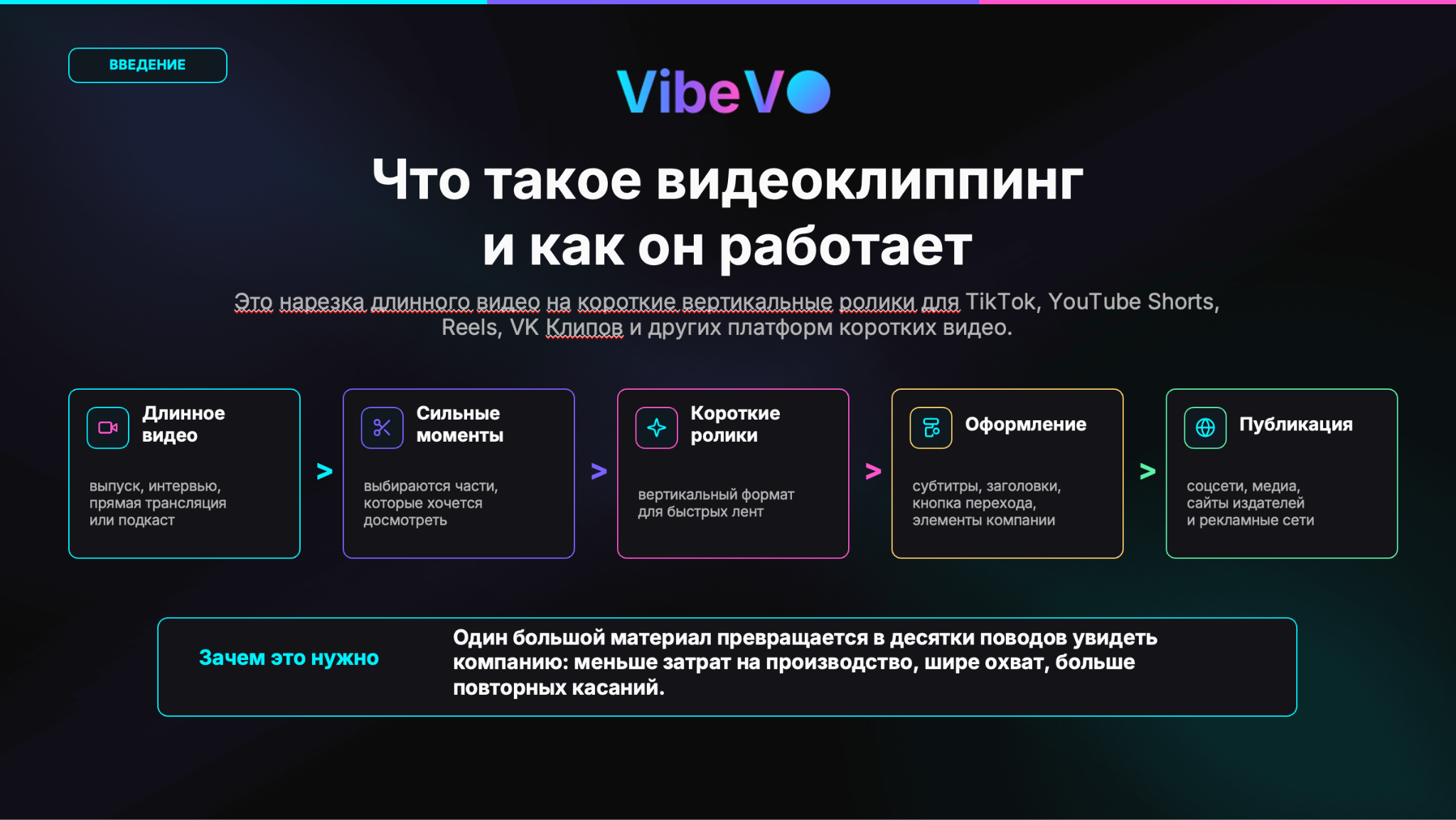
    Video clipping is the transformation of long material into short vertical videos for recommendation feeds and author publications. The original video is broken down into strong moments, each fragment receives subtitles, a title, design elements, and a clear next step: go, save, watch to the end, take advantage of an offer, or learn more.

    The economics of this approach are simple: one large piece of content provides dozens of reasons to re-engage with the audience. Instead of a one-off release, a company gets a series of repeated touchpoints, and platforms get content that is easier to distribute in fast feeds. Therefore, video clips are becoming not an auxiliary technique, but a separate way to buy attention.

    External benchmarks in the presentation show why this shift has become widespread:

    Illustration 1

    Even if markets and platforms differ by country, the logic of consumption itself is already obvious: attention has shifted to short videos.

    How video clipping works: the path from a long episode to a series of short videos
    Chart 1. How video clipping works: the path from a long episode to a series of short videos.
    Source: VibeVO data, updated 08.06.2026. Click on the chart to open it in full size.

    Overall picture: topics and platforms

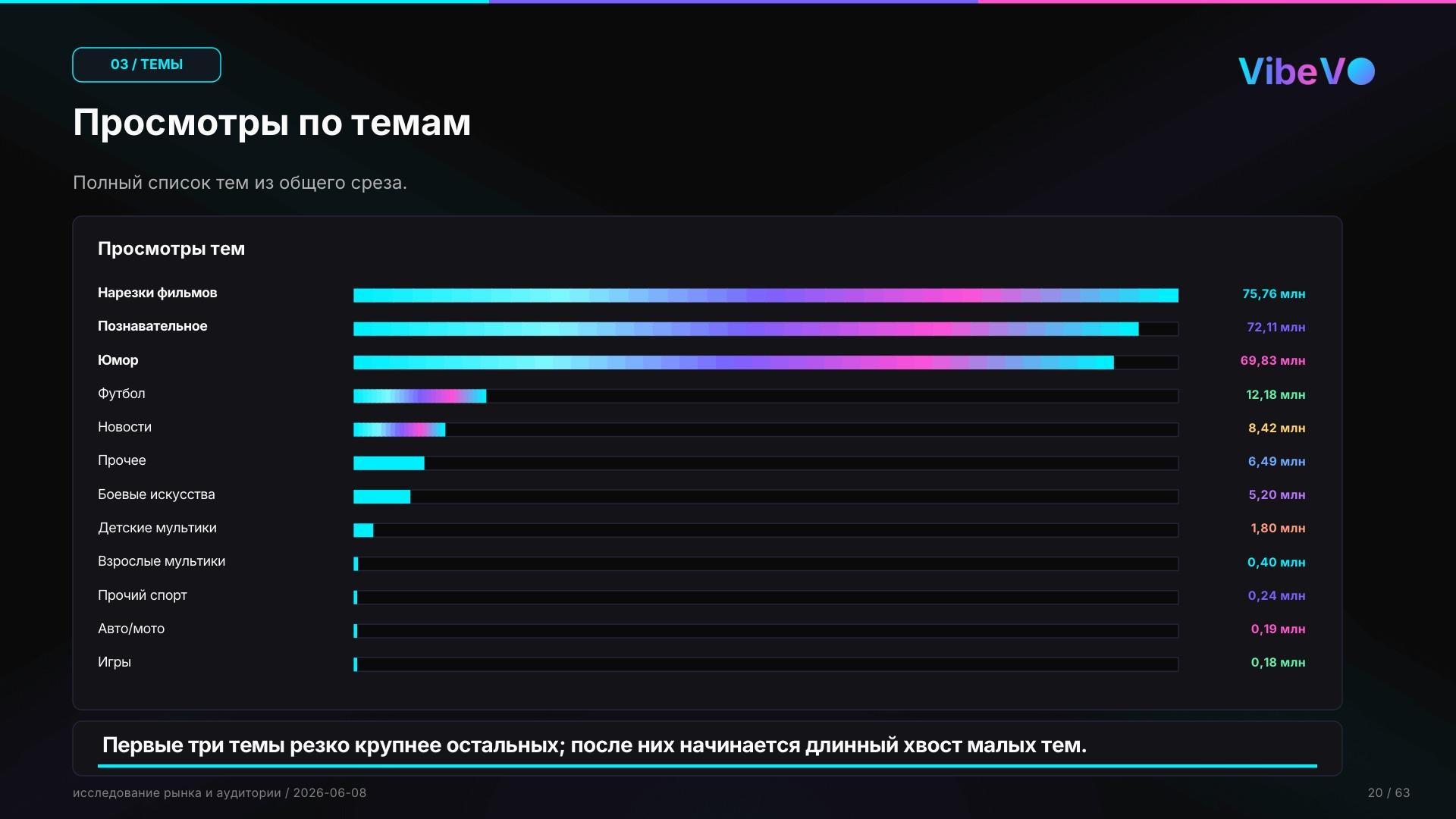
    In the updated cut, the market looks concentrated. The three largest topics — movie clips, educational videos, and humor — account for 86.1% of the saved volume. Movie clips garnered 75.76 million views in 30 days, or 30.0%. Educational videos yielded 72.11 million views, which is 28.5%. Humor is almost at the same level: 69.83 million views, or 27.6%.

    After the top three, a long tail begins: football — 12.18 million views, news — 8.42 million, other topics — 6.49 million, martial arts — 5.20 million. Children’s and adult cartoons, other sports, auto and moto, games are significantly less represented in the studied cut. This is an important caveat for placements: small topics cannot be generalized by the same rules as the largest ones.

    Illustration 2

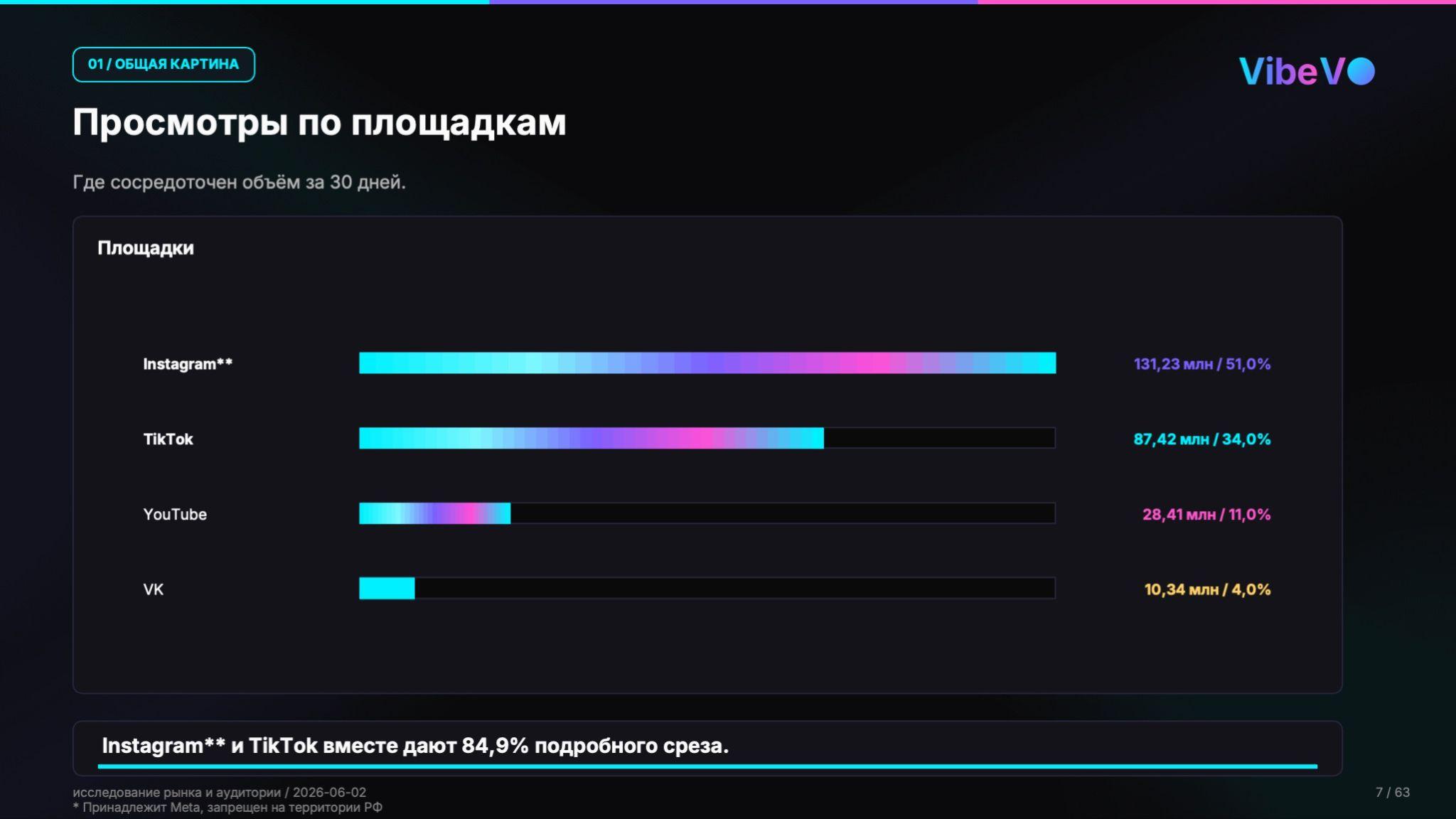
    By platforms, Instagram* became the leader: 131.23 million views, or 51.0% of the detailed volume. TikTok yielded 87.42 million views, or 34.0%. Together, they form 84.9% of the detailed cut, but other platforms do not disappear: they can be important for individual topics, creators, and strong publications.

    Просмотры по темам за 30 дней: три крупнейшие темы резко крупнее остальных
    Chart 2. Views by topic over 30 days: the three largest topics are significantly larger than the rest.
    Source: VibeVO data, updated 08.06.2026. Click on the chart to open it in full size.
    Просмотры по площадкам: Instagram* и TikTok формируют основную массу просмотров
    Chart 3. Views by platform: Instagram* and TikTok form the bulk of views.
    Source: VibeVO data, updated 08.06.2026. Click on the chart to open it in full size.

    Database size and strength of individual platforms

    The database includes 4,224 videos with an active topic, 141 authors, 228 pages, and 16 advertising campaigns. This allows us to look not only at the overall volume but also at how platforms behave differently. Some provide scale, while others provide a stronger upper part of publications.

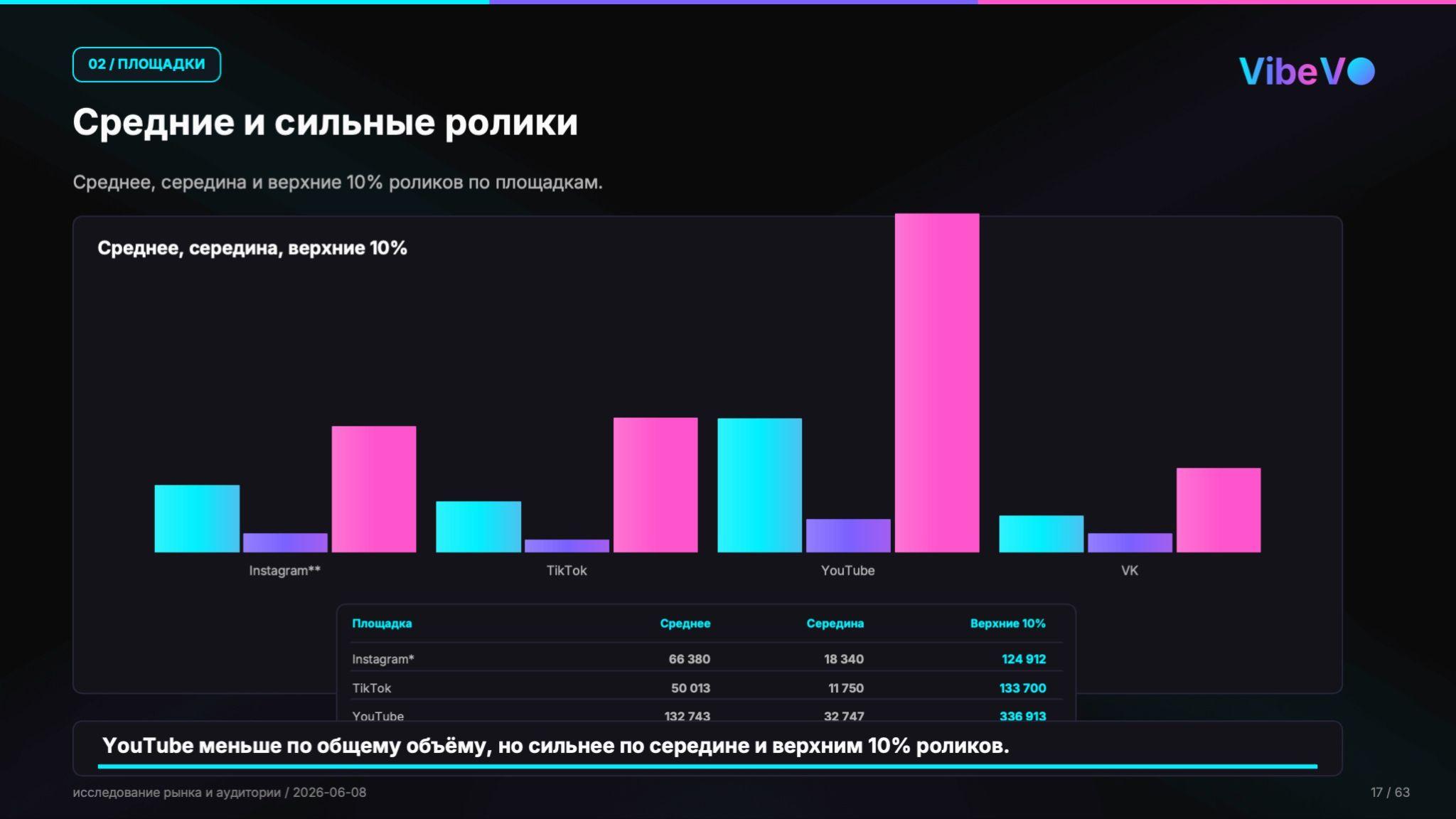
    Instagram* leads in overall volume, but YouTube’s algorithms react more sharply to viral videos and give them a larger share of reach. On average, one video on YouTube received 132,743 views. For Instagram*, the average was 66,380, and for VK, it was 36,277.

    Such a distribution changes the placement plan. Mass reach is logically sought in large Instagram* and TikTok bundles, but if there is viral content, YouTube can be a platform where it is easier to gain reach.

    Illustration 3
    Распределение охватов среди топ 10% самых популярных, медианы и среднее значение по площадкам: YouTube меньше по общему объему, но сильнее по верхним 10%
    Chart 4. Distribution of reach among the top 10% most popular, median and average values by platform: YouTube is smaller in overall volume but stronger in the top 10%.
    Source: VibeVO data, updated 08.06.2026. Click on the chart to open it in full size.

    It is better to analyze topics in bundles: topic plus platform

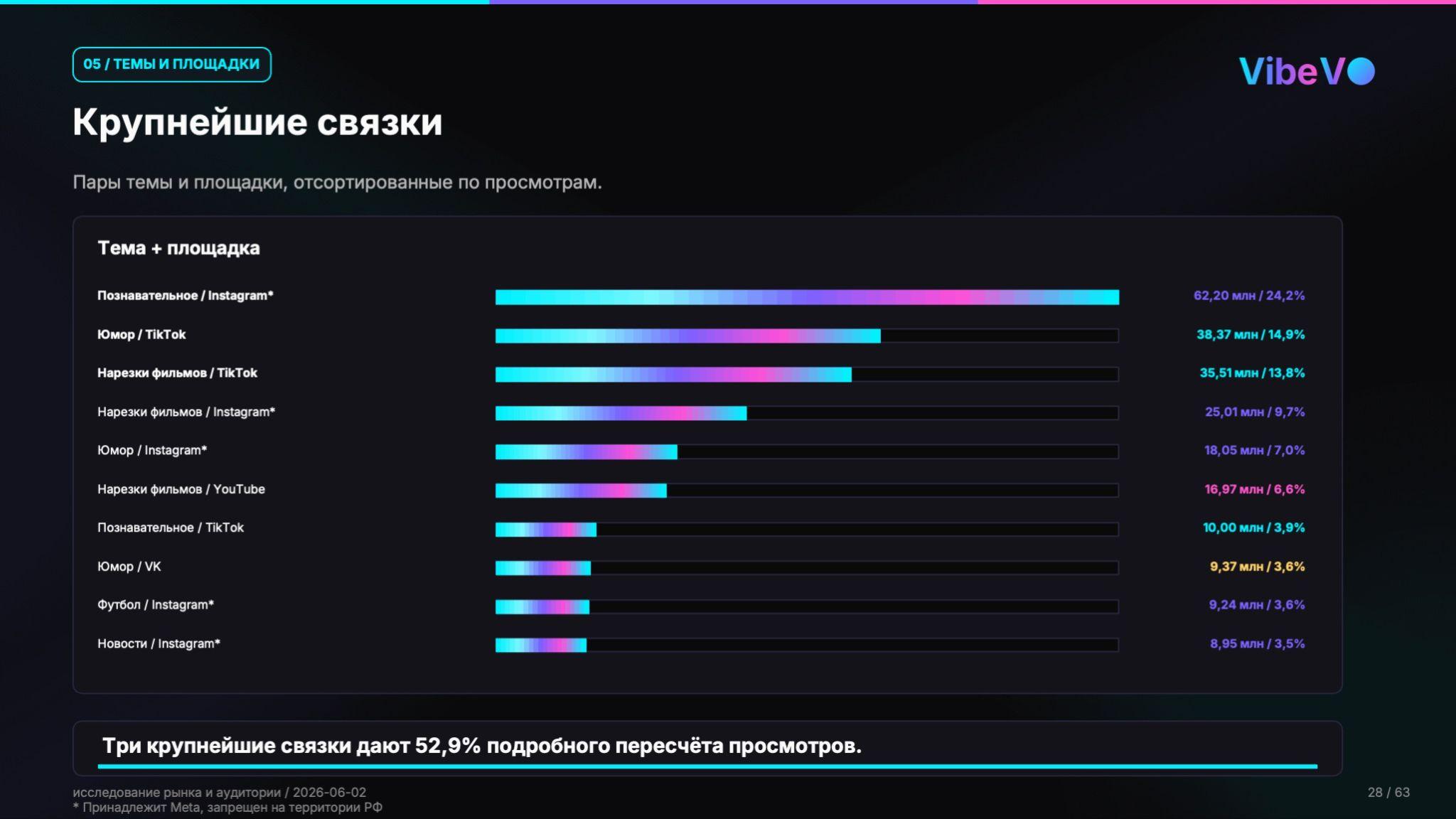
    The total volume across the platform does not fully explain the market. The largest reach points occur where the topic and the distribution medium coincide. In the updated data, the largest combination is educational videos on Instagram*: 62.20 million views, or 24.2% of the detailed recalculation. This is followed by humor on TikTok – 38.37 million views, or 14.9%, and movie clips on TikTok – 35.51 million views, or 13.8%.

    The three largest combinations account for 52.9% of the detailed recalculation of views.

    That is why video clipping cannot be launched using a single general grid for all tasks. For educational videos, auto/moto, Instagram* works better; humor, games, and movie clips rely heavily on TikTok; adult cartoons rely on YouTube. Different topics require different platforms, creators, and designs.

    Illustration 4
    Largest topic and platform combinations: main volume arises from several combinations
    Chart 5. Largest topic and platform combinations: main volume arises from several combinations.
    Source: VibeVO data, updated 08.06.2026. Click on the chart to open it in full size.
    Platform shares within topics: different topics have different main platforms
    Chart 6. Platform shares within topics: different topics have different main platforms.
    Source: VibeVO data, updated 08.06.2026. Click on the chart to open it in full size.

    Views are sharply distributed: the top portion of videos yields results

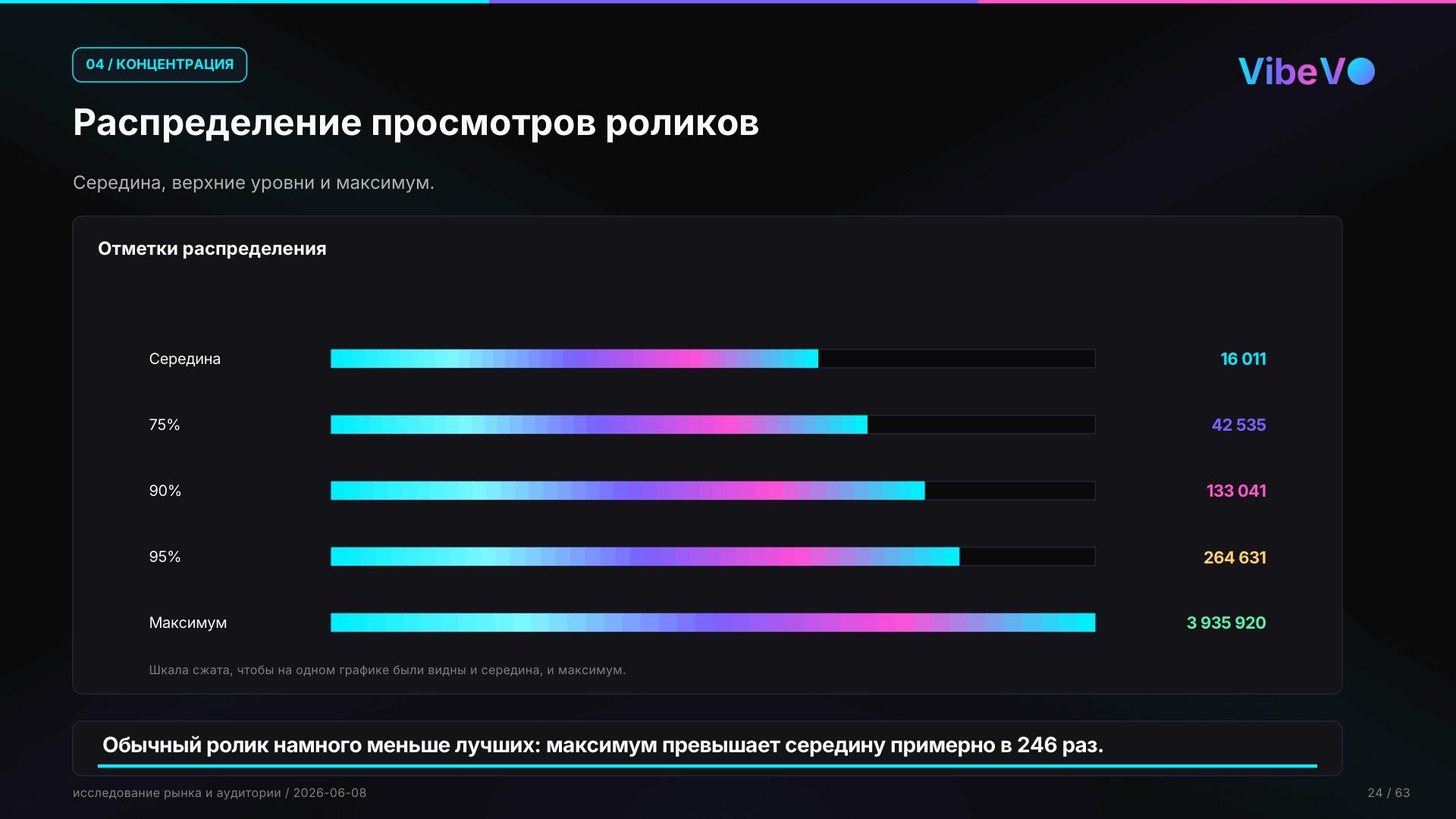
    In short feeds, the average result hides a very strong unevenness. The average number of views is 16,011 views over 30 days. The 75th percentile is 42,535 views, the 90th percentile is 133,041. The maximum video garnered 3,935,920 views, which is approximately 246 times more than the median. As expected, the distribution is very uneven.

    Even more illustrative is the share of the best publications. The top 10 videos generated 23.88 million views, or 9.3% of the volume. The top 50 videos – 62.48 million, or 24.3%. The top 10% of videos collected 165.54 million views, or 64.3% of all views. In other words, most views are generated by the top 5% of videos.

    A practical conclusion for advertising in video clipping: you cannot rely on a single video. You need a set of video clips with different first seconds, titles, subtitles, overlays, and advertising message options. It’s not just the most beautiful video that wins, but a series of attempts where the best publications quickly gain more weight.

  • Mass Video Posting: How to Publish 100 Videos a Day on 10+ Accounts

    Mass Video Posting: How to Publish 100 Videos a Day on 10+ Accounts

    Do you dream of your content flooding TikTok, YouTube, and Instagram while you go about your business? Mass video posting is the automatic publication of short videos across multiple accounts simultaneously. Mass-posting services allow you to upload content to all key platforms through a single panel. This saves time and ensures scheduled reach without manual effort.

    How mass video posting works

    A mass-posting service connects to social media APIs and lets you schedule publications. You upload a video once, set a schedule for each platform, and the system automatically publishes the content. This seamlessly integrates with your content marketing strategy.

    Key features of cross-posting services

    • Publication on 5 or more platforms: TikTok, YouTube, Instagram, VK, Telegram.
    • Scheduled auto-posting: set the time, and the system publishes videos even at night.
    • Mass upload with proxies and anti-detect for safe management of 10+ accounts.
    • Unified panel for monitoring all platforms.

    How to choose a mass-posting service

    When choosing, pay attention to the package cost, the number of supported accounts, and API availability. For example, a monthly package may include 500 publications, which suits active bloggers. Also important is support for proxies and anti-detect browsers to avoid blocks.

    Selection criteria

    1. Number of platforms and accounts.
    2. Schedule flexibility.
    3. Package cost.
    4. API availability for integration.
    5. User reviews.

    Frequently asked questions

    How to publish 100 videos a day?

    Use a mass-posting service with a queue feature. Upload all videos, set intervals, and the system will distribute publications automatically.

    Массовый постинг видео: как публиковать 100 роликов в день на 10+ аккаунтов — illustration 2

    Is it safe to use proxies and anti-detect?

    Yes, it reduces the risk of blocks when managing multiple accounts. Services with support for proxies and anti-detect ensure IP rotation and simulate real user behavior.

    How much does a monthly mass-posting package cost?

    Prices range from 1,500 to 10,000 rubles depending on the number of publications and functionality. For example, a package for 500 publications costs about 3,000 rubles.

    Conclusion

    Mass video posting saves time and increases reach. Choose a service with a suitable package, set a schedule, and forget about manual uploads. While you sleep, videos are already being published on all platforms. Start with a trial period to evaluate convenience, and scale your promotion strategy today.