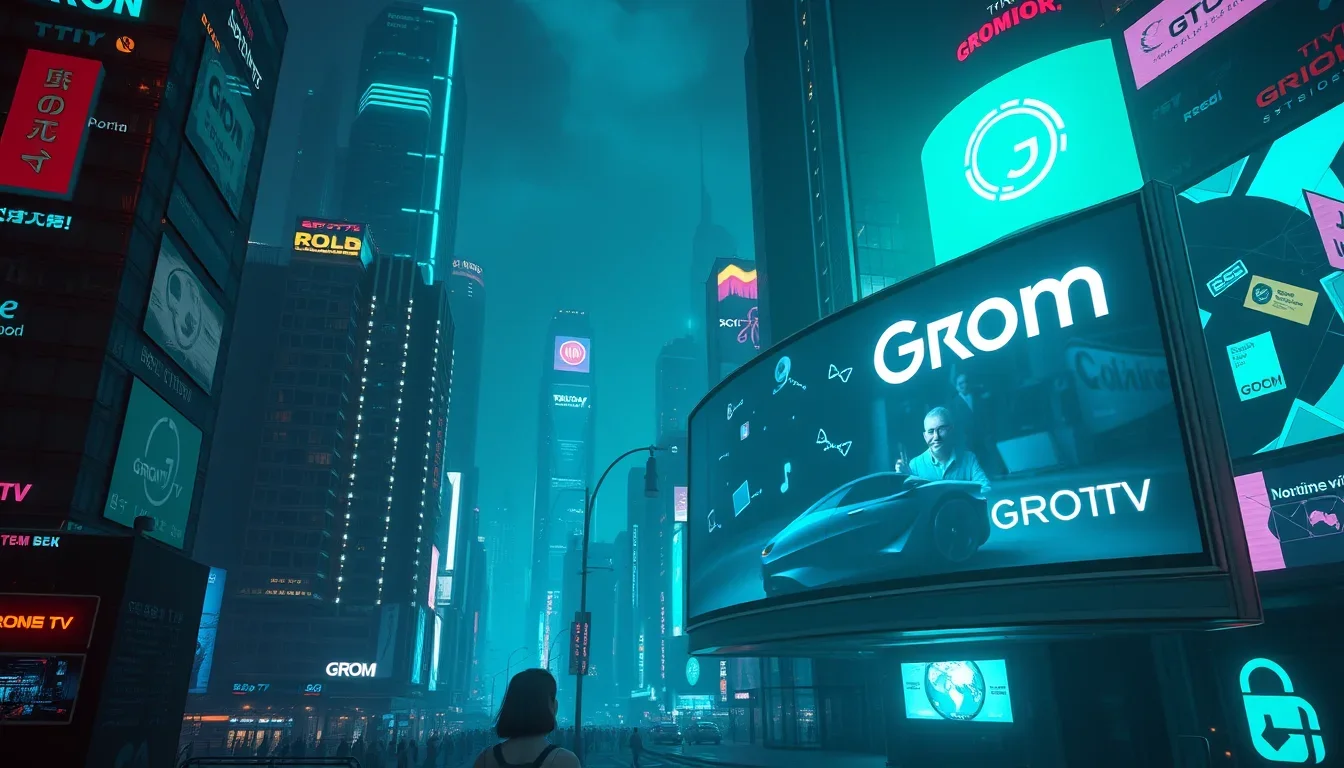
Mass video generation by neural network is now available in the format of endless online television. GPTunneL launches Grom TV – an innovative platform where anyone can launch their own AI-generated video in just 20-25 seconds. This revolutionizes the concept of creating AI video for advertising and opens new horizons for AI content production.
Imagine you are the director of your own channel, where your prompt turns into a video in real time. The effectiveness of AI versus real UGC in this format reaches new heights, demonstrating how quickly and extensively content can be generated.
What is Grom TV and how does it work?
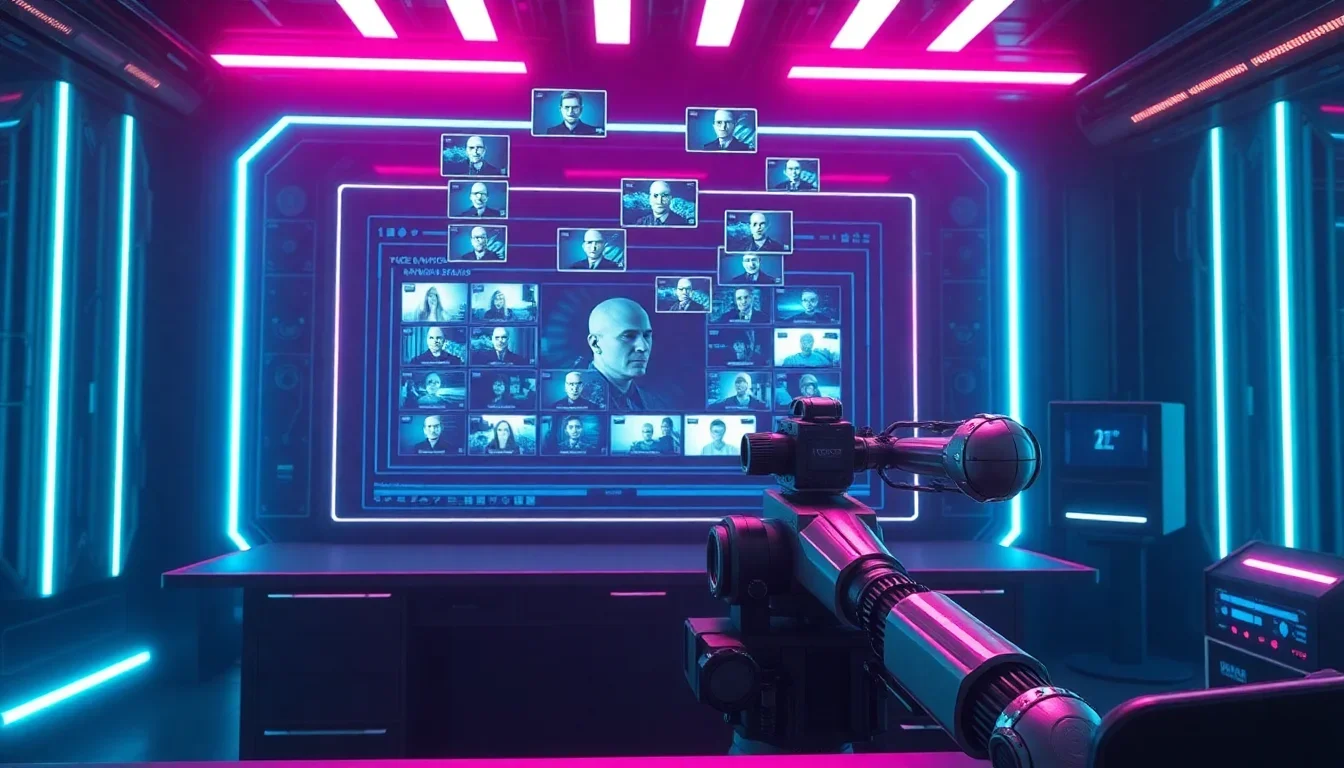
Grom TV is generative online television where users enter text queries (prompts), and a neural network generates videos based on these queries. Your creations are broadcast live along with clips from other users. This is not just video generation from text; it’s a whole interactive experience.
Your neuro-production by subscription in real time
- Visit the website: gptunnel.ru/lab?section=tv
- Register: The process is as simple as possible.
- Write a prompt: Enter your query in the chat to the right of the screen.
- Wait 20-25 seconds: This is the time from entering the prompt until the video appears on air. The generation itself takes about 7.8 seconds.
- Watch: Your creation is broadcast live.
For example, you can create a Gandalf and Scooby-Doo crossover, a film noir scene, or a KISS concert with “The Big Bang Theory” characters. The neural network confidently works with different styles, whether it’s Disney plasticity or black-and-white noir, and knows what Homer Simpson looks like without additional explanations.
Behind the Scenes Technology: How does the neuro-pipeline work?
Normal video generation is an asynchronous process. Grom TV, however, works live, which requires a completely different architecture. Every millisecond is crucial here so that the broadcast doesn’t “stutter.”
Secrets of high speed and stability
One Grom TV video lasts eight seconds with sound, including lip-sync if there is speech. Its generation takes about 7.8 seconds. This means a real-time coefficient of 0.97 — generation is ahead of the broadcast, albeit with a small margin. The entire process runs on one Nvidia B200 chip; sometimes a second one is connected to optimize speed.
«Scaling was impossible — now it is. A single Nvidia B200 chip allows us to generate about 10,000 unique clips per day without a single repeat. This is the very AI video factory for e-commerce and beyond,» notes the founder of GPTunneL.
Next, ffmpeg comes into play, which in 0.3 seconds manages to:
- Adjust playback tempo to generation speed.
- Apply a «film» style: grain, vignette, soft color.
- Cut the video into two-second segments for smooth transitions.
The use of the HLS protocol ensures compatibility with all devices: browsers, VLC, smart TVs. This guarantees that AI avatar with subtitles or AI clips with face replacement will be accessible to the widest possible audience.
Infinite Content: When the Queue is Empty?
Grom TV does not stand idle. If the queue of user prompts becomes empty, Grom GPT – GPTunneL’s own LLM model – steps in. It generates plots and feeds them into the broadcast, ensuring continuous transmission. This is like a neural network writing scripts and editing automatically.
The ability to generate 10,000 unique clips per day without repeats demonstrates unprecedented efficiency. This is much more than a team of 500 people could create, making the AI conveyor of 500 videos per day a reality, not a dream.
Safety and Moderation: Ethical Deepfake
Live broadcast does not allow to «rewind», so the moderation system is built to filter unacceptable content before video generation. This ensures an ethical deepfake approach.
Two Lines of Defense
- GromMod: The first filter from GPTunneL. Analyzes the entire prompt and rejects unacceptable content (e.g., violence) even before it is sent to the GPU. Rejection is instantaneous.
- Grom at the script stage: The second line of defense. Transforms the user’s request into a safe script for the video model, cleaning out sensitive details and softening formulations, but preserving the creative intent.
This two-level system ensures that only safe content reaches the model. This is critically important for creating AI UGC for a crypto project or any other niche where reputation plays a key role.
GPTunneL: A Platform for the Future
Grom TV is a laboratory experiment of the Russian AI platform GPTunneL, which combines over a hundred AI tools for generating text, images, video, music, and voice. The project, which started in 2023, grew into a platform with over one and a half million users by 2026.
This is a vivid example of what happens when a platform has its own models (video, LLM-moderator, LLM-scriptwriter) and its own hardware. AI video for advertising, mass video generation by neural network, creation of AI commercials – all this becomes accessible and scalable.
Technically, it is possible to raise the generation quality to full-fledged streams with digital avatars, stable picture, and HD resolution. If a business is interested in a live generative video channel, such a solution can be implemented on a B200 server chip in real time.
Conclusion: The Future of AI Production is Already Here
Grom TV is not just an experiment; it’s a demonstration of the principle: generative video can be broadcast live on a single graphics card, and it will be a full-fledged, working channel. From AI UGC for a crypto project to a neural network for UGC advertising – the possibilities are endless. Where to order for crypto? Perhaps this is where the answer begins.
We continue to refine the pipeline, improve speech quality, splice stability, and moderation. To see this for yourself, visit Grom TV, write your prompt, and become part of this technological revolution. It’s like an analog of Synthesia, but live and with the ability to generate 100 videos per day!
Frequently Asked Questions
How much does one AI creative cost in Grom TV?
As part of the Grom TV experiment, video generation is available for free. The cost of 1 minute of AI video in commercial solutions will depend on the complexity of the request and the volume.
Can Grom TV be used to create AI videos for advertising?
Yes, Grom TV demonstrates the potential for mass video generation by neural networks, which is ideal for creating AI commercials. In the future, specialized B2B solutions may be developed.
What is a real-time coefficient of 0.97?
This means that the video generation time (7.8 seconds) is slightly faster than the clip’s duration (8 seconds), ensuring stable live streaming without delays.
How does GPTunneL ensure content moderation?
GPTunneL uses a two-level moderation system: GromMod filters out inappropriate prompts before generation, and Grom softens formulations at the script stage while preserving the creative intent.
Where can I order mass video generation for crypto?
Grom TV is currently a demonstration platform. For commercial inquiries regarding AI UGC for a crypto project and mass video generation, it is recommended to contact GPTunneL directly to discuss B2B solutions.